

Land Due Diligence Checklist: 15 Checks Before You Buy

A land due diligence checklist is the set of legal, physical, regulatory, and financial checks you run between signing a purchase agreement and closing. Before you buy land, verify ownership and title, confirm the exact boundaries with a survey, check zoning and setbacks for your intended use, confirm legal access, test the soil and septic feasibility, screen for flood zones and wetlands, price utility connections, and confirm taxes, liens, and lender requirements. Do these checks while your contract still lets you cancel or renegotiate — after closing, the problems become yours.
In This Article
- What Is Land Due Diligence?
- The 15 Checks
- Due Diligence Timeline: What Happens When
- Red Flags That Should Stop the Deal
- Due Diligence Costs at a Glance
- How Due Diligence Protects Your Land Loan
- Frequently Asked Questions (FAQs)
What Is Land Due Diligence?
Land due diligence is the investigation period between an accepted offer and closing. For a house purchase, an inspection covers the structure. Vacant land has no structure to inspect, so the risks hide in public records, in the soil, and in rights that may have been separated from the surface decades ago. Most land contracts allow a due diligence window of 30 to 90 days, negotiated into the agreement. Use it. A verbal assurance from a seller or listing agent is not a substitute for a recorded document, a permit, or a written confirmation from the county office responsible.
Start every check with the parcel number and the legal description, not the street address. Street addresses, owner names, and online map pins can be incomplete or wrong; the parcel number is what county offices use.
The 15 Checks
1. Confirm Ownership and Title
Verify that the seller is the record owner and that the title is clean. Order a title search through a title company or attorney, and review it for liens, judgments, easements, and competing claims. A deed alone does not prove clean title, and it does not prove the seller owns every right attached to the land — mineral rights, for example, are often severed from the surface. This is also why your lender will require title insurance.
2. Get a Current Boundary Survey
A professional boundary survey establishes the exact dimensions and corners of the lot using physical markers. For a standard residential lot, expect roughly $500 to $1,200, and significantly more for large rural tracts with dense vegetation or steep slopes. The survey reveals encroachments — a neighbor’s fence, driveway, or outbuilding crossing your line — and maps easements. Catching an encroachment during due diligence gives you leverage to resolve it before closing instead of inheriting a boundary dispute. Our guide to land survey costs breaks down what drives the price.

3. Verify Zoning and Permitted Use
Contact the local planning or zoning office and confirm, in writing, that the parcel’s zoning allows your exact intended use — a primary residence, a cabin, a farm building, or a commercial use. Zoning also controls building height, density, and minimum lot size. A parcel zoned agricultural may not allow a residence at all, or may require a conditional-use permit that takes months. Never assume the use shown in the listing is the use the county allows.
4. Check Setbacks and Building Envelope
Setbacks are the minimum distances a structure must sit from property lines, roads, and neighboring buildings. Combined with easements, they define the building envelope — the ground you can actually build on. A large-looking lot can have a surprisingly small buildable area once setbacks, easements, and floodplain lines are drawn. Ask the planning office for the setback schedule and sketch the envelope before you commit.
5. Confirm Legal Access in Writing
Legal access means a recorded right to reach the lot — a public road frontage or a recorded access easement. Physically driving onto the lot is not proof. A landlocked parcel, or one reached only by crossing a neighbor’s land without a recorded easement, can be unbuildable and nearly unfinanceable. Pull the easement from the county record, walk the route, and check its physical condition: a dirt track that washes out each spring is a different problem than a paved county road.
6. Review Easements, CC&Rs, and Deed Restrictions
Easements let utility companies, neighbors, or agencies use part of your land. Covenants, conditions, and restrictions (CC&Rs) are private agreements recorded against the property, common in planned communities, and can go well beyond zoning: minimum home sizes, approved materials, landscaping standards, and bans on structures like metal buildings. Request the full CC&Rs and HOA documents, read them, and confirm any HOA dues and balances.
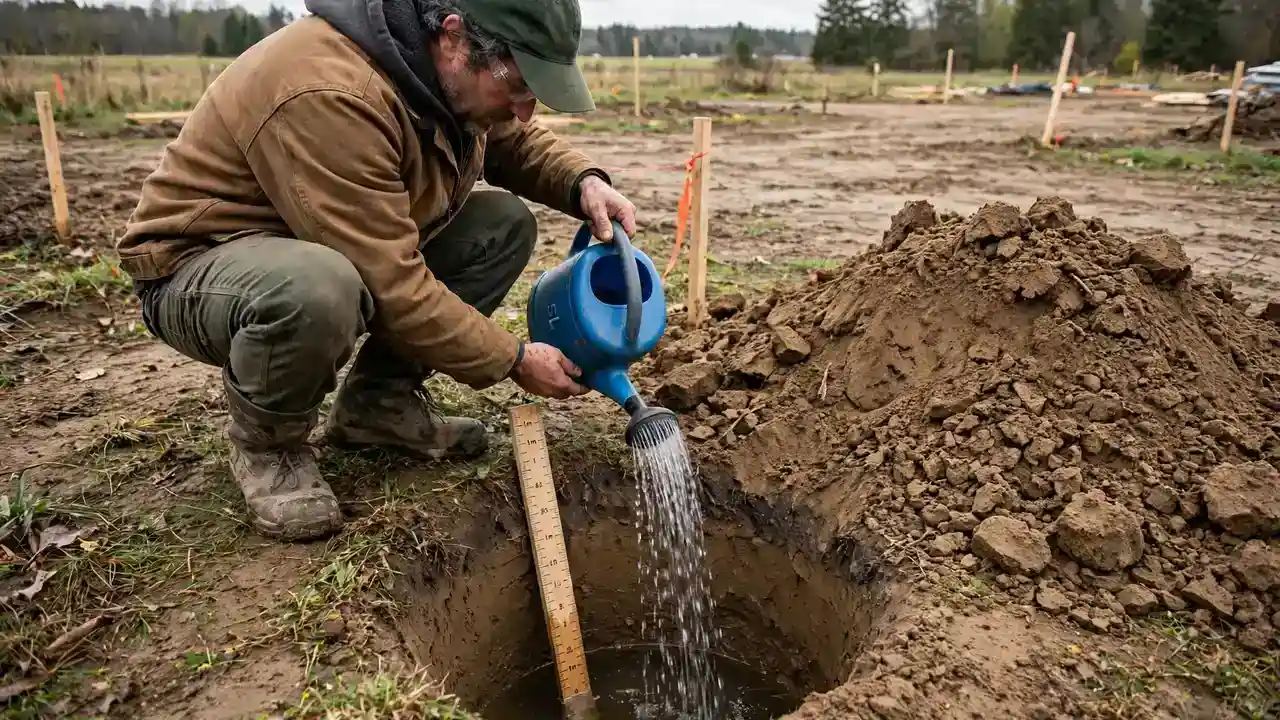
7. Run a Soil Test and Perc Test
If the lot is not on public sewer, a percolation (perc) test determines whether the soil absorbs water fast enough to support a septic system. No passing perc test, no septic system, no buildable home. A soil report also matters for foundations: expansive clay, a high water table, or shallow bedrock can add thousands to construction costs. Our perc test guide explains the process, costs, and what to do if a test fails.
8. Check the Flood Zone and Wetlands
Check the FEMA flood maps for the whole parcel, not just the building spot, and confirm whether any portion sits in a wetland or a regulated buffer. Flood-zone land can require flood insurance, elevated construction, or a special permit, and wetlands are protected under federal and state rules — filling or building on them without a permit can mean fines and restoration orders. A lender will flag both, so find out before the appraisal does.
9. Screen for Environmental Risks
Look up the parcel on the EPA’s Cleanups in My Community map and ask the state environmental agency for cleanup records, especially if the land was once a farm, shop, mill, or dump. Dumping, old fuel tanks, and pesticide residue are common rural surprises. For commercial or higher-risk parcels, a Phase I Environmental Site Assessment — a records and site review following the ASTM E1527 standard — is the recognized screening step.
10. Verify Utilities and Get Written Connection Costs
Call each utility provider and ask, in writing, whether it can serve the lot and what it will cost to bring service to the house site. Power, water, sewer or septic, gas, and internet each have their own provider and their own price. Extending a power line or drilling a well can cost tens of thousands of dollars, and those costs are rarely in the listing price. Get the numbers before you finalize your offer — they change the total cost of the purchase.
11. Confirm Taxes, Liens, and Assessments
Check property tax records for unpaid taxes, special assessments, and tax liens, and confirm the annual tax bill you will inherit. Land buyers pay property taxes every year even if they never build, and effective rates on undeveloped land range from near zero in some unincorporated areas to over 2% of assessed value in others. Our guide to property tax on vacant land explains how vacant land is assessed. Unpaid taxes and liens must be cleared at or before closing.
12. Check Insurance Availability
Confirm the lot is insurable in your market before closing. Properties in wildfire zones, flood zones, or remote areas can face steep premiums or outright refusals from standard carriers. Call an insurance agent with the parcel details early — an uninsurable lot is also an unfinanceable one, because your lender will require coverage.
13. Review Mineral, Timber, and Water Rights
Confirm which rights transfer with the sale. Surface ownership does not automatically include mineral rights, timber rights, or water rights, and a third party holding those rights can legally access the land to exercise them. The deed and title search should show whether rights were severed; if they were, understand exactly what the holder can do on your land.
14. Confirm Lender Requirements Early
Land loans are not like home mortgages. Raw land financing typically requires down payments of 30% to 50%, and Fannie Mae does not purchase mortgages on vacant land, so these loans stay in the originating lender’s portfolio. Before you waive contingencies, confirm with your lender that the parcel qualifies: some lenders will not finance land without legal access, a perc test, or a minimum acreage. Our land loan requirements guide covers credit score, down payment, and income expectations.
15. Recalculate Your Offer on Total Cost
Add up the full picture before closing: purchase price, survey, title and closing costs, utility extensions, well or septic, permits, insurance, and annual taxes. Land closing costs routinely surprise buyers who budgeted only for the price. If the total changes the deal, renegotiate or walk away while your contingencies still allow it — that is what they are for.
Due Diligence Timeline: What Happens When
A typical 30-to-90-day window breaks down like this. Week 1: order the title search and survey, pull zoning, flood, and tax records, and request CC&Rs. Weeks 2–4: schedule the perc test and soil work, call utility providers, and get the lender’s parcel requirements in writing. Weeks 4–8: resolve anything that came back unclear — easement questions, environmental screening, insurance quotes — and renegotiate or extend if a test is still pending. Build extensions into the contract for tests that commonly run long, especially environmental work.
Red Flags That Should Stop the Deal
Walk away, or at least pause and get professional advice, if you find any of these: no recorded legal access; a failed perc test with no sewer alternative; title defects the seller cannot clear; zoning that prohibits your intended use; a floodway or wetland covering the only building spot; undisclosed liens or back taxes larger than the deal can absorb; or a seller who refuses to allow surveys and testing during the contingency period. Any one of these can turn a bargain parcel into an unbuildable, unsellable lot.
Due Diligence Costs at a Glance
Typical U.S. ranges, which vary by county and parcel size: boundary survey $500–$1,200 for a residential lot (several thousand for a large or complex tract); title search and title insurance vary by state and price; perc test a few hundred dollars; Phase I environmental assessment a few thousand dollars; county record searches are often free online. Budget $1,500–$5,000 for a standard residential parcel’s checks, and more for large, rural, or environmentally flagged land. These costs are small next to the price of buying the wrong parcel.
How Due Diligence Protects Your Land Loan
Lenders underwrite the parcel, not just the borrower. A clean title, a current survey, confirmed zoning, legal access, and a passing perc test are the same documents your lender needs to approve the loan and order an appraisal. Parcels that fail these checks often fail appraisal too — our vacant land appraisal guide explains how appraisers value land with constraints. Doing due diligence early keeps your financing contingency intact and your closing date realistic.
Frequently Asked Questions (FAQs)
How long does land due diligence take?
Typically 30 to 90 days, negotiated into the purchase contract. Standard residential parcels often finish in 30 to 45 days; large, rural, or environmentally flagged parcels take longer.
How much does land due diligence cost?
Budget roughly $1,500 to $5,000 for a standard residential parcel, covering survey, title work, perc testing, and record checks. Large or complex parcels cost more.
What is the most important due diligence check?
Legal access, title, and zoning together — without all three, you may own land you cannot reach, cannot prove you own, or cannot build on.
Can I do land due diligence myself?
Much of the initial screening can be done online through assessor, recorder, tax, planning, and GIS systems, but surveys, title examination, perc tests, and environmental assessments require licensed professionals.
What happens if due diligence finds a problem?
While your contingency period is open, you can renegotiate the price, ask the seller to cure the issue, extend the deadline, or cancel and recover your earnest money deposit.
Do I need a survey if the seller provides an old one?
An old survey may not reflect current boundaries, easements, or encroachments. Lenders and title insurers usually require a current survey, and it is the only way to confirm what you are actually buying.
Is a perc test required for a land loan?
Lenders generally require proof the lot can support wastewater disposal. If the lot is on public sewer, a sewer availability letter serves instead; otherwise a passing perc test is normally required.
Does due diligence differ for recreational or farm land?
The core checks are the same, but farm and recreational parcels add questions about water rights, timber rights, agricultural zoning, conservation easements, and income-producing use — check those before closing.
By Jameel Noori, Founder & Developer, Land Loan Calculator
About the author: Jameel Noori is the Head of Content & Land Finance Research at Land Loan Calculator. He writes practical, U.S.-focused guides on land financing, loan math, and buyer strategy.
Reviewed by: Jameel Noori, Founder & Lead Developer of Land Loan Calculator, reviewed this article for accuracy.
Disclaimer: This article is for informational purposes only and is not financial advice. Land loan rates and terms vary by lender, property, and market conditions. Consult a licensed loan professional before making financing decisions.
