
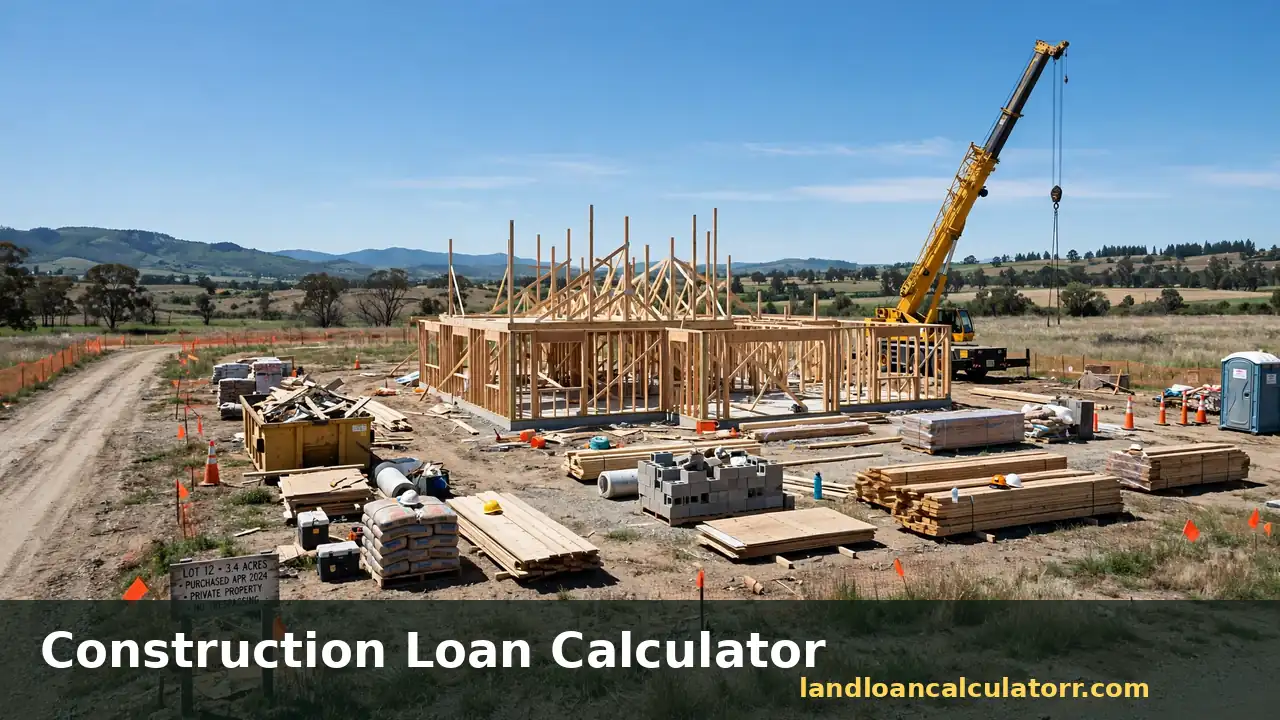
Construction Loan Calculator

This construction loan calculator estimates a construction-to-permanent loan for land you buy and build on. Enter the land price, the construction budget, your down payment, interest rate, build time, and permanent loan term to see what you would pay during construction and after the loan converts to a regular mortgage. In other words, it works as a construction loan calculator with land included in the total project cost.
During the build, you pay interest only on the amounts drawn so far, not on the full loan amount. That keeps early payments lower while work is under way. After construction finishes, the loan converts to a permanent mortgage, and your payment switches to principal and interest over the term you choose.
Use the calculator below as a planning tool. It gives a clear, lender-neutral estimate so you can compare land-and-build budgets, test different down payments, and see how a longer build or a higher rate changes the cost before you talk to a lender.
Step 1 · Enter your numbers
Project & Loan Details
Construction-to-permanent loans commonly require 20–25% down on the total project cost.
During construction you pay interest only, and only on the amount drawn so far — draws grow as the build progresses.
Step 2 · Your estimate
Amortization Schedule — Permanent Loan (Estimate)
All figures are estimates only — never guaranteed rates. Construction interest is estimated on a straight-line draw schedule (average balance ≈ half the loan). Actual draws, rates and terms vary by lender. Not a loan offer.
How This Construction Loan Calculator Works
This construction loan calculator starts with total project cost. Land cost plus the build budget equals the total project cost. For example, $120,000 for land plus $280,000 for construction gives a $400,000 project.
Your down payment is then subtracted from that total to give the loan amount. The larger your down payment, the smaller the loan you need and the lower both your interest-only payments and your permanent payment will be.
During construction, the calculator estimates interest-only payments on drawn amounts. Because draws are released in stages as work is completed, you do not owe interest on the full loan from day one. For a simple estimate, the tool assumes draws are taken on a straight-line basis over the build period, so the average drawn balance is roughly half the loan amount.
At full draw, the interest-only payment is the full loan amount multiplied by the monthly interest rate. That is the highest interest-only payment you would face during the build, and it is shown separately so you can budget for the final months of construction.
After the build, the loan converts automatically to the permanent term you selected, such as 30 years or 15 years. The permanent payment is a standard amortizing payment on the full loan amount at the rate you entered. A shorter term raises the monthly payment but reduces total interest over the life of the loan.
Worked Example
Here is the default example used by this construction loan calculator, so you can check the math at a glance.
- Land: $120,000
- Construction budget: $280,000
- Total project cost: $400,000
- Down payment: 25%, or $100,000
- Loan amount: $300,000
- Interest rate: 8.5%
- Build period: 12 months
- Permanent term: 30 years
At 8.5%, the interest-only payment at full draw is about $2,125 per month. That is $300,000 multiplied by 8.5% and divided by 12 months.
Estimated interest during a 12-month build is about $12,750. This reflects the straight-line draw assumption: on average, about half the loan is drawn during the build, so total interest is roughly half of a full year of interest at full draw.
After conversion to a 30-year permanent loan, the payment is about $2,307 per month. That payment includes both principal and interest and stays level for the term, assuming a fixed permanent rate.
Try changing the inputs to see the trade-offs. A larger down payment lowers the loan amount and every payment that follows. A shorter permanent term, such as 15 years, raises the monthly permanent payment to about $2,953 on the same $300,000 loan, but it pays the loan off in half the time.
Construction-to-Permanent vs. Standalone Construction Loans
A construction-to-permanent loan, also called a one-close loan, is a single loan that covers both the build and the permanent mortgage. You close once, before construction starts. The lender funds the build in draws, and when construction is complete, the loan converts to a permanent mortgage without a second closing.
A standalone construction loan, also called a two-close loan, works differently. You take a short-term construction loan, build the home, and then separately apply for and close a permanent mortgage. That means two closings, two sets of closing costs, and two underwriting reviews.
Rate lock differences matter here. With a one-close loan, the permanent rate structure is generally set at the start, so you have more certainty about the payment after conversion. With a two-close loan, you requalify and lock a rate at the end of the build, when rates, your income, or your credit may have changed.
A construction-to-permanent loan usually suits buyers building a primary home who want one closing, lower total fees, and payment certainty. A standalone construction loan can suit experienced builders, investors, or buyers who expect to refinance on better terms later and are comfortable with the extra closing and requalification risk. For a side-by-side comparison of the two loan types, see our guide to construction loan vs land loan.
The Draw Process, Step by Step
Construction loans are not paid out in one lump sum. They follow a draw schedule tied to completed work, with inspections at each stage. This construction loan calculator follows the same staged approach when it estimates interest during the build.
- Application with plans, specs, and builder contract. You apply with detailed building plans, specifications, a line-item budget, and a signed contract with a licensed builder. The lender reviews your finances and your builder together.
- Appraisal of the finished value. The lender orders an appraisal based on the finished home, valued from your plans and specifications rather than the empty lot. That finished value supports the loan amount.
- Draw schedule with inspections. Funds are released in stages, such as foundation, framing, roofing, and finish work. Before each draw, an inspector verifies that the work is complete.
- Interest-only period. During the build, you pay interest only on amounts drawn so far. Payments rise as more draws are taken, reaching the full-draw amount near completion.
- Conversion. When construction is complete and the final inspection is passed, a construction-to-permanent loan converts to a permanent mortgage and principal-and-interest payments begin.
Keep your builder, lender, and inspector in close contact. A draw that is delayed by incomplete work or missing paperwork can delay the next stage of construction, so clear documentation at each step matters. For general borrower guidance, see the Consumer Financial Protection Bureau.

Construction Loan Requirements
Construction loans have stricter requirements than a standard mortgage because the lender is financing a home that does not exist yet. Knowing the checklist early, before you run this construction loan calculator to finalize a budget, helps you avoid delays.
- Licensed builder. Most lenders require a licensed, insured builder with a track record of completed projects. Owner-builders face a steeper climb and fewer lender options.
- Detailed plans and budget. You will need blueprints, specifications, a line-item construction budget, permits or proof of permit eligibility, and a realistic construction timeline.
- 20–25% down typical. Conventional construction loans commonly require 20–25% down. Land you already own free and clear may count toward that equity, and government-backed programs may allow less.
- Credit 680–720+. Many conventional lenders look for credit scores in the 680–720 range or higher, along with stable income and a manageable debt-to-income ratio.
- Contingency reserve. Lenders often expect a contingency reserve, commonly 5–10% of the construction budget, to cover cost overruns without stopping the build.
Income, assets, and reserves are reviewed just as they are for a mortgage, but the project itself is also underwritten. A well-documented budget and a credible builder make approval much more likely. For the related land side of the purchase, see land loan requirements, and return to the Land Loan Calculator homepage for other land financing tools.

Construction Loan Calculator FAQs
How does a construction loan work when I also buy the land?
A construction-to-permanent loan can include the land purchase and the build in one loan. The land cost and construction budget are combined into a total project cost, your down payment is subtracted, and the remainder is the loan amount. The loan funds the land purchase at closing and then releases construction funds in draws, converting to a permanent mortgage when the home is complete.
Do I pay interest only during construction?
Yes, during the build you generally pay interest only, and only on amounts drawn so far. Early payments are therefore lower than the full-draw interest-only payment. Once construction finishes and the loan converts, payments switch to principal and interest.
How much down payment do I need for a construction loan?
Conventional construction loans typically require 20–25% down. On a $400,000 project, 25% is $100,000. Land you own outright may count as equity toward the down payment, and some government-backed programs allow a smaller down payment for eligible borrowers.
What credit score do I need for a construction loan?
Many conventional lenders look for scores of 680–720 or higher, plus stable income and a reasonable debt-to-income ratio. Requirements vary by lender and program, so a lower score does not always rule you out, but it may mean a larger down payment or a higher rate.
How are construction loan draws released?
Draws are released in stages tied to completed work, such as foundation, framing, and finish work. After each stage, an inspector verifies the work before the lender releases the next draw to the builder. This protects both you and the lender, because funds are only paid for work that is actually done.
What happens when construction finishes?
With a construction-to-permanent loan, the loan converts to a permanent mortgage after the final inspection. You then begin principal-and-interest payments over the permanent term, such as 30 years. With a standalone construction loan, you instead close a new permanent mortgage, which means a second closing and a fresh underwriting review.
Can I use a construction loan for a barndominium or modular home?
Often, yes, but lender policies vary. Barndominiums and modular homes can be harder to appraise and insure than a conventional site-built home, so some lenders are more cautious. Ask lenders early whether they finance your home type, and bring plans, specifications, and comparable sales to support the finished value.
What if my build goes over budget?
Overruns are common, which is why a contingency reserve of 5–10% of the construction budget is so important. If costs exceed the loan amount plus your reserve, you will usually need to pay the difference out of pocket or renegotiate the scope of work. A detailed, line-item budget and a fixed-price builder contract reduce this risk.
By Jameel Noori, Founder & Developer, Land Loan Calculator
About the author: Jameel Noori is the Founder & Developer of Land Loan Calculator. He writes practical, U.S.-focused guides on land financing, loan math, and buyer strategy.
Reviewed by: Jameel Noori, Founder & Lead Developer of Land Loan Calculator, reviewed this article for accuracy.
Disclaimer: This article is for informational purposes only and is not financial advice. Land loan rates and terms vary by lender, property, and market conditions. Consult a licensed loan professional before making financing decisions.