
Land Payment Calculator

A land payment calculator estimates your monthly payment for buying land — and, more usefully, shows how that payment is spent over the life of the loan. Enter the land price, down payment, interest rate, and loan term, and it returns your monthly principal and interest, property tax and insurance, total interest, and cash needed at closing, plus a year-by-year payment schedule showing how much of each year’s payments goes to principal versus interest and how the balance falls. On a $150,000 parcel with 25% down at 8.5% over 15 years, the payment is $1,107.83 per month in principal and interest — $1,307.83 with taxes and insurance. Use the free tool below to run your own numbers, then read the schedule to see when your payments start working mostly for you instead of the lender.
- Land Payment Calculator
- How to Calculate a Land Payment
- What Goes Into Your Monthly Land Payment
- Down Payment: How It Changes Your Payment
- Land Loan Interest Rates in 2026
- Loan Term: Short vs Long
- Amortizing vs Interest-Only vs Balloon
- Worked Example: $150,000 Parcel
- How to Lower Your Land Payment
- Land Payment Calculator vs Mortgage Calculator
- Common Mistakes to Avoid
- How Your Payment Splits Into Principal and Interest Over Time
- Frequently Asked Questions (FAQs)
Land Payment Calculator
Enter your numbers below. The calculator shows your monthly principal and interest, monthly tax and insurance, total monthly payment, total interest over the loan, estimated closing costs, cash needed at closing, and — if you enter a balloon year — the balloon balance. The term-comparison table underneath shows what the same loan costs at 10, 15, and 20 years, and the year-by-year payment schedule below that shows how each year’s payments split between principal and interest and how the balance falls over time.
Land Payment Calculator
Enter your land purchase details to estimate the monthly payment, total interest, cash needed at closing, and any balloon balance.
All results are estimates. Your lender’s rate, fees, and underwriting decide the final terms. For a full year-by-year breakdown, see our land loan amortization calculator.
How to Calculate a Land Payment
The monthly principal-and-interest payment on a fully amortizing land loan uses the standard loan payment formula:
M = P × r × (1 + r)^n ÷ ((1 + r)^n − 1)
Where M is the monthly payment, P is the loan amount (price minus down payment), r is the monthly interest rate (annual rate ÷ 12), and n is the number of monthly payments (years × 12). Our step-by-step guide to how to calculate a land loan walks through this formula with more examples.
To calculate by hand:
- Subtract your down payment from the land price to get the loan amount.
- Divide the annual interest rate by 12 for the monthly rate.
- Multiply the loan term in years by 12 for the number of payments.
- Apply the formula above — or skip the math and use the calculator.
Remember: the formula gives principal and interest only. Your actual monthly outlay also includes property tax, insurance, and any HOA dues, which the calculator adds in.
What Goes Into Your Monthly Land Payment
A land loan payment has up to four parts:
Principal and interest (P&I)
The core of every payment. Early payments are mostly interest; the principal share grows over time as the balance falls. On the $150,000 example above, the first payment is about $796.88 interest and $310.95 principal.
Property taxes
Vacant land is taxed, usually at a lower assessed value than improved property, but rates vary widely by county. Lenders often escrow one-twelfth of the annual tax bill into each payment. Our guide to property tax on vacant land explains how assessments work.
Insurance
Some lenders require liability coverage on the parcel, and a policy is wise even when it is optional — a visitor injured on your land can become your liability.
HOA or POA dues
Parcels inside a subdivision or planned community may carry monthly or annual association dues. These are not part of the loan payment, but they belong in your monthly carrying-cost budget.

Down Payment: How It Changes Your Payment
Land lenders typically require 20% to 50% down — far more than a home mortgage — because vacant land is riskier collateral. A bigger down payment shrinks the loan, the monthly payment, and the total interest. Here is what changes on a $150,000 parcel at 8.5% over 15 years:
| Down payment | Loan amount | Monthly P&I | Total interest |
|---|---|---|---|
| 10% ($15,000) | $135,000 | $1,329.40 | $104,291.71 |
| 20% ($30,000) | $120,000 | $1,181.69 | $92,703.74 |
| 25% ($37,500) | $112,500 | $1,107.83 | $86,909.76 |
| 35% ($52,500) | $97,500 | $960.12 | $75,321.79 |
| 50% ($75,000) | $75,000 | $738.55 | $57,939.84 |
Going from 10% to 50% down cuts the monthly payment by about $591 and saves roughly $46,352 in interest. Our down payment calculator explores this trade-off in more depth.
Land Loan Interest Rates in 2026
Land loan rates run higher than home mortgage rates because the collateral produces no rent and no shelter. In 2026, typical ranges are:
- Improved lots (utilities, road access): roughly 7% to 9.5%
- Raw or unimproved land: roughly 8.5% to 12%
- Seller financing: often 8% to 12%, with shorter terms
- Farm Credit and USDA/FSA loans: often at the lower end for qualifying agricultural borrowers
Your rate depends on credit score, down payment, land type, and loan term. See current ranges and what moves them in our land loan interest rates guide. Even a 1% rate difference matters: on a $112,500 loan over 15 years, 8.5% costs $86,909.76 in interest, while 9.5% costs about $98,956 — roughly $67 more every month.
Loan Term: Short vs Long
Land loans usually run 10 to 20 years, shorter than the 30-year home mortgage standard. A shorter term means a higher monthly payment but far less total interest:
| Term | Monthly P&I | Total interest |
|---|---|---|
| 10 years | $1,394.84 | $54,880.68 |
| 15 years | $1,107.83 | $86,909.76 |
| 20 years | $976.30 | $121,812.27 |
Figures assume a $112,500 loan at 8.5%. Stretching from 10 to 20 years drops the payment by about $419 a month but adds roughly $66,932 in interest. Choose the shortest term whose payment you can comfortably afford — and check the trade-off in our 15-year vs 30-year land loan comparison.
Amortizing vs Interest-Only vs Balloon
Not every land loan amortizes fully. Know which structure you are signing:
Fully amortizing
Every payment covers interest plus principal, and the balance reaches zero at the end of the term. This is the safest structure for most buyers.
Interest-only
You pay only interest for a set period, so the balance never falls. Payments are low, but you build no equity and still owe the full loan at the end.
Balloon
The loan amortizes over, say, 20 years but comes due after 5 or 7 years, when the remaining balance — the balloon — must be refinanced or paid off. On the $150,000 example, a 5-year balloon on a 15-year amortization leaves a balance of about $89,351.60 due at year 5. Balloon loans are common in land deals, so always run the balloon figure in the calculator before you sign.
Worked Example: $150,000 Parcel
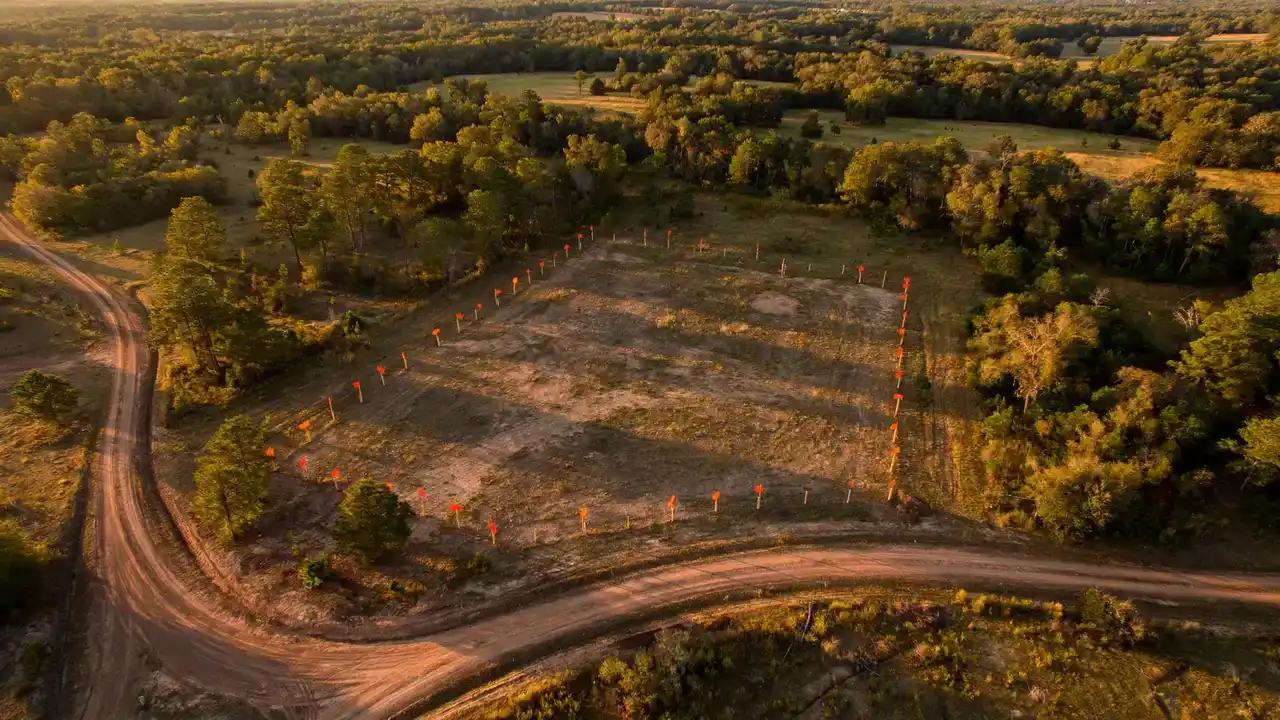
Suppose you buy a 5-acre parcel for $150,000 with 25% down, an 8.5% rate, and a 15-year term, plus $1,800 a year in property tax and $600 a year in insurance:
- Down payment: $37,500; loan amount: $112,500
- Monthly principal and interest: $1,107.83
- Monthly tax: $150.00; monthly insurance: $50.00
- Total monthly payment: $1,307.83
- Total interest over 15 years: $86,909.76
- Total cost of the loan: $199,409.76
- Closing costs at 3%: $4,500; cash needed at closing: $42,000
If you add an extra $200 a month to principal, the same loan pays off in about 11.2 years instead of 15, saving roughly $25,268 in interest. Extra payments are the cheapest way to cut the total cost of a land loan.
How to Lower Your Land Payment
- Increase the down payment. Every extra 5% down on a $150,000 parcel cuts the payment by roughly $74 a month at 8.5% over 15 years.
- Improve your credit before applying. A higher score can move you into a lower rate tier; see what lenders require in our land loan requirements guide.
- Make extra principal payments. Even $100 to $200 a month shortens the term by years, as the worked example shows.
- Compare financing channels. Farm Credit associations, USDA/FSA programs, and seller financing can beat a bank’s rate — compare them in our land financing calculator.
- Refinance when rates fall. If rates drop 1% or more, refinancing a land loan can pay for itself within a couple of years; read can you refinance a land loan for the requirements.
- Watch the term trade-off. A longer term lowers the payment but raises total interest sharply — run both in the calculator before deciding.
Land Payment Calculator vs Mortgage Calculator
The math is the same, but the inputs differ. Land loans carry larger down payments, higher rates, shorter terms, and frequent balloon structures, while home mortgages include escrowed taxes and insurance as standard and rarely balloon. A generic mortgage calculator that assumes 20% down, a 30-year term, and a 6% rate will badly understate a land payment. Use a land-specific calculator — like the one on this page — that lets you set the down payment, rate, term, and balloon year that land lenders actually offer. For general guidance on mortgage costs, the Consumer Financial Protection Bureau’s Owning a Home guide explains what lenders can charge and how to compare offers. For the full mortgage-style view with taxes and insurance, see the land mortgage calculator.
Common Mistakes to Avoid
- Budgeting for P&I only. Taxes, insurance, and HOA dues can add hundreds a month to the true carrying cost.
- Ignoring the balloon date. A low payment that balloons in 5 years is not the same deal as a 15-year amortizing loan.
- Assuming a 30-year term. Most land lenders cap terms at 15 to 20 years; a 30-year assumption understates the payment.
- Skipping closing costs. Budget 2% to 5% of the price for closing, plus the down payment, as cash at closing.
- Not checking lender requirements. Credit, income, and land-type rules vary; confirm them before you fall in love with a parcel.
- Our land closing costs guide lists every fee buyers actually pay.
How Your Payment Splits Into Principal and Interest Over Time
A fixed monthly payment does not mean a fixed split. Every monthly payment first covers the interest charged on the balance you still owe, and whatever is left reduces the principal. Because interest is charged on the remaining balance, the split changes every month: early payments are mostly interest, and the principal share grows as the balance falls. The year-by-year payment schedule in the calculator above shows this shift in plain numbers — in the worked example, the first year’s payments put about $3,880 toward principal and $9,414 toward interest, while the final year’s payments put about $12,702 toward principal and only $592 toward interest.
That shift is why extra principal payments are so powerful early on. An extra payment goes straight to the balance, so the next month’s interest is charged on a smaller amount — and every payment after that carries a slightly larger principal share. The worked example shows the effect: adding $200 a month to principal pays the same loan off in about 11.2 years instead of 15 and saves roughly $25,268 in interest. The same logic works in reverse: stretching the term lowers the monthly payment but keeps you in the high-interest early years for longer, which is why a 20-year term on the same loan costs far more interest than a 10-year term.
Use the schedule when you compare offers, too. Two loans with the same monthly payment can still differ: the one that pays principal down faster in the early years leaves you with more equity and a smaller balance if you sell or refinance. If your loan has a balloon year, the schedule stops there and the final row is the lump sum due — plan for that date before you sign.
Frequently Asked Questions (FAQs)
How do you calculate a land loan payment?
Subtract the down payment from the land price to get the loan amount, then apply the standard amortization formula M = P × r × (1 + r)^n ÷ ((1 + r)^n − 1), where r is the monthly rate and n is the number of payments. Add monthly property tax and insurance for the total payment. The calculator on this page does the whole calculation instantly.
What is a good down payment for land?
Most lenders want 20% to 50% down, with raw land at the higher end. A 25% down payment is a common middle ground: on a $150,000 parcel it means $37,500 down and a $1,107.83 monthly principal-and-interest payment at 8.5% over 15 years.
How much is the monthly payment on $100,000 of land?
It depends on the down payment, rate, and term. With 25% down ($75,000 borrowed) at 8.5% over 15 years, principal and interest run about $738.55 a month. With 20% down ($80,000 borrowed) at the same rate and term, about $787.79 a month.
Are land loan payments higher than mortgage payments?
Usually yes, for the same borrowed amount. Land loans carry higher rates, larger down payments, and shorter terms than home mortgages, and many include balloon payments. That is why a land-specific calculator gives a more accurate figure than a generic mortgage calculator.
What credit score do you need for a land loan?
Most land lenders look for a score of 680 or higher, with the best rates going to borrowers at 720 and above. Some Farm Credit associations and seller-financing deals accept lower scores with a larger down payment.
Do land loans have balloon payments?
Many do. A common structure amortizes over 15 to 20 years but comes due after 5 to 7 years, when the remaining balance must be refinanced or repaid. Always check the balloon year in your loan terms and run it through the calculator above.
Can you pay off a land loan early?
Usually yes, and extra principal payments are the fastest way to cut total interest. Check your loan for a prepayment penalty first — some seller-financed and private land loans include one, while most bank and Farm Credit loans do not.
Does the calculator include property taxes and insurance?
Yes. Enter your annual property tax and insurance and the calculator adds one-twelfth of each to the monthly payment, so the total reflects your real monthly carrying cost rather than principal and interest alone.
By Jameel Noori, Founder & Developer, Land Loan Calculator
About the author: Jameel Noori is the Founder & Developer of Land Loan Calculator. He writes practical, U.S.-focused guides on land financing, loan math, and buyer strategy.
Reviewed by: Jameel Noori, Founder & Lead Developer of Land Loan Calculator, reviewed this article for accuracy.
Disclaimer: This article is for informational purposes only and is not financial advice. Land loan rates and terms vary by lender, property, and market conditions. Consult a licensed loan professional before making financing decisions.