
Farm Mortgage Calculator

Use this farm mortgage calculator to estimate your payment on farm real estate — land plus buildings — before you talk to a lender. It is built for the way farm loans actually work, with long terms, annual or semi-annual payments, and a loan-to-value check that flags a structure most ag lenders would reject.
Enter the farm property value, your down payment, the interest rate, the term, and how often you will pay. The tool then shows your estimated payment, the mortgage amount, your loan-to-value ratio, total interest, and a year-by-year amortization schedule, so you can test a larger down payment or a different term in seconds.
Because farm income is seasonal, the payment date matters as much as the payment amount. An annual payment timed after harvest can be easier to manage than twelve monthly payments, even when the total cost is similar — and that is why this calculator lets you compare monthly, semi-annual, and annual schedules side by side.
Step 1 · Enter your numbers
Farm Mortgage Details
Agricultural lenders commonly want 25–40% down on farm real estate and often lend up to about 70–75% of appraised value.
Farm mortgages are long-term loans — many run 20–30 years, sometimes with a balloon payment before the end.
Annual and semi-annual payments matched to crop and livestock income are common in farm lending.
Step 2 · Your estimate
Amortization Schedule — Principal & Interest (Estimate)
All figures are estimates only — never guaranteed rates. Actual farm mortgage terms vary by lender, appraisal, and borrower. Not a loan offer.
How This Farm Mortgage Calculator Works
Start with the farm property value. This is the appraised value of the whole property — the land, barns, outbuildings, and farmhouse — not just the bare acreage. If you are buying in stages, or if only part of the property is being financed, use the value of the property that will secure the loan.
Next, set your down payment as a percentage. The calculator subtracts that amount from the value to give the mortgage amount, then divides the mortgage by the value to give loan-to-value, or LTV. LTV is the number lenders watch most closely. Most agricultural lenders cap farm real estate loans near 70–75% of appraised value, which means a buyer usually needs 25–40% down.
When you set a down payment of only 10%, the LTV rises to 90%, and the calculator shows a high-LTV warning. That warning is not a rejection, but it is a realistic signal: at 90% LTV, many farm lenders will ask for more money down, additional collateral, a guarantee, or a different loan structure before they approve the loan.
The interest rate and term then determine the payment. A longer term lowers each payment but increases total interest, because interest is charged for more years. A shorter term does the opposite. Try 15 years against 30 years on the same loan and compare both the payment and the total interest — the difference is often tens of thousands of dollars.
Finally, choose the payment frequency. Monthly payments spread the cost evenly through the year. Semi-annual payments give two larger payments, often timed to planting and harvest seasons. Annual payments give a single large payment, usually timed after the main income arrives. The calculator recalculates the payment, the schedule, and the payoff time for whichever frequency you choose, so you can see whether a farm-friendly schedule is affordable in practice, not just in theory.
Read the results together, not in isolation. A low payment on a long term can still mean a high total cost. A higher down payment lowers the payment, lowers total interest, and lowers LTV at the same time. The amortization schedule below the results shows how much of each early payment goes to interest, and how the balance falls year by year.
What Is a Farm Mortgage?
A farm mortgage is a long-term loan secured by farm real estate. The borrower uses the loan to buy, refinance, or improve a farm, and the lender takes a lien on the property — the land, barns, sheds, and farmhouse — as security. If the borrower cannot repay, the lender can enforce that lien, which is why the appraisal and the down payment matter so much.
That security is also what makes a farm mortgage different from a general land loan. A bare-land loan is secured only by acreage. A farm mortgage is secured by a working property, with buildings that have their own value, condition, and insurance needs. The lender therefore looks at the whole operation: the land, the buildings, the farm income, and the borrower's ability to service the debt from that income.
Lenders include Farm Credit associations, community banks, USDA-guaranteed programs, and life insurance companies. Farm Credit associations specialize in agricultural lending and often understand seasonal income and long farm terms better than a general lender. Community banks may know the local land market well. USDA-guaranteed programs can help qualified borrowers who need a guarantee to get approved. Life insurance companies often lend on larger, well-established farm properties at longer terms.
Terms are usually long because farmland is a long-lived asset and farm income is spread over many seasons. Fifteen to thirty years is common, and some loans include a balloon payment — a large payment due before the loan is fully repaid — after, for example, ten or fifteen years. If your loan has a balloon, plan for refinancing or repayment well before that date, and test the payment in the calculator at the balloon term as well as the full term.
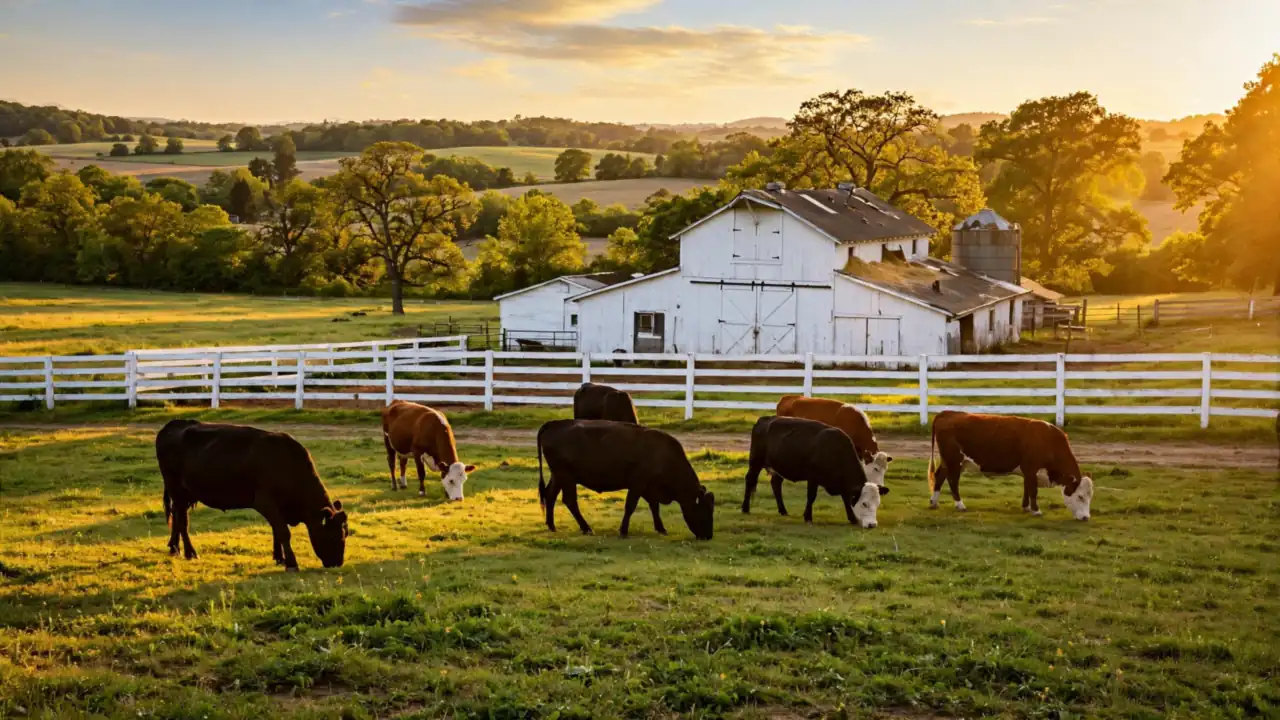
A farm mortgage can also finance improvements, such as a new barn, fencing, drainage, or a farmhouse renovation, when those improvements are part of the secured property and are reflected in its appraised value. Lenders will usually want plans, costs, and a post-improvement value before they approve improvement financing.
Worked Example
Take the calculator defaults as a worked example. A $400,000 farm property with 30% down means a down payment of $120,000 and a mortgage of $280,000. At 7% interest over 25 years with annual payments, the estimated payment is about $24,027 per year.
Over the full 25 years, total interest on that loan is about $320,674. That brings the total cost of the property, before taxes, insurance, and maintenance, to about $720,674. The loan-to-value ratio is 70%, because $280,000 divided by $400,000 equals 0.70 — squarely inside the range most ag lenders prefer.
Now change one input and watch the story change. Cut the down payment to 10% and the mortgage rises to $360,000, the LTV rises to 90%, and the high-LTV warning appears. The annual payment rises sharply, and total interest rises too. That is why a larger down payment is often the cheapest way to make a farm purchase financeable, even though it takes more cash at closing.
Switch the same $280,000 loan at 7% over 25 years from annual to monthly payments and the payment becomes about $1,979 per month. The total interest is similar, but the cash-flow pattern is very different. A monthly schedule suits a farm with steady monthly income, such as a dairy or a diversified operation with monthly sales. An annual schedule suits a farm whose income arrives mainly at harvest.
Farm Mortgage Rates and Terms in 2026
For qualified borrowers, ag and farm land loans in 2026 are typically quoted roughly in the 6.25%–8.50% range, depending on credit, down payment, loan size, property type, and whether the rate is fixed or variable. Borrowers with strong credit, a large down payment, and a low LTV tend to sit at the lower end of that range, while riskier properties or thinner cash flow push a quote higher.
Terms of 15–30 years are common for farm mortgages, and some loans include a balloon payment after a shorter fixed period. A balloon does not mean the loan is bad, but it does mean you need a plan: will you refinance, sell, or pay the balance from farm income or savings when it comes due? Always ask whether the rate is fixed for the whole term, fixed for an initial period, or variable, and what happens at each reset.
Rates also move with the wider market, so a quote from last season may not match today's offer. Before you lock a rate, compare at least two or three farm lenders, and compare the same structure — same term, same down payment, same payment frequency — so the comparison is fair. For current context, see land loan rates and use this calculator to test what each quoted rate does to your payment.
Do not judge a loan by its rate alone. Fees, prepayment terms, escrow requirements, and whether the lender requires annual financial reporting all affect the real cost and the real burden of the loan. A slightly higher rate with flexible prepayment and no balloon may be better for a farm that expects extra income in good years.
Farm Mortgage vs. Farm Operating Loan
A farm mortgage and a farm operating loan serve different jobs, even though both support the same farm. Confusing them can lead to the wrong term, the wrong collateral, and a payment schedule that does not match the income it is meant to be repaid from.
| Feature | Farm Mortgage | Farm Operating Loan |
|---|---|---|
| Purpose | Buy or refinance farm real estate, or finance major improvements to it | Fund day-to-day farm operations for a season or year |
| Collateral | Farm real estate: land, barns, and farmhouse | Usually crops, livestock, equipment, or accounts receivable |
| Term | Long term, typically 15–30 years, sometimes with a balloon | Short term, typically one season to a few years |
| What it pays for | Land and buildings, and long-lived improvements | Seed, fertilizer, feed, fuel, labor, and other operating costs |
In short, use a farm mortgage for the farm itself, and an operating loan for what the farm produces in a season. If you need to compare operating costs, try the farm operating loan calculator. If you are comparing Farm Credit options, the farm credit loan calculator can help you test those structures as well. For a general estimate across farm purchase types, use the farm loan calculator to compare long-term payments.
Farm Mortgage Requirements
Lenders want to know three things: what the property is worth, how much of your own money is in it, and whether the farm can repay the loan from its income. Every requirement below is really an answer to one of those questions.
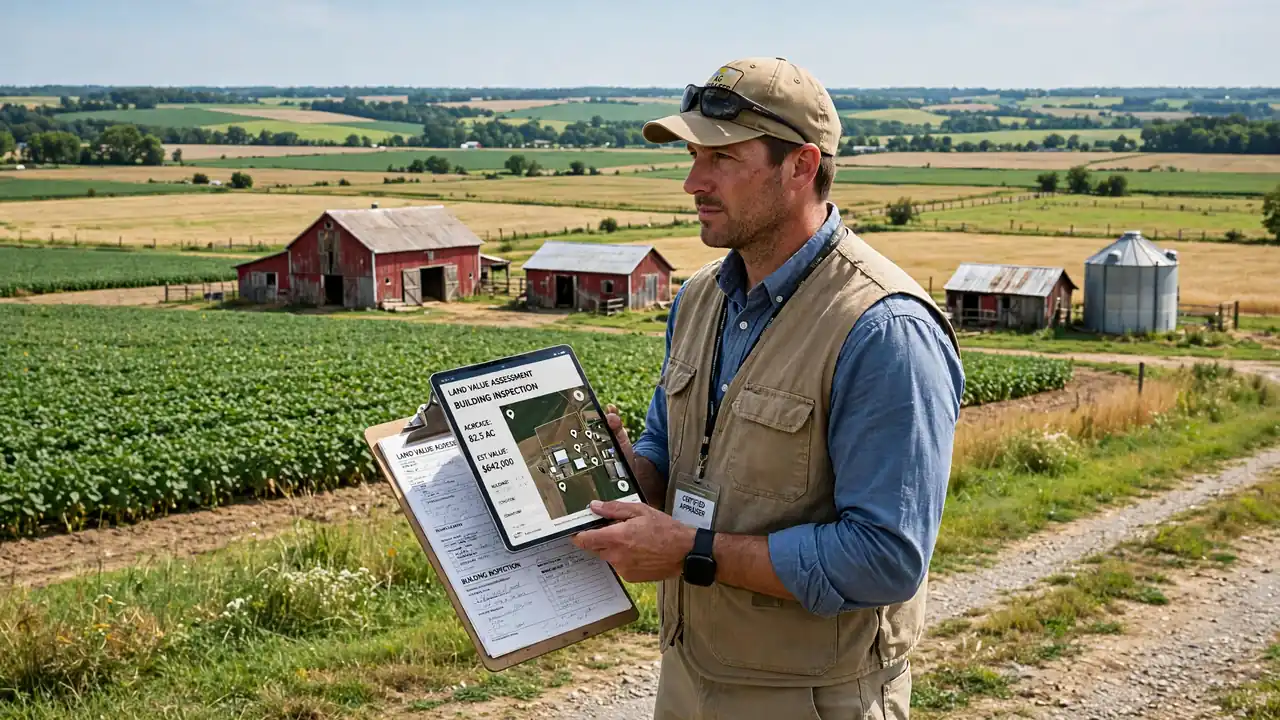
First, expect an appraisal of the land plus the buildings. The appraiser values the acreage, the soil and location, and each building's condition and usefulness. A barn in good repair adds value; a farmhouse needing major work may reduce it or trigger a repair condition. The loan is based on appraised value, not only on the purchase price, so a low appraisal can change the down payment you need.
Second, plan for a down payment of 25–40% in most cases. That range reflects the 70–75% LTV cap discussed above. A larger down payment lowers the lender's risk, lowers your payment, and often improves your rate. It also gives you a cushion if land values fall.
Third, be ready to show credit and cash flow. Lenders review credit history, existing debts, and farm income, and they often calculate debt service coverage — farm income available for debt payments divided by the debt payments themselves. A coverage ratio above 1.0 means income covers the payments; lenders usually want a comfortable margin above that, especially for farms with variable income.
Fourth, larger loans often need a farm business plan. That plan should explain what you grow or raise, how you sell it, what your costs are, and how the new property or improvement changes your income. It does not need to be long, but it does need to be realistic, with numbers that match your tax returns and bank statements.
Other documents commonly requested include tax returns, financial statements, a purchase agreement, insurance information, and, for some properties, surveys or environmental checks. Gathering these early can shorten approval. For a broader checklist, see land loan requirements, and start any purchase estimate with the land loan calculator on the homepage.
Farm Mortgage Calculator FAQs
What is a farm mortgage?
A farm mortgage is a long-term loan secured by farm real estate, including land, barns, outbuildings, and a farmhouse. The borrower repays the loan over many years, usually from farm income, while the lender holds a lien on the property as security until the loan is repaid.
How much down payment do I need for a farm mortgage?
Most farm mortgage borrowers need 25–40% down, because most ag lenders cap loans near 70–75% of appraised value. A larger down payment lowers your loan, your payment, and your total interest, and it can also improve your chances of approval and your interest rate.
How long are farm mortgage terms?
Farm mortgage terms are typically 15–30 years, which matches the long life of farmland and farm buildings. Some loans include a balloon payment after ten or fifteen years, so always check whether your loan is fully amortizing or whether a large balance will come due before the end of the term.
What is a good LTV for a farm mortgage?
A good LTV for a farm mortgage is usually 70–75% or lower, meaning you borrow no more than 70–75% of the appraised value and put down at least 25–30%. Lower LTVs generally mean lower lender risk, easier approval, and often better rates, while LTVs above 75% often trigger extra requirements.
Can I get a farm mortgage with annual payments?
Yes. Annual and semi-annual payments are common in farm lending because they can be matched to crop and livestock income. An annual payment is often timed after harvest, when cash is available. Use this calculator to compare annual, semi-annual, and monthly payments before you choose a schedule.
What credit score do I need for a farm mortgage?
There is no single minimum credit score for every farm mortgage, because lenders also weigh down payment, LTV, farm cash flow, and debt service coverage. In general, stronger credit improves your rate and approval odds, while weaker credit may require a larger down payment, a guarantee, or additional collateral.
Can a farm mortgage include buildings and a farmhouse?
Yes. A farm mortgage is secured by farm real estate as a whole, so it can include the land plus barns, sheds, and the farmhouse, provided those buildings are part of the appraised property and are in acceptable condition. The appraisal values the land and the buildings together.
How is a farm mortgage different from a land loan?
A farm mortgage is secured by a working farm property — land plus buildings — and is usually repaid from farm income over a long term. A general land loan may be secured only by bare acreage, with different terms, down payment rules, and lender expectations. For a generic land purchase, compare this page with the land mortgage calculator.
By Jameel Noori, Founder & Developer, Land Loan Calculator
About the author: Jameel Noori is the Founder & Developer of Land Loan Calculator. He writes practical, U.S.-focused guides on land financing, loan math, and buyer strategy.
Reviewed by: Jameel Noori, Founder & Lead Developer of Land Loan Calculator, reviewed this article for accuracy.
Disclaimer: This article is for informational purposes only and is not financial advice. Land loan rates and terms vary by lender, property, and market conditions. Consult a licensed loan professional before making financing decisions.