
Delaware Land Loans: Requirements, Rates & Lenders

Buying land in Delaware is unlike buying land almost anywhere else on the East Coast — and financing it is different too. Delaware land loans come with larger down payments, shorter terms, and stricter property checks than a standard mortgage, but they are the most practical way to buy a building lot near Wilmington, a beach parcel in Sussex County, or farm acreage in Kent County without paying cash. This guide explains what Delaware lenders look for, what a loan typically costs, which loan type fits your plans, and how to apply without wasting weeks on the wrong lender.
In This Guide
- What Is a Delaware Land Loan?
- Delaware Land Loan Requirements
- Typical Rates and Terms for Delaware Land Loans
- Types of Delaware Land Loans
- Best Lenders for Delaware Land Loans
- How to Apply for a Delaware Land Loan (Step by Step)
- Estimate Your Payment
- Costs Beyond the Loan
- Delaware-Specific Things to Check
- Mistakes to Avoid When Financing Land in Delaware
- Frequently Asked Questions (FAQs)
What Is a Delaware Land Loan?
A Delaware land loan is a loan used to buy vacant land or a building lot in Delaware. Unlike a home mortgage, the collateral is bare land, so lenders usually require a bigger down payment, a stronger credit score, and a shorter repayment term than a conventional mortgage.
Land loans are also called lot loans or vacant land loans. The key distinction is the condition of the land: raw or unimproved land has no utilities, driveway, or septic system and is the hardest to finance, while improved land has road access and utilities nearby and is treated as lower risk. A building lot is a parcel that is ready — or nearly ready — for construction.
If you already know roughly how much you can borrow, run the numbers on our land loan calculator before you start talking to lenders. A clear monthly-payment estimate keeps your land search realistic from day one — especially in a state where beach lots and farmland can carry very different price tags within a few miles of each other.
Delaware Land Loan Requirements
Lenders in Delaware underwrite land loans more conservatively than home loans. The exact numbers vary by lender and property, but these are the benchmarks most borrowers encounter.
Credit Score
Most Delaware lenders look for a credit score of 650 or higher, and the best rates generally go to borrowers at 700 or above. One Delaware land lender, the John Thomas Team at AnnieMac Home Mortgage in Newark, sets a minimum credit score of 680 for its 10-year fixed land loan program and 660 for its 20-year fixed program. A score below 620 makes conventional land financing very difficult, though seller financing or an FSA farm loan may still be an option. For the full picture, see our guide to land loan requirements.
Down Payment
Expect to put down 20% to 50% of the purchase price: improved lots near towns often need 20–25% down, raw or unimproved land commonly needs 30–50% down, and farm land through Farm Credit lenders often needs 20–35% down. Dover Federal Credit Union lends up to 80% of value on raw land, which means a minimum 20% down, while Tidemark Federal Credit Union lends up to 70% of the lot’s value, so at least 30% down. The AnnieMac 10-year program caps loan-to-value at 80% and requires a 20% borrower contribution from the borrower’s own funds; its 20-year program caps loan-to-value at 65%. Eligible beginning farmers can buy through the USDA Farm Service Agency’s Down Payment Program with as little as 5% down. Use our down payment calculator for land to see how different down payments change your monthly payment.
Income and Debt-to-Income Ratio
Lenders want proof you can carry the payment comfortably. Most cap your debt-to-income (DTI) ratio at around 43%, meaning your total monthly debts — including the new land payment — should not exceed 43% of your gross monthly income. Self-employed borrowers should expect extra scrutiny: two years of tax returns, profit-and-loss statements, and bank statements are standard.
Property Requirements
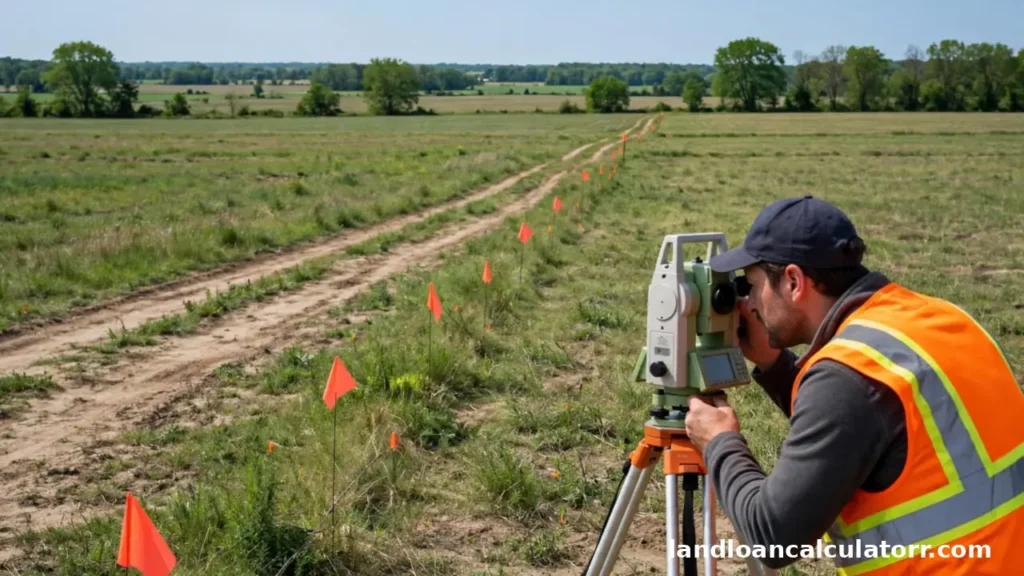
The land itself has to pass muster. Lenders typically require a survey confirming boundaries and acreage, an appraisal based on comparable land sales, legal road access (a deeded easement counts; a handshake agreement with a neighbor does not), a soil test and septic feasibility if you plan to build, and clear title with no unresolved liens or boundary disputes. In Delaware, also check whether the parcel has an approved DNREC site evaluation for its septic system, whether it sits in a flood zone or the Inland Bays watershed, whether public water and sewer are available or a well and septic system are needed, whether the lot meets the county’s minimum lot size and frontage rules, and whether the parcel has the road frontage the county requires.
Typical Rates and Terms for Delaware Land Loans
Land loan rates in Delaware are higher than home mortgage rates and move with the market. Expect rates roughly 1 to 3 percentage points above comparable 30-year mortgage rates, depending on your credit score, down payment, loan term, and whether the land is raw or improved. Rates vary by lender and change frequently, so get written quotes from at least three lenders.
Typical terms look like this:
- Loan amounts: roughly $50,000 to $500,000 for residential lots under the AnnieMac 10-year program, and up to $1,000,000 under its 20-year program. Tidemark Federal Credit Union lends up to $400,000 on a lot. Farm loans can run much higher, and beach or Wilmington-metro lots often cost far more than inland parcels.
- Terms: 10 to 15 years is common for land loans in Delaware — Tidemark Federal Credit Union offers terms up to 15 years, Dover Federal Credit Union up to 12 years, and AnnieMac offers fixed 10-year and 20-year programs. Improved lots can sometimes stretch to 20 years with the right lender, while raw land loans often cap at 10 to 15 years.
- Fixed vs. adjustable: fixed-rate land loans are available from AnnieMac (10-year and 20-year fixed programs) and from Tidemark Federal Credit Union, whose construction loan converts to an adjustable-rate mortgage once the home is complete.
- Fees: expect an origination fee of 0–2%, plus appraisal, survey, title, and recording fees. Delaware also charges a realty transfer tax at closing — 4% of the purchase price in most jurisdictions, split between buyer and seller — covered in the Delaware-specific section below.
For a deeper look at how land loan pricing works, see our guide to land loan interest rates.
Types of Delaware Land Loans
Matching the loan type to your plan is the single biggest factor in getting approved at a fair rate.
Raw Land Loans
For unimproved parcels with no utilities or structures. These carry the highest down payments (often 30–50%) and the shortest terms, because the lender’s collateral is the least liquid. Best for buyers who want to hold farmland, woodland, or recreational land long-term or build much later. Dover Federal Credit Union lends up to 80% of value on raw land, mainly to buyers who intend to build.
Improved Lot Loans
For parcels with road access, utilities at or near the lot line, and a soil test already done. Down payments are lower (often 20–25%) and terms can stretch longer. This is the easiest land loan to get approved for.
Construction-to-Permanent Loans
If you plan to build within a year or two, a construction-to-permanent loan can finance the land purchase and the build in one package, converting to a regular mortgage when construction finishes. You will need approved building plans and a builder contract before the lender commits, and interest-only payments during construction are common. TD Bank, for example, finances land purchases as part of a construction project, with interest-only payments during the construction phase. Tidemark Federal Credit Union offers construction financing for up to nine months at up to 100% of the property’s value at a fixed rate with interest-only payments, converting to an adjustable-rate mortgage once the home is complete. Community Bank Delaware will fund the lot purchase first, then work with your builder to advance funds to complete the home.
Farm and Agricultural Loans
For working farmland, poultry ground, and rural properties with farm buildings. Horizon Farm Credit — the Farm Credit lender for Delaware since MidAtlantic Farm Credit became Horizon Farm Credit — is a member-owned cooperative serving Delaware, Maryland, Pennsylvania, Virginia and West Virginia. Its land loans cover bare land, lots, timberland and construction, including one-time-close construction-to-permanent financing, and it works with the USDA Farm Service Agency, so a farm buyer who does not fit a conventional land loan can ask about an FSA guarantee. See Horizon Farm Credit’s land loans.
USDA and FSA Loans
The USDA Farm Service Agency (FSA) offers Direct Farm Ownership Loans up to $600,000 with repayment terms up to 40 years, and a Down Payment Program for beginning farmers that requires only a 5% down payment while FSA finances up to 45% of the purchase price. You must be a U.S. citizen or permanent resident, show farm management experience, and demonstrate an ability to repay. Details are on the FSA Farm Ownership Loans page.
Delaware adds its own option for young farmers. The Delaware Department of Agriculture’s Young Farmers Program offers a 30-year, no-interest loan of up to 70% of the appraised value of a farm’s development rights, capped at $500,000, to Delaware citizens aged 18 to 40 with at least three years of farming experience, a net worth of no more than $300,000, buying a farm with at least 15 tillable acres. The land bought through the program is permanently preserved through the Delaware Agricultural Lands Preservation Foundation. See the Delaware Young Farmers Program page.
Seller Financing (Land Contract)
When a bank says no — or when the seller wants a faster sale — the seller can finance the purchase directly. You agree on a down payment, interest rate, and payment schedule, and the seller holds the deed until you pay in full. Seller financing is common on rural Delaware land, where banks often want 20% to 40% down. Terms are negotiable, but rates are often higher than bank loans and the contract must be reviewed by a Delaware real estate attorney. Estimate your payments with our land contract calculator.

Best Lenders for Delaware Land Loans
There is no single “best” lender for Delaware land — the right choice depends on where the land sits and what you plan to do with it.
- Horizon Farm Credit (formerly MidAtlantic Farm Credit). The Farm Credit lender for Delaware, and a member-owned agricultural lending cooperative serving Delaware, Maryland, Pennsylvania, Virginia and West Virginia. Its land and lot loans cover bare land, lots, timberland and construction — including one-time-close construction-to-permanent financing — with bare-land terms up to 20 years and no maximum acreage or loan amount, and it works with conservation easements and the USDA Farm Service Agency, so a farm buyer who does not fit a conventional land loan can ask about an FSA guarantee. This is usually the first call for farm acreage, poultry ground and large rural parcels in Kent and Sussex counties. See Horizon Farm Credit’s land loans.
- AnnieMac Home Mortgage — John Thomas Team (Newark). A Delaware mortgage team that has financed raw land, building lots, and recreational acreage across New Castle, Kent, and Sussex counties for more than 20 years. Its 10-year fixed program (investment or future-build residential land) requires a minimum credit score of 680, lends up to 80% loan-to-value, from $50,000 to $500,000, on up to 20 acres, non-owner-occupied only, with a 20% borrower contribution from the borrower’s own funds and no requirement to build. Its 20-year fixed program (Non-QM, larger loans) requires a minimum credit score of 660, lends up to 65% loan-to-value (60% on cash-out), from $100,000 to $1,000,000, with no acreage limit and no land-type restriction — raw land, unimproved land, hunting and recreational property, and agricultural land may all be eligible when the appraisal supports the value. Neither program has a prepayment penalty. Details as reported in the Delaware land loans guide from AnnieMac.
- Tidemark Federal Credit Union. A Delaware credit union serving Delaware, Maryland, and Virginia. Its land loans are available in Delaware for raw land and building lots, with financing up to 80% of the lot’s value and repayment terms of up to 15 years, and its construction financing covers up to nine months at up to 100% of the property’s value at a fixed rate. A strong option for buyers in Sussex County and the Delmarva area. See Tidemark’s construction and land loans.
- Dover Federal Credit Union. First chartered in 1958 by civilian and Air Force workers at Dover Air Force Base, and now serving 40,000 members across Delaware. Its land loans offer up to 80% loan-to-value on raw land with terms of up to 12 years, fixed rates and no prepayment penalties, mainly for buyers who intend to build. A strong option for buyers in Kent County and around Dover. See Dover Federal’s land loans.
- Community Bank Delaware. Started in 2006 by local business professionals, with over $250 million in assets, serving Sussex County residents through commercial and personal loan products. Its lot loans are available for buyers who want to secure a lot but are not ready to begin building, and its home construction loans fund the lot first, then advance funds with the builder to complete the home. See Community Bank Delaware’s mortgages and lot loans.
- USDA Farm Service Agency. Best for working farms and beginning farmers, as described above — and Delaware’s Young Farmers Program can sit alongside a commercial farm loan as a no-interest second layer. Delaware’s FSA state office is at 1221 College Park Drive, Suite 201, Dover, DE 19904 (302-678-4250).
- Seller financing. Worth considering for parcels that are hard to appraise or in areas with few comparable sales — and common across rural Delaware.
Get quotes from at least three lenders — a Farm Credit lender, a local credit union or community bank, and one other option — and compare the APR, not just the interest rate.
How to Apply for a Delaware Land Loan (Step by Step)
- Check your credit and fix errors. Pull your reports, dispute mistakes, and pay down revolving balances. Even a 20-point improvement can change your rate.
- Work out what you can afford. Use our land loan calculator and our guide to how much land you can afford to set a realistic budget before you shop for parcels.
- Get pre-qualified. A pre-qualification letter tells sellers you are a serious buyer and tells you your real borrowing limit.
- Find the parcel and make an offer. Include financing and inspection contingencies — never waive them on raw land.
- Order the survey and appraisal. Your lender orders the appraisal; you typically arrange the survey. Our guide to land survey costs explains what to expect.
- Complete the soil test and title search. A failed soil test can kill a building plan, so do this before you are emotionally committed to the parcel. In Delaware, also confirm whether the parcel has an approved DNREC site evaluation, whether it sits in a flood zone, and whether public water and sewer are available or a well and septic system are needed.
- Submit the full application. Expect to provide two years of tax returns, recent pay stubs, two months of bank statements, and documentation of the down payment source.
- Underwriting and closing. Underwriting for land typically takes 30 to 45 days. Delaware closings are handled by a settlement agent or attorney — budget for attorney and title fees, and remember the 4% realty transfer tax, which is usually split between buyer and seller.
Estimate Your Payment
Before you make an offer, run the numbers. Use our land loan calculator on the homepage to plug in the purchase price, down payment, rate and term and see your estimated monthly payment, then try our land payment calculator, which walks through the same math with taxes and fees included. Because Delaware land loans usually run 10 to 20 years with 20% to 50% down, the term you choose changes the payment more than the rate does — test a 10-year and a 20-year term side by side, then check the result against the rates on our land loan interest rates page.
Costs Beyond the Loan
The loan payment is only part of what land costs you. Budget for these before you buy:
- Closing costs: typically 2–5% of the purchase price, including title insurance and recording fees. Delaware’s realty transfer tax is the biggest single line item: the combined state and local rate is 4% of the purchase price in most jurisdictions, split evenly so the buyer pays 2% and the seller pays 2% under the standard Delaware Association of Realtors contract. On a $300,000 land purchase, the total transfer tax is $12,000 — $6,000 from the buyer and $6,000 from the seller. A qualifying first-time buyer gets a 0.5% reduction on the first $400,000 of value (up to $2,000 saved), which would cut that buyer’s share from $6,000 to $4,500 — but only if the buyer has never held residential real estate and will occupy the property as a principal residence within 90 days.
- Survey: $500–$2,000+ depending on acreage and terrain. Heavily wooded Delaware parcels cost more to survey than open lots.
- Soil test and septic design: $500–$1,500 or more; a failed soil test may mean an engineered septic system costing far more. Delaware’s onsite wastewater systems are permitted by DNREC, and a site evaluation by a licensed Class D soil scientist is required before an unimproved lot can be sold. See our guide to perc tests for land loans.
- Septic system and well: most rural Delaware parcels are not on public sewer or water, so a new septic system and a drilled well are major costs. Every well in Delaware must be constructed by a water well contractor licensed by DNREC. Septic systems must sit at least 100 feet from private wells and 10 feet from property lines, and coastal Sussex County parcels draining to the Inland Bays face additional standards.
- Property taxes: Delaware has no state-level property tax and no sales tax, and its average effective property tax rate is roughly 0.5% of market value — among the lowest in the country — but rates vary by county, with Sussex County lowest (around 0.3%) and New Castle County highest (around 0.7%). County reassessments are underway and reshaping rates, so check the specific county’s current rate before you commit.
Delaware-Specific Things to Check
Delaware is not one land market — it is three, and the rules change with the county.
New Castle Metro vs. Kent Farmland vs. Sussex Beaches
New Castle County — Wilmington, Newark, and the northern suburbs — is Delaware’s population and jobs center: land is scarce, lots are small, prices are high, and most loans are for improved residential lots or land bundled with construction. Kent County — Dover, Smyrna, and Milford — is the agricultural middle: farmland, poultry ground, and larger rural parcels at lower prices, with the state capital’s commuter demand. Sussex County — Rehoboth Beach, Bethany Beach, Lewes, Seaford, and Georgetown — blends beach and resort demand with farmland: coastal lots carry vacation-home premiums and flood-zone rules, while inland Sussex holds some of the state’s largest and cheapest farm parcels.
Farmland Values — High for the Region, Cheap for a Building Lot
Delaware is the second-smallest state in the U.S. — just 1,949 square miles — and its farmland is among the most valuable in the country. USDA figures put Delaware farm real estate at about $9,550 per acre in 2025, more than double the national average of $4,350 per acre, ranking Delaware eighth among all states. The 2022 Census of Agriculture counted about 522,834 acres in farms in Delaware — roughly 42% of the state’s land area. The Bureau of Economic Analysis puts the value of all Delaware land (including developed beach and Wilmington-metro land) far higher, at roughly $57,692 per acre. Farm real estate averages mix working ground and buildings, so use them to compare regions, not to price a building lot — but they explain why even a small Delaware parcel can cost more than many acres elsewhere.
DNREC Septic Rules — the Site Evaluation Comes First
Delaware regulates all onsite wastewater systems through the Department of Natural Resources and Environmental Control (DNREC), under the Regulations Governing the Design, Installation and Operation of On-Site Wastewater Treatment and Disposal Systems (7 Del. Admin. Code 7101). Getting a septic system approved is a three-step process:
- Site evaluation by a licensed Class D soil scientist, who digs soil borings, runs percolation tests, and checks depth to the water table — Delaware’s water table is often just 2 to 8 feet below the surface. State law requires a site evaluation on unimproved lots before sale. DNREC reviews the report within 10 working days, and an approved site evaluation is good for five years.
- Design and permit by a licensed designer — Class B for gravity systems, Class C for engineered and pressure-dosed systems. Gravity permits take about 10 working days from receipt; engineered permits take about 20.
- Installation by a licensed Class E system contractor.
A septic system is not a utility you tuck behind the garage: it needs a defined disposal area, a replacement area held in reserve, separation from the well and property lines, and access for the truck that will eventually pump it. In the Inland Bays watershed of coastal Sussex County — Rehoboth Bay, Indian River Bay, and Little Assawoman Bay — the Pollution Control Strategy sets additional standards beyond the statewide baseline.
The Realty Transfer Tax — 4% and Split
Delaware’s realty transfer tax is one of the highest in the U.S., and it is the largest single closing cost on most land purchases. The state rate is 3% by default, but when the county or municipality has enacted its full 1.5% local transfer tax — which most have — the state rate drops to 2.5%, producing a combined rate of 4% in nearly every transaction. The tax is split evenly between buyer and seller, so each side typically pays 2% of the purchase price, though the split is negotiable in the contract. A first-time buyer who has never held residential real estate and will occupy the property as a principal residence within 90 days gets a 0.5% reduction on the first $400,000 of value — a maximum saving of $2,000. Transfers valued below $100 are exempt, as are transfers between close family members and between spouses.
No Sales Tax — and Low Property Taxes
Delaware is one of the few states with no sales tax, which keeps the cost of building materials and fixtures down when you build on your lot. There is also no state-level property tax: counties, school districts, and municipalities set their own rates. The average effective property tax rate statewide is roughly 0.5% of market value — well below the national average — with Sussex County lowest at around 0.3%, Kent County around 0.4–0.5%, and New Castle County highest at around 0.7%. But those figures are in flux: a 2023 law requires reassessments every five years, New Castle County has already completed its reassessment, and Kent and Sussex counties are still working through theirs — so confirm the current rate with the county assessor before you commit.
Zoning and Subdivision — County Rules Decide Buildability
Delaware zoning is local, and each of the three counties writes its own rules for unincorporated land. Minimum lot sizes vary enormously by county and district. In Kent County, the minimum lot size without public sewer is 0.5 acre in all zoning districts, with a minimum road frontage of 150 feet. In Sussex County, lots in a minor subdivision must have a minimum area of 3/4 of an acre and a minimum width of 150 feet, with entrances approved by the Delaware Department of Transportation (DelDOT), and lots not connected to a central sewer system generally need at least 3/4 of an acre. Always check the county’s zoning map, the minimum lot area and frontage for the district, and whether the parcel is a conforming lot before you offer — and confirm road access, since DelDOT controls entrances onto state roads.
Flood Zones and the Sussex Coast
Much of coastal Sussex County sits in or near a FEMA flood zone, and beach lots in Rehoboth, Dewey, Bethany, and Fenwick Island carry flood insurance requirements that can add thousands of dollars a year to ownership costs. Check the parcel against the FEMA flood maps and the county’s floodplain rules before you offer, and ask your insurer for a flood quote during your contingency period, not after closing.
Wetlands and the DNREC Permit — Check Before You Buy
Wetlands cover nearly a quarter of Delaware, so a parcel that looks like dry farmland or woods can include regulated tidal or nontidal wetlands. Delaware’s Wetlands and Subaqueous Lands Act requires a DNREC permit for dredging, filling or building in wetlands and subaqueous lands, and a lender will not finance a lot whose buildable area is mostly wetland. Check the parcel against DNREC’s wetland maps and ask DNREC’s Wetlands and Subaqueous Lands Section whether a permit is needed before you make an offer. Read DNREC’s wetlands guidance.
Recorder of Deeds — Your Deed Is Not Recorded Until the Tax Is Paid
Delaware deeds are recorded with the Recorder of Deeds in the county where the land sits — New Castle, Kent or Sussex County — and under 30 Del. C. § 5408 no document can be recorded until the realty transfer tax is paid, with an affidavit of the true consideration filed with the deed. Confirm the recording fee and the affidavit requirement with the county Recorder of Deeds before closing, and keep a certified copy of the recorded deed: your lender will want proof the lien is recorded. Read the Delaware transfer tax law.
The Coastal Zone Act — Heavy Industry Is Off-Limits Near the Coast
If your parcel sits in Delaware’s coastal zone, the Delaware Coastal Zone Act of 1971 prohibits new heavy industry there and requires a DNREC coastal zone permit for new manufacturing and other regulated activities in the zone. That protects the value of residential and recreational land near the coast, but it also means a buyer who plans a commercial or industrial use must check the coastal zone boundary and permit rules first. Read DNREC’s Coastal Zone Act guidance.
Timberland and the Delaware Forest Service
If the parcel is wooded, the Delaware Forest Service can help you plan for it: its Forest Stewardship Program writes custom stewardship plans for woodland owners, and its Forest Legacy Program protects working forestland through conservation easements or purchase. Timber income and a stewardship plan can also support a farm or timberland loan application, so ask about them before you buy. See the Delaware Forest Service.
Farmland Preservation Easements — the Land May Already Be Restricted
Delaware’s Agricultural Lands Preservation Program, created in 1991, lets farmland owners first enroll in a 10-year Agricultural Preservation District and then sell a permanent Agricultural Conservation Easement — the development rights — to the state. Nearly 160,000 acres are preserved this way, and land under an easement can never be developed, which changes both its price and its financing: Horizon Farm Credit notes that it works with conservation easements, and an FSA farm ownership loan can still finance preserved farmland for agricultural use. Always check whether a parcel carries a preservation easement before you offer. Read about the Aglands Preservation Program.
For a sense of how state guides differ across the country, compare this guide with our Maryland land loan guide and our
Mistakes to Avoid When Financing Land in Delaware
- Skipping the soil test before closing. A failed soil test can make a parcel unbuildable — and your lender may not finance it at all.
- Assuming a mortgage lender will finance raw land. Most mortgage lenders do not. Go to a land specialist first.
- Buying coastal land without checking flood zones. A lot that looks buildable can sit in a high-risk flood zone with insurance costs that change the whole deal.
- Forgetting the transfer tax. Delaware’s 4% realty transfer tax is the biggest closing cost — budget your 2% buyer share before you offer, not after.
- Ignoring the DNREC site evaluation. An unimproved lot cannot legally be sold in Delaware without a site evaluation, and a failed one can mean an engineered septic system costing far more than buyers expect.
- Buying without checking the county’s minimum lot size. Kent County requires at least 0.5 acre without sewer and Sussex County generally 3/4 of an acre, with 150 feet of frontage — a nonconforming lot needs county relief.
- Assuming public water and sewer are available. Most rural Delaware parcels need a well and septic system, and both add major cost and permitting time.
- Underestimating site costs. The driveway, well, septic, and electric can cost more than the land itself on a remote parcel — and Delaware’s high water table can add more still.
- Buying without confirmed road access. Landlocked parcels are hard to finance and hard to sell — and in Delaware, entrances onto state roads need DelDOT approval.
- Not shopping lenders. Rates and down payments for land loans vary far more between lenders than mortgage rates do. Three quotes is the minimum.
Frequently Asked Questions (FAQs)
What credit score do you need for Delaware land loans?
Most Delaware lenders look for a credit score of 650 or higher, with the best rates going to borrowers at 700 or above. One Delaware land lender, the John Thomas Team at AnnieMac, requires 680 for its 10-year fixed land loan program and 660 for its 20-year program. USDA FSA farm ownership loans do not use a hard credit score cutoff in the same way, but a history of on-time payments matters.
How much is a down payment on land in Delaware?
Expect 20% to 50% of the purchase price. Improved lots near towns typically need 20–25% down, while raw or unimproved land commonly needs 30–50% down. The main exception is the USDA FSA Down Payment Program, which lets a beginning farmer buy with 5% down while FSA finances up to 45% of the purchase price.
What are typical land loan rates in Delaware?
Land loan rates generally run about 1 to 3 percentage points above comparable 30-year mortgage rates, depending on your credit score, down payment, and loan term. Because rates move constantly, we do not publish a fixed number here — see our current land loan interest rates page for the latest rates and a breakdown of what drives them.
Can you get a land loan with no money down in Delaware?
A true zero-down land loan is rare, but the closest options are the USDA FSA Down Payment Program for beginning farmers (5% down, with FSA financing up to 45% of the purchase price) and the Delaware Young Farmers Program, which offers a 30-year, no-interest loan of up to 70% of the appraised value of a farm’s development rights, capped at $500,000. Seller financing is another route if the seller agrees.
Do banks in Delaware finance raw land?
Yes, but not all of them. Horizon Farm Credit (formerly MidAtlantic Farm Credit), Dover Federal Credit Union, Tidemark Federal Credit Union, and Community Bank Delaware all offer land or lot loans in Delaware, and the USDA Farm Service Agency finances working farmland. Most large national mortgage lenders do not finance raw land, so start with a Farm Credit lender, a local credit union, or a community bank.
How long does it take to get a land loan in Delaware?
Most land loans close in 30 to 45 days from a complete application, similar to a mortgage. Rural parcels can take longer if the survey, appraisal, soil test, or DNREC site evaluation uncovers an issue, and FSA farm ownership loans can take several months. Start the soil test and survey early — they are the most common source of delays.
Can you buy land with a septic system in Delaware?
Yes, but the system is regulated by DNREC, and an unimproved lot cannot be sold without a site evaluation by a licensed Class D soil scientist. The evaluation is reviewed by DNREC, usually within 10 working days, and an approved site evaluation is good for five years. If you are buying land that already has a septic system, ask for its permit, maintenance records, and the location of the disposal area before you close.
Are land loans tax deductible in Delaware?
Interest on a land loan is generally not deductible in the same way as mortgage interest on a primary residence, because the land is not a qualified residence until a home is built and occupied. If you build a home on the lot and take out a mortgage, the mortgage interest may be deductible under federal rules. Because tax rules are individual, check with a tax professional before relying on a deduction. This article is not tax advice.
By Jameel Noori, Founder & Developer, Land Loan Calculator
About the author: Jameel Noori is the Founder & Developer of Land Loan Calculator. He writes practical, U.S.-focused guides on land financing, loan math, and buyer strategy.
Reviewed by: Jameel Noori, Founder & Lead Developer of Land Loan Calculator, reviewed this article for accuracy.
Disclaimer: This article is for informational purposes only and is not financial advice. Land loan rates and terms vary by lender, property, and market conditions. Consult a licensed loan professional before making financing decisions.
