

Land Purchase Calculator

Buying land is not just about the monthly loan payment. A land purchase calculator should show you the true cost of buying land: your payment, your closing costs, and the cash you actually need at closing. That is what the tool below does, so you can budget with confidence before you make an offer.
Many buyers are surprised at closing. The price looks affordable, but the down payment plus title, appraisal, survey, and lender fees can add thousands of dollars to the amount due on day one. When you see those figures together, you can compare parcels fairly and avoid stretching your savings too thin.
Enter a land price, down payment, interest rate, loan term, and closing-cost percentage. The calculator instantly estimates your payment, loan amount, closing costs, cash needed at closing, total interest, and the true total cost of the purchase.
Step 1 · Enter your numbers
Land Purchase Details
Title insurance, appraisal, survey, recording and lender fees usually add about 2–5% of the price on a land purchase.
Step 2 · Your estimate
Amortization Schedule — Principal & Interest (Estimate)
All figures are estimates only — never guaranteed rates. Closing costs vary by state, lender and property. Not a loan offer.
How This Land Purchase Calculator Works
The calculator uses four cost pieces. First is the land price, the amount you agree to pay the seller. Second is the down payment, shown as a percentage of the price, which reduces the amount you need to borrow.
Third is the closing-cost percentage, which estimates the fees paid at settlement. Fourth is the loan terms: the interest rate, the repayment period, and how often you pay. Together, these inputs produce a payment that reflects the loan itself, not the whole purchase.
Two results deserve special attention. “Cash needed at closing” is your down payment plus estimated closing costs. It is the money you should have ready on settlement day, before any seller credit or earnest-money adjustment. “True total cost” adds the price, the closing costs, and all the interest you will pay over the life of the loan.
Try changing one input at a time. A larger down payment lowers the loan and the payment. A shorter term raises the payment but cuts total interest sharply. A higher rate does the opposite, which is why comparing lender quotes matters so much. Run the same comparison in this land purchase calculator to see the tradeoff in dollars, not just in theory.
What Does It Really Cost to Buy Land?
The sticker price is only part of the story. On most land purchases, land closing costs add about 2–5% of the price. Title insurance protects you against ownership claims, while an appraisal confirms the value for the lender. A survey confirms the boundaries, and recording fees put the deed on the public record. Origination and other lender fees are charged for processing the loan.
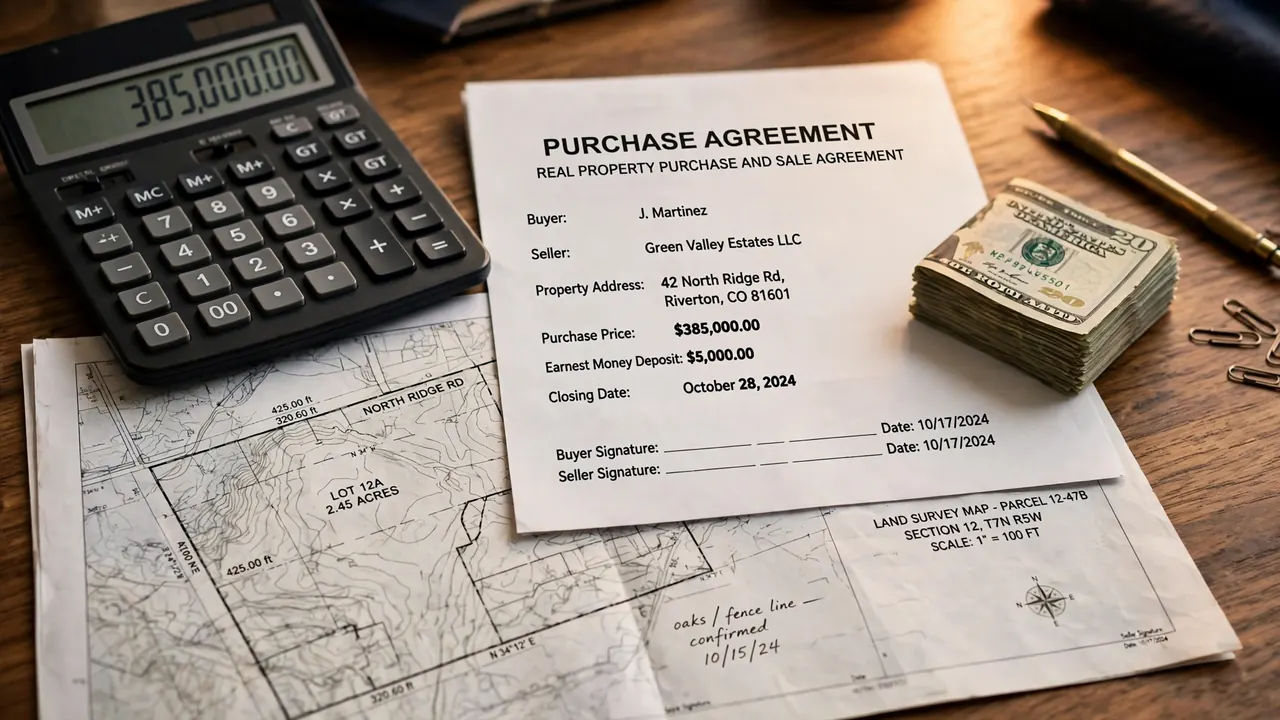
Do not forget the costs that arrive after closing. Property taxes depend on the county and the assessed value, and they continue every year you own the land. Insurance, even for vacant land, protects against liability and, in some areas, fire or storm damage. If the parcel lacks utilities, connecting water, power, or septic can cost far more than buyers expect.
Clearing, grading, driveway access, and fencing are also common post-purchase costs, especially for wooded or rural parcels. Budgeting for them before you buy helps you judge whether a low price is truly a bargain. The escrow process holds deposits and documents until every condition is met, and our guide to land purchase escrow explains how that protection works.
That is why the calculator separates the loan payment from the cash and total-cost figures. A payment that fits your monthly budget can still be a poor choice if the closing cash wipes out your reserves. Plan for both, and keep a cushion for the first year of ownership.
Worked Example
Start with the calculator defaults: $150,000 land at 25% down. That means a $37,500 down payment and a $112,500 loan. At 8% interest for 15 years, paid monthly, the estimated payment is about $1,075 per month. You can reproduce every figure in this example with the land purchase calculator above by entering the same defaults.
Closing costs at 3% add $4,500, so the cash needed at closing is $42,000: the $37,500 down payment plus the $4,500 in closing costs. Over the full term, total interest comes to about $81,020. Add the price, the closing costs, and that interest, and the true total cost is about $235,520.
Notice how interest changes the picture. The loan itself is $112,500, yet interest adds more than $81,000 over 15 years. Shortening the term or making a larger down payment reduces that interest, even though the monthly payment rises. Use the amortization schedule in the tool to see how each year shifts the balance from interest toward principal.
How to Lower Your Land Purchase Cost
A bigger down payment is the most direct lever. It lowers the loan amount, the monthly payment, and the total interest, and it can improve your chances of approval. Land lenders often require more equity than home lenders, so saving extra before you buy can open better terms.
A shorter term is a tradeoff, not a free win. Payments rise, but total interest falls sharply, and you build equity faster. If the shorter-term payment still leaves room for taxes, insurance, and maintenance, it is often the cheaper path over time. If it strains your budget, a longer term with extra principal payments can offer flexibility.
Negotiate seller credits where the market allows. A seller contribution toward closing costs lowers your cash needed at closing dollar for dollar, though lenders usually cap the amount. Asking for repairs, clearing, or a survey credit can also reduce your post-purchase spending.
Finally, compare lenders side by side. Rates, origination fees, and down-payment rules vary widely for land. If you are still weighing a purchase, read our guide to a loan for land purchase before you apply, and start with the land loan calculator on our homepage to test different loan sizes.
Land Purchase Financing Options
Bank land loans are the most familiar route. Local and community banks often know the area and may lend on parcels that national lenders avoid. Expect a larger down payment than for a home, a shorter maximum term, and a rate above a typical mortgage rate, reflecting the higher risk of raw land.
Seller financing is another option, especially for rural or hard-to-finance parcels. The seller acts as the lender, often with a shorter term and a balloon payment. Terms can be flexible, but read the contract carefully and confirm how taxes, insurance, and title are handled. A local attorney can review the note before you sign.
For rural land, Farm Credit and USDA programs are worth checking. Farm Credit lenders specialize in agricultural and rural property, while USDA programs may support eligible rural buyers and properties. Rules, acreage limits, and property requirements differ, so confirm eligibility early rather than after you have made an offer. For federal program details, see USDA Rural Development.
Whichever route you choose, run the numbers first with a land financing calculator. Compare the payment, the cash to close, and the true total cost across lenders and terms, not just the advertised rate. The cheapest monthly payment is not always the cheapest loan.
Land Purchase Calculator FAQs
How much cash do I need to buy land?
Plan for the down payment plus closing costs. On a $150,000 purchase with 25% down and 3% closing costs, that is $42,000. Add a reserve for taxes, insurance, and any immediate site work, so closing does not leave you without a cushion.
What are typical closing costs on land?
Closing costs on land usually run 2–5% of the price. They include title insurance, appraisal, survey, recording fees, and lender origination charges. The exact mix depends on the state, the lender, and whether the parcel has any title or boundary issues.
How much down payment do I need to buy land?
Many land lenders require 20–50% down, more than for a typical home loan. Raw or rural land usually needs the most equity. A larger down payment also lowers your payment and total interest, and it can improve your approval chances.
Can I include closing costs in the land loan?
Sometimes, but do not count on it. Some lenders allow limited seller credits or a higher loan amount, while others require closing costs to be paid in cash. Ask each lender what is allowed before you set your budget, and confirm the cap in writing.
What is the true cost of buying land?
The true cost is the price plus closing costs plus all interest paid over the loan term. For the worked example, that is about $235,520. It excludes taxes, insurance, and post-purchase work, so treat it as the financing cost, not the full cost of ownership.
How long are land purchase loans?
Land loans often run 5–20 years, shorter than many home mortgages, although some lenders offer up to 25 or 30 years for improved or rural property. Shorter terms mean higher payments but much less total interest, so compare the true total cost, not just the payment.
Does buying land require an appraisal and survey?
Usually, yes. Lenders generally require an appraisal to confirm value, and a survey is strongly recommended to confirm boundaries, access, and easements. Even a cash buyer benefits from both, since boundary or value problems are expensive to fix after closing.
How can I estimate land taxes before buying?
Check the county assessor or tax office for the parcel's assessed value and current tax rate, and ask whether the land has any agricultural or homestead exemption. A local title company or tax office can also confirm whether back taxes or special assessments apply.
By Jameel Noori, Founder & Developer, Land Loan Calculator
About the author: Jameel Noori is the Founder & Developer of Land Loan Calculator. He writes practical, U.S.-focused guides on land financing, loan math, and buyer strategy.
Reviewed by: Jameel Noori, Founder & Lead Developer of Land Loan Calculator, reviewed this article for accuracy.
Disclaimer: This article is for informational purposes only and is not financial advice. Land loan rates and terms vary by lender, property, and market conditions. Consult a licensed loan professional before making financing decisions.