
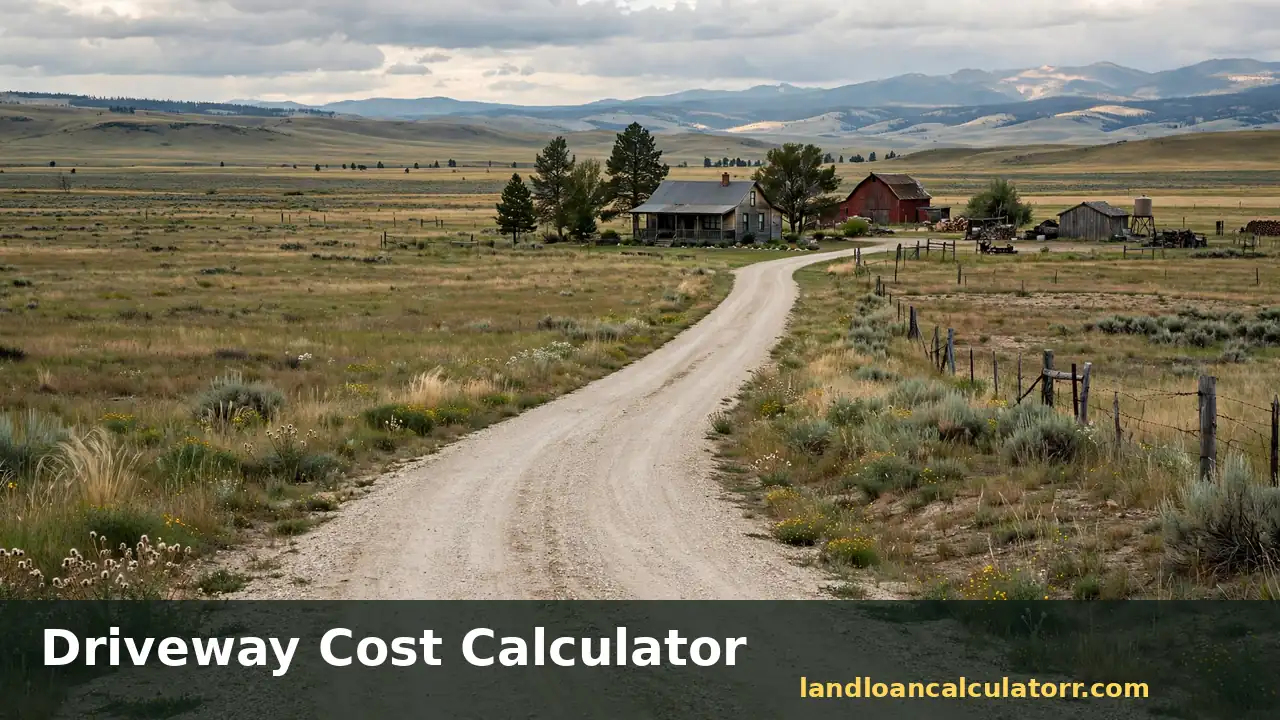
Driveway Cost Calculator: Gravel, Asphalt & Concrete

A new driveway on raw land typically costs $3,000–$40,000+ depending on length and material — gravel is cheapest, pavers the most premium — so use this driveway cost calculator to estimate your rural driveway before you buy land or break ground.
Driveway Cost Calculator
Estimate Your Driveway Cost
Rural driveways are often 150–500 ft from the road to the homesite. Length is the biggest cost driver.
12 ft fits one vehicle comfortably; 16–20 ft allows passing and turnaround space.
Estimated Total Driveway Cost
$15,500
2,400 sq ft driveway · Est. payment $144/mo if financed
Driveway Area
2,400 sq ft
Material + Installation
$9,600
Site Prep
$3,600
Culvert, Excavation + Permits
$2,300
Cost per Linear Foot
$78
Cost per Sq Ft (All-In)
$6.46
Loan Amount
$11,625
Total Interest
$5,671
Estimates use typical U.S. installed ranges per square foot. Actual quotes depend on local contractor rates, soil and slope, base depth, and how far material must be hauled. Get at least two local quotes for long rural driveways.
How Much Does a Driveway Cost?
Typical installed costs per square foot are about $4 for gravel, $9 for asphalt, $12 for concrete and $20 for pavers, before major clearing or drainage work. On a standard 12-foot-wide driveway, that difference alone can move the total by thousands of dollars.
For rural properties, length usually dominates the quote. A 200-foot driveway covers 2,400 square feet at 12 feet wide, while a 500-foot driveway covers 6,000 square feet — so every extra foot from the road multiplies material, base rock and labor. Long haul distances for stone and concrete can add even more.
Gravel vs. Asphalt vs. Concrete for Rural Driveways
Gravel is the cheapest upfront option and the easiest to repair: you can regrade it and top it up without tearing out a slab. It needs regular grading and fresh stone, can rut in wet weather, and is harder to clear of snow cleanly.
Asphalt costs more than gravel but gives a smooth, snow-plow-friendly surface that handles cold climates well. It typically needs sealcoating every few years and can soften in extreme heat. Concrete lasts longest and needs the least routine maintenance, but it costs more upfront, can crack if the base or drainage is poor, and repairs are more visible.
For gravel maintenance best practice, see the FHWA Gravel Roads Construction and Maintenance Guide.

What Else Adds to Driveway Cost?
Clearing and grading can add a large share of the bill on wooded or sloped land. Trees, stumps, topsoil removal and reshaping the grade all take time and equipment before any surface material goes down.
Base rock depth matters too: a thin base may save money now but rut quickly under heavy vehicles, while a deeper compacted base costs more and lasts longer. Culverts and drainage — ditches, cross-drains and pipes where the driveway meets the road — protect the surface from washouts.
Finally, excavation and haul-off distances affect price. Hauling spoil away, or bringing stone in over a long distance, adds truck time and fuel, which is why two similar driveways in different locations can quote very differently.

How to Use This Driveway Cost Calculator
Start with driveway length and width to set the area, then choose your material and site prep level. Enter culvert, excavation and permit costs if you have quotes, or keep the defaults for a rough estimate.
Finally, adjust the down payment, interest rate and loan term to see the loan amount and estimated monthly payment if you finance the work. Change any input and the totals update instantly, so you can compare gravel against concrete in seconds.
Financing a Driveway With Your Land Purchase
Driveway work is commonly rolled into land improvement financing, especially when the access road is needed to make the parcel usable. Lenders may treat it as part of the overall project cost rather than a separate home-improvement loan.
Run the numbers first with a land loan calculator to estimate payments on the land itself, and use a land development cost calculator to budget clearing, utilities and access together before you commit.
Driveway Cost Calculator FAQs
How much does a 200 ft gravel driveway cost?
At 12 feet wide, a 200-foot gravel driveway covers 2,400 square feet. At about $4 per square foot for material plus $1.50 for moderate site prep, plus $2,300 for culvert, excavation and permits, the estimate is $15,500 — though clearing, base depth and haul distance can change it.
What is the cheapest driveway material?
Graded dirt is cheapest, but among finished surfaces gravel is usually the lowest-cost option at roughly $4 per square foot installed. It is also easy to repair, though it needs regular grading and topping up.
How much does an asphalt driveway cost per square foot?
Asphalt typically costs about $9 per square foot installed. That is before site prep, drainage and permits, which the calculator adds separately, so the all-in cost per square foot will be higher.
How long does a gravel driveway last?
With a good compacted base, proper drainage and regular grading, a gravel driveway can last decades, although the surface itself needs fresh stone every few years. Poor drainage is the fastest way to shorten its life.
Do I need a permit for a driveway on my land?
Often, yes — especially for a new entrance onto a public road, where the county or state road authority may require a driveway or encroachment permit and a culvert. Rules vary by location, so check with your local road department before grading.
Does a driveway add value to land?
A usable, well-drained driveway can add value by making a parcel accessible and build-ready, particularly for landlocked or heavily wooded lots. The return depends on the local market and how much of the cost buyers would otherwise have to take on.
How wide should a rural driveway be?
Twelve feet is a common minimum for a single-lane rural driveway, while 16 to 20 feet allows vehicles to pass and gives room for deliveries and emergency access. Widen the entrance and add a turnaround where possible.
Can I finance a driveway with a land loan?
In many cases, yes: driveway and access work can be included in land improvement financing or a construction-to-permanent package, subject to the lender's appraisal and underwriting. Confirm with your lender what site work is eligible before you start.
By Jameel Noori, Founder & Developer, Land Loan Calculator
About the author: Jameel Noori is the Founder & Developer of Land Loan Calculator. He writes practical, U.S.-focused guides on land financing, loan math, and buyer strategy.
Reviewed by: Jameel Noori, Founder & Lead Developer of Land Loan Calculator, reviewed this article for accuracy.
Disclaimer: This article is for informational purposes only and is not financial advice. Land loan rates and terms vary by lender, property, and market conditions. Consult a licensed loan professional before making financing decisions.