

Kentucky Land Loans: Requirements, Rates & Lenders

Yes, you can get a land loan in Kentucky, and Kentucky land loans follow the same basic rules as land loans anywhere else: expect 20% to 35% down, a credit score around 680 or higher, and a lender that looks hard at the land itself. Farm Credit Mid-America and Rural 1st finance much of the state’s farmland and rural land, while community banks, credit unions, and Old National Bank cover lots and smaller parcels. From Bluegrass horse farms around Lexington to crop and cattle land in the west and mountain parcels in the east, Kentucky land means very different things in different places, and lenders price that difference into the down payment, the rate, and the term.
If you are buying a small wooded lot, a working farm, or a horse property with barns and fencing, the same basic rules apply: lenders want a clear title, legal access, a realistic value, and a borrower who can carry the payment. The details, however, change with the land itself. A tillable farm with road frontage is a different risk from a steep, landlocked mountain tract, and lenders price that difference into every part of the loan.
Use this guide to compare your options before you make an offer. Check the requirements, run your numbers, and talk to a lender who actually finances Kentucky land, not just houses. Where a fact comes from a statute or a state program, this guide names the source so you can check it yourself.
Kentucky Land Loan Requirements
Lenders treat vacant land as riskier than a finished home, because there is no house to live in or rent out if the loan goes bad. That is why Kentucky land loans carry larger down payments and more property checks than a standard mortgage. The exact bar moves with the lender and the land, but the pattern below is what most Kentucky buyers run into. For a fuller checklist, see our guide to land loan requirements.
Credit score
Most Kentucky land lenders look for a credit score of around 680 or higher, although some community banks and agricultural lenders will consider lower scores when the borrower brings a larger down payment, strong cash reserves, or a clear farm income history. A score in the 700s usually opens up more lenders and better pricing, while scores below 680 often mean a higher rate, a larger down payment, or a shorter loan term. Check your credit reports before you apply, and fix errors and pay down revolving balances first, because small score changes can move your rate and your down payment.
Down payment
Down payments for Kentucky land typically run from 20% to 35% of the purchase price, depending on the land type. A serviced, buildable lot near a town with utilities and road access is often at the lower end. Raw recreational land, steep mountain parcels, and large agricultural tracts are usually at the higher end. Rural 1st, which serves Kentucky, offers bare land loans on 10 or more acres with as little as 15% down for qualifying borrowers, while Farm Credit lenders may structure farm purchases around the farm’s income. Whatever the structure, plan to have the down payment plus closing costs and several months of reserves in the bank before you apply.
Income and debt-to-income ratio
Lenders also review your debt-to-income ratio, or DTI. This compares your monthly debt payments with your gross monthly income, and many land lenders want total DTI at or below the mid-40s in percentage terms. Agricultural lenders weigh farm income, off-farm income, and cash flow differently. Self-employed buyers and farmers should expect to show two years of tax returns, profit-and-loss statements, and, for a working farm, production and lease history. If the land will produce income, such as crops, cattle, or a horse operation, bring the records that prove it.
Property checks
Two Kentucky-specific documents matter more than buyers often expect: documented legal access and a survey that confirms the boundaries. Many rural Kentucky parcels are reached by easements or private drives, and a lender will want the access recorded and insurable. Expect a lender to ask about a survey, a perc test or septic approval for a building site, a well or water source, and a clean title. A lender will also want to know what you plan to do with the land: build now, build later, farm it, hold it, or use it recreationally. Each plan carries a different risk, and some lenders only finance certain plans.
Appraisal
Finally, expect an appraisal. The lender will order an appraisal from a licensed appraiser familiar with rural Kentucky land, and land appraisals can be slower than home appraisals because there are fewer comparable sales, especially for large or remote parcels. If the appraisal comes in below the purchase price, the lender will lend against the appraised value, and you will need to cover the gap in cash or renegotiate the price. Order the appraisal early and choose an appraiser who knows the county where you are buying.
Kentucky Land Loan Rates
Land loan rates in Kentucky generally follow national patterns: they are usually higher than rates for a primary-home mortgage, because vacant land is harder for a lender to resell if the loan defaults. The size of the gap depends on the land type, your credit, your down payment, and the lender. For current rate ranges and the factors that move them, see our guide to land loan rates.
Rates also vary by land type. A serviced, buildable lot in or near a growing town will usually price closer to mortgage rates than a remote recreational parcel or a large farm. Agricultural land with a proven income history can price better than raw land with no income, because the lender can underwrite the farm’s cash flow as well as the borrower.
Your credit score, down payment, loan term, and whether the rate is fixed or adjustable all move the rate. A larger down payment and a shorter term usually mean a lower rate. Fixed rates cost more at the start but never change; adjustable rates can start lower and then move with the market. Some land loans also carry a balloon payment, where a large sum is due at the end of the term, so ask your lender to spell out exactly when and how much is due.
Because rates change with the market and with each lender’s appetite for land, treat any rate you see online as a starting point, not a quote. Get written quotes from at least three lenders, compare the same loan amount, term, and down payment, and ask each lender to itemize fees and any prepayment penalty. A lower rate with high fees can cost more than a slightly higher rate with low fees.
Types of Land in Kentucky
Land comes in many shapes in Kentucky, and each type can be financed differently. Understanding the land category first helps you pick the right lender and the right loan.
Bluegrass horse farms
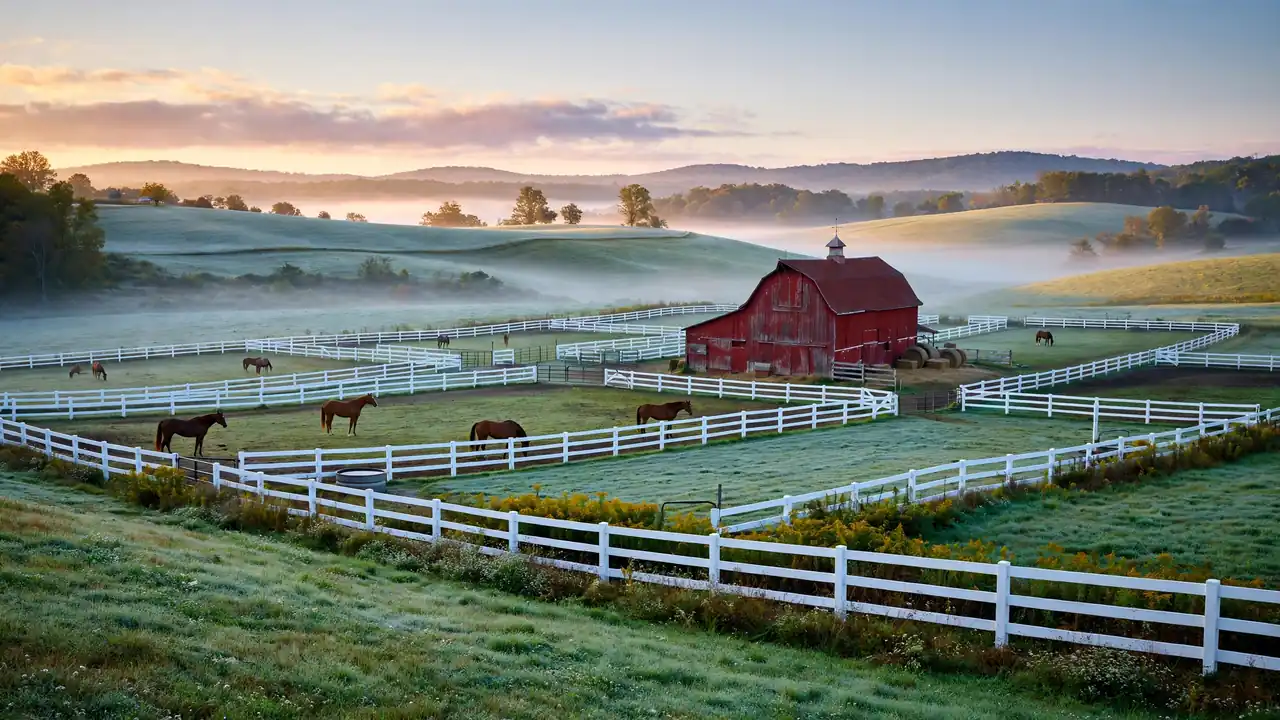
The Bluegrass region around Lexington, Versailles, and Paris is the center of Kentucky’s horse country. Horse farms here combine fenced pastures, barns, and often a home, and their value depends on the land, the improvements, and the operation. Lenders look at pasture quality and fencing, barn condition, water sources, and whether the farm produces income from boarding, breeding, or training. A well-kept horse farm with road frontage and good soil is one of the easier Kentucky properties to finance, while a farm with aging barns and deferred maintenance will cost more to borrow against.
Crop and cattle farmland
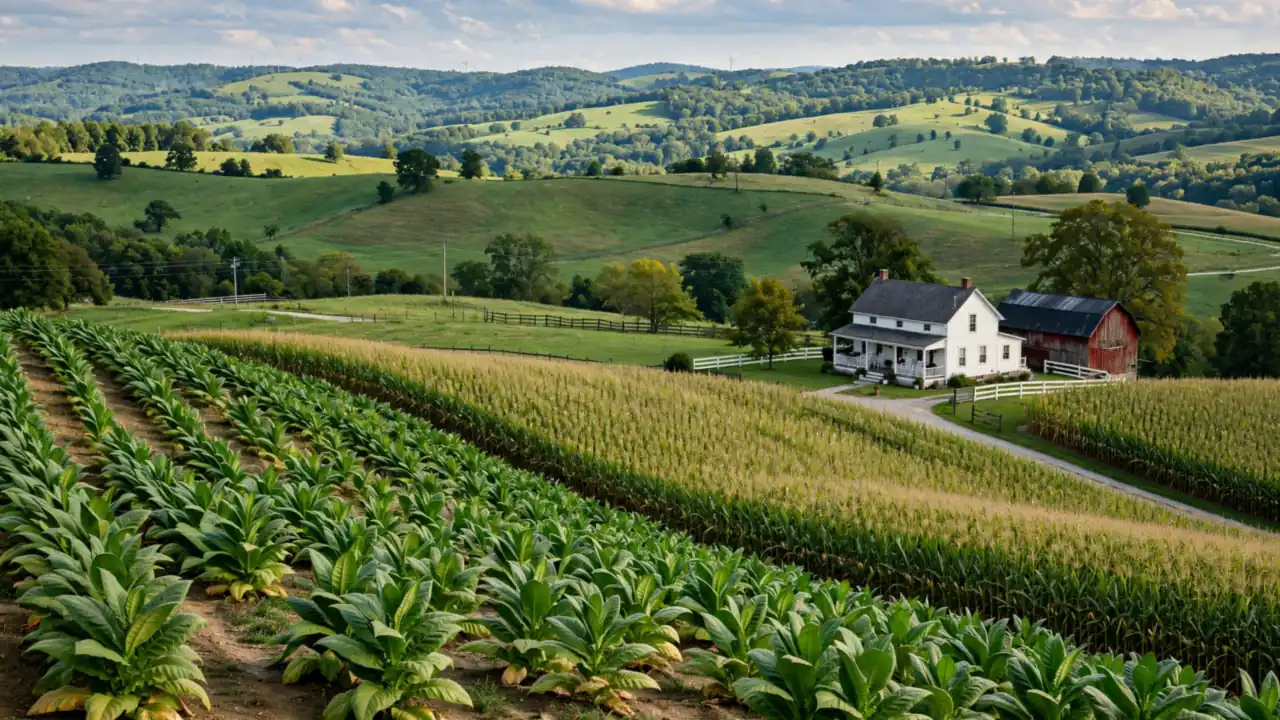
Western Kentucky and the Pennyrile region, around Hopkinsville, Henderson, and Owensboro, hold much of the state’s row-crop and cattle ground. Corn, soybeans, wheat, and tobacco fields sit alongside cattle operations, and these farms often come with outbuildings, grain storage, and fencing. Lenders underwrite them on soil quality, tillable acreage, water, and the farm’s income history. Bring yield records, lease agreements, and any crop insurance history, because a lender will want to see that the farm can service the debt from its own income.
Appalachian mountain and recreational land
Eastern Kentucky, around Pikeville and Hazard and near the Daniel Boone National Forest, offers mountain views, timber, and hunting land. These parcels can be beautiful and cheap per acre, but they are the hardest to finance: steep slopes, limited road access, and few comparable sales. Expect a larger down payment and a shorter term, and expect the lender to ask hard questions about access in bad weather, septic and water, and whether mineral rights are included. A mountain lot with recorded access, a perc approval, and power nearby will finance far more easily than one without them.
Residential lots and small parcels
Lots in or near Kentucky’s growing metros, including Louisville, Lexington, and the northern Kentucky suburbs of Cincinnati, are the easiest land to finance. Many banks offer lot loans for these parcels, and some pair the lot loan with a one-time-close construction loan so you can buy the lot and build the home under a single closing. Ask a lot lender how long you have to start building, what happens if you wait, and whether the lot loan converts to a construction loan or must be refinanced.
Lake and riverfront land
Kentucky’s lakes and rivers, including Kentucky Lake, Lake Barkley, Cave Run Lake, and Dale Hollow Lake, draw buyers looking for waterfront and water-access land. These parcels can be a good investment and a great getaway, but they bring checks that other land does not. Floodplain maps, shoreline rules, and any homeowners association or lake authority restrictions all matter, and a lender will want to know whether the lot has a buildable site above the floodplain. Waterfront lots also appraise differently from inland land, because comparable sales are fewer and the premium for water frontage varies by lake and by season. If the lot is in a subdivision around a lake, ask whether the lot can be financed as a land loan or only as part of a construction loan, and confirm who maintains the road and the water access. A lake lot with recorded access, a perc approval, and a buildable site above the flood line will finance far more easily than a low, flood-prone lot without them.
Best Lenders for Kentucky Land Loans
No single lender is best for every Kentucky buyer. The right lender depends on the land type, the county, your down payment, and whether the land will produce income. Start with the lenders below, then compare at least three written offers.
Farm Credit Mid-America
For farmland and rural property, Farm Credit Mid-America is the lender most Kentucky farmers start with. It serves farmers and rural property owners statewide, with offices in Mt. Sterling, Hopkinsville, Bowling Green, and Elizabethtown, and it offers farm real estate loans plus country home and rural living loans through Rural 1st. Its loan officers work with farm income, which many banks do not underwrite well, and they know Kentucky’s counties and land values firsthand.
Rural 1st
Rural 1st offers bare land loans on 10 or more acres with a fixed rate and as little as 15% down for qualifying borrowers, and Kentucky is one of the 22 states it serves. Rural 1st is a good fit for buyers of larger rural tracts who want a fixed rate and a lender that understands country property. It also finances country homes, construction, and land improvements, so a buyer can work with one lender from the land purchase through the build.
Old National Bank
Old National Bank has a footprint that includes Kentucky and publishes lot lending for buyers in its markets. As a large regional bank, it is worth a call for lots and smaller parcels, alongside a Farm Credit lender, so you can compare a bank’s terms with an agricultural lender’s. Ask about its lot and land loan options for the county where you are buying.
Community banks and credit unions
Community banks in the county where you are buying often know the local market, the planning office, and the appraisers. They can be flexible on unusual parcels, and they keep the decision local. Kentucky credit unions sometimes offer competitive land and lot loans to members, particularly for residential lots and smaller parcels. If you already bank with a credit union, ask what it offers before you shop elsewhere.
Seller financing and USDA programs
Seller financing, where the seller carries a note instead of a bank loan, is common for rural Kentucky land. It can close faster and with fewer property conditions than a bank loan, but it still needs a written agreement, a title search, and a plan for the balloon payment if there is one. For working farms, also ask a lender about USDA Farm Service Agency farm ownership loans, which are designed for farmers and ranchers buying land. The FSA state office for Kentucky is in Lexington at 771 Corporate Drive, Suite 205, and can be reached at 859-224-7601. FSA loan terms change regularly, so confirm current terms with the local FSA office rather than relying on a general guide.
How to Apply for a Kentucky Land Loan
Applying for Kentucky land loans is smoother when you do the property checks before you fall in love with the parcel. Work through the steps below in order.
- Check access, boundaries, and buildability first. Confirm the recorded access, get a survey, and ask the county whether a dwelling is allowed on the parcel.
- Strengthen your credit and down payment position. Aim for a credit score around 680 or higher, gather proof of income and assets, and set aside 20% to 35% for a down payment plus closing costs.
- Compare at least three lenders. Talk to a Farm Credit lender, a community bank or credit union, and a lot lender if you plan to build, and get each offer in writing.
- Get pre-qualified and make a careful offer. Use your pre-qualification to set a realistic budget, then make an offer with contingencies for financing, appraisal, and perc approval. See our guide to land loan pre-approval for what to bring.
- Complete the appraisal, survey, and title work. Order the appraisal early, confirm legal access and boundaries, and clear any title or easement issues, including severed mineral rights.
- Close and plan your site work. Review the loan terms, closing costs, and any balloon or adjustable-rate features before signing. Our guide to the land loan closing process walks through the final steps. After closing, start the well, septic, and access work your building plan needs.
Estimate Your Kentucky Land Payment
Before you make an offer, run the numbers for a few different prices, down payments, and terms. A larger down payment lowers your loan amount and your monthly payment, and a shorter term raises the monthly payment but cuts the total interest you pay.
Try the site’s land loan calculator to test monthly payments, and use the land affordability calculator to see how much land your income can support. Enter the loan amount after your down payment, not the full purchase price, and add property taxes and insurance to get the full monthly cost. For example, on a $300,000 purchase with 25% down, your loan amount is $225,000, and the calculator shows the monthly payment for that loan at the rate and term your lender quotes.
Run the same numbers at a higher rate and a longer term so you know your payment in the worst case, not just the best case. If the payment only works at the lowest rate you have seen, the land is too expensive for your budget.
Kentucky-Specific Things to Check
Kentucky land comes with a few checks that surprise buyers from other states. Work through them before you close, not after.
Real estate transfer tax
Kentucky charges a real estate transfer tax under KRS 142.050 of $0.50 for each $500 of value, which is 0.1 percent. On a $300,000 sale that is $300. The tax is imposed on the grantor, meaning the seller, and it is collected by the county clerk as a prerequisite to recording the deed, once per transaction in the county where the deed is recorded. Your closing statement will show it, but it is a seller cost, not a buyer cost, so do not budget for it as part of your down payment.
Property tax and the PVA
Each county’s Property Valuation Administrator, or PVA, assesses property at fair cash value, and local tax rates vary by county and by taxing district. Ask the county PVA what the current assessment is, what the tax bill has been, and whether any exemptions apply, such as the homestead exemption for an owner-occupied home or the agricultural use-value assessment for qualifying farmland. Kentucky allows qualifying agricultural land to be assessed at its agricultural use value rather than its market value, which can lower the tax bill substantially, so confirm the parcel’s classification with the PVA before you buy.
Kentucky Agricultural Finance Corporation
The Kentucky Agricultural Finance Corporation, or KAFC, offers low-interest loans for Kentucky farmers, including a Beginning Farmer Loan Program, Ag Infrastructure loans, and diversification loans. KAFC works through the Kentucky Department of Agriculture’s Office of Agricultural Policy, and applicants apply through a lending agency. If you are a beginning farmer buying land or improving a farm, ask your lender whether a KAFC loan fits your purchase, and see the Kentucky Ag Finance Corporation loan programs page on kyagr.com.
Mineral rights
Mineral rights are a Kentucky issue that catches buyers off guard, especially in the eastern coalfields and in areas with oil and gas history. In Kentucky, mineral rights can be severed from surface rights, so the deed may not include them. Ask the title company to confirm whether the mineral rights transfer with the land, and read the deed carefully. A lender will also want to know whether mineral rights are included, because severed minerals can affect the value and the appraisal.
Flood zones and septic
Kentucky’s rivers and creeks flood, and many rural parcels are not on a city sewer system. Before you buy, check the flood maps for the parcel, and confirm that you can insure the property at a price you can live with. A perc test or site evaluation shows whether the soil can support a septic system, and a failed perc test can make a lot unbuildable, so get it done before closing, not after. For a deeper look at this topic, see our guide to perc tests for land loans.
USDA Rural Development in Kentucky
USDA Rural Development runs housing and community programs across Kentucky, and its rural housing loans can help some buyers who plan to build a home on the land they purchase. See the USDA Rural Development Kentucky programs page to check which programs serve your county, and ask a lender whether a USDA program fits your plans.
Kentucky Land Loans FAQs
How much down payment do I need for Kentucky land?
Most Kentucky land buyers should plan for 20% to 35% down. Buildable lots near towns are often at the lower end, while raw land, steep mountain parcels, and large farm tracts are usually at the higher end. Rural 1st offers bare land loans on 10 or more acres with as little as 15% down for qualifying borrowers.
Who are the best lenders for land loans in Kentucky?
Farm Credit Mid-America is strong for farmland and rural property statewide, and Rural 1st is a good fit for bare land of 10 or more acres. Community banks and credit unions are worth checking for local knowledge, and Old National Bank also serves Kentucky buyers.
Can I get a land loan for a horse farm in Kentucky?
Yes. Horse farms in the Bluegrass region finance well when the land, fencing, barns, and water sources are in good condition and the operation has a clear income history. Bring records for boarding, breeding, or training income, and confirm the property’s water supply and access before you apply.
What credit score do I need for a Kentucky land loan?
Many lenders look for around 680 or higher. A stronger score, a larger down payment, and a straightforward property can mean better pricing, while a lower score usually means a higher rate or a bigger down payment.
Are mineral rights included with Kentucky land?
Not always. In Kentucky, mineral rights can be severed from surface rights, especially in the eastern coalfields and in areas with oil and gas history. Ask the title company to confirm whether the mineral rights transfer with the land, and read the deed carefully before you close.
Can I finance mountain land in eastern Kentucky?
Yes, but expect a larger down payment and a shorter term. Steep slopes, limited road access, and few comparable sales make mountain parcels harder to appraise and finance. A mountain lot with recorded access, a perc approval, and power nearby will finance far more easily than one without them.
How much is Kentucky’s real estate transfer tax?
Kentucky charges $0.50 for each $500 of value, which is 0.1 percent, so the tax on a $300,000 sale is $300. It is imposed on the seller, the grantor, and it is collected by the county clerk as a prerequisite to recording the deed.
How long does a Kentucky land loan take to close?
Most Kentucky land loans close in 30 to 60 days, although rural appraisals, surveys, and title work can extend the timeline. Ordering the appraisal and survey early, and clearing any title or easement issues quickly, keeps the closing on schedule.
Sources
- Kentucky Revised Statutes 142.050, real estate transfer tax
- Kentucky Department of Agriculture, Kentucky Ag Finance Corporation loan programs
- Farm Credit Mid-America, Mt. Sterling office
- Rural 1st, bare land loans
- USDA Rural Development, Kentucky programs
By Jameel Noori, Founder & Developer, Land Loan Calculator
About the author: Jameel Noori is the Founder & Developer of Land Loan Calculator. He writes practical, U.S.-focused guides on land financing, loan math, and buyer strategy.
Reviewed by: Jameel Noori, Founder & Lead Developer of Land Loan Calculator, reviewed this article for accuracy.
Disclaimer: This article is for informational purposes only and is not financial advice. Land loan rates and terms vary by lender, property, and market conditions. Consult a licensed loan professional before making financing decisions.
