

Land Loan Closing Process: Step by Step

The land loan closing process typically takes 30–60 days and runs through eight clear steps: pre-approval and an offer, a signed purchase agreement, title search and title insurance, survey, appraisal and inspections, underwriting, review of the Closing Disclosure, closing day signing and funding, and finally recording and disbursement. If you understand what happens at each stage, you can spot problems early, answer lender requests quickly, and avoid last-minute delays.
Closing on land is similar to closing on a house, but it is not identical. With vacant land there is no house to inspect, yet the lender still needs confidence in the value, boundaries, access, and legal title of the parcel. That is why surveys, title work, and land-specific checks such as a perc test can matter as much as your credit and income.
This guide walks through the land loan closing process step by step, explains how long each phase usually takes, lists the documents you will need, and flags the issues most likely to slow things down. Use it alongside a land loan calculator to test how your down payment, rate, and term affect your monthly payment before you commit to a purchase.
Land Loan Closing Process: The 8 Steps
1. Get pre-approved and make an offer
Pre-approval comes first for most buyers. A lender reviews your credit, income, debts, and available funds, then tells you how much it may lend and on what general terms. Pre-approval is not a final loan approval, and it does not guarantee the land itself will qualify, but it gives you a realistic price range and shows sellers you are serious.
When you find a parcel you want, work with your agent to make an offer that reflects comparable land sales, access, utilities, zoning, and any known restrictions. Your offer should also set out contingencies, such as financing, title, survey, and inspection contingencies, and a proposed closing date. Contingencies protect you if the land cannot be financed, the title is not clear, or an inspection reveals a serious problem.
2. Sign the purchase agreement
Once the seller accepts your offer, you sign a purchase agreement, also called a sales contract. This is the document that starts the formal closing clock. It states the price, the parcel being sold, earnest money, contingencies, deadlines, and who pays which closing costs.
Read this agreement carefully before you sign. Check the legal description of the land, the closing deadline, and what happens to your earnest money if the deal falls through. If anything is unclear, ask your agent or a real estate attorney to explain it. Small wording differences can matter, especially for access rights, easements, and mineral or water rights.
3. Title search and title insurance
After the contract is signed, a title company or attorney searches public records for the parcel. The search checks who owns the land, whether there are liens, judgments, unpaid taxes, or competing claims, and whether easements or restrictions affect how the land can be used. The goal is to confirm that the seller has the right to sell and that the title can be transferred cleanly to you.
If the search finds a problem, such as an old lien, an unclear inheritance, or a recording error, it must be resolved before closing. This is one of the most common reasons closings are delayed, so it helps to start title work promptly. Land title insurance then protects you and your lender against certain title defects that were not found in the search, subject to the terms of the policy.

4. Survey, appraisal and inspections
A survey confirms where the parcel begins and ends, where any structures, easements, or encroachments sit, and whether the legal description matches the ground. For land, this step can reveal boundary disputes, shared driveways, or access routes that are not obvious from a listing.
An appraisal then estimates the land’s market value for the lender. If the appraisal comes in below the purchase price, the lender may lend less, ask for a larger down payment, or require a price renegotiation. Inspections and land tests add another layer: soil conditions, drainage, flood risk, zoning, and utility access can all affect whether the land is buildable and financeable. Where a septic system is planned, a perc test checks whether the soil can absorb wastewater at an acceptable rate.
5. Underwriting and conditions
Underwriting is the lender’s detailed review of you and the property. The underwriter verifies income, assets, debts, and credit, reviews the appraisal, title commitment, survey, and insurance information, and checks that the loan meets the lender’s land-loan rules. Land loans often carry stricter terms than home loans, including larger down payments and shorter terms, because vacant land is harder to sell if a borrower defaults.
Most files come back with conditions, which are simply items the lender needs before final approval. Common conditions include updated bank statements, proof of funds, an explanation for a large deposit, a corrected document, or a new appraisal detail. Respond promptly and send exactly what was asked for. Sending extra, unclear, or partial documents usually slows the file down rather than speeding it up.
6. Review the Closing Disclosure
Once the loan is cleared to close, you receive a Closing Disclosure. This five-page form sets out the final loan terms, projected monthly payments, and the amount of cash you must bring to closing. Compare it line by line with the Loan Estimate you received earlier in the process. Look for changes in the interest rate, loan amount, monthly payment, and closing costs, and ask your lender about anything you do not understand.
Under federal rules, your lender must give you the Closing Disclosure at least three business days before you close. That waiting period is there so you have time to review the final numbers and ask questions before you sign. The Consumer Financial Protection Bureau (CFPB) explains this rule and what the form contains in its guidance on Closing Disclosures. If a major change is made after you receive the form, such as a change to the annual percentage rate, a prepayment penalty, or the loan product, a new three-business-day review period may be required, so do not assume a late change is harmless.
7. Closing day: signing and funding
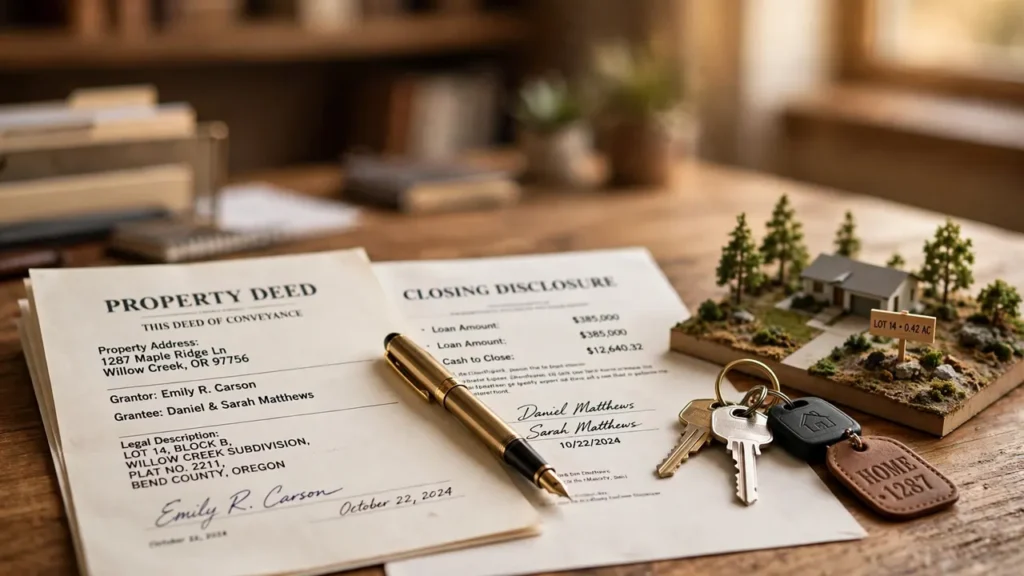
On closing day you sign the loan and transfer documents. These typically include the promissory note, which is your promise to repay the loan, the mortgage or deed of trust, which secures the loan against the land, and the deed transferring ownership to you. You will also sign disclosures, tax forms, and any documents required by your state or closing agent.
Many closings are handled through escrow, where a neutral third party holds funds and documents until all conditions are met, then releases them as instructed. Bring a government-issued photo ID and be ready to provide the funds for your down payment and closing costs, usually by cashier’s check or wire transfer, as your closing agent directs. Do not wire money based on emailed instructions alone: confirm wiring details by phone using a number you already trust, because wire fraud is a real risk at closing.
8. Recording and disbursement
After signing, the deed and mortgage are recorded with the county recorder or equivalent office. Recording makes the transfer public and establishes the order of claims against the property. Once recording is confirmed, funds are disbursed: the seller is paid, the lender’s loan is funded, and any outstanding fees, taxes, or payoffs are settled.
How Long Does the Land Loan Closing Process Take?
For most straightforward land purchases, the land loan closing process takes 30–60 days from a signed purchase agreement to recording. Simpler cash-like files with a clear title and a recent survey can close nearer 30 days. Files with title defects, survey disputes, appraisal problems, or slow third parties can take longer, and rural parcels sometimes need extra time for access, utility, or zoning checks.
| Phase | Typical time |
|---|---|
| Pre-approval, offer and purchase agreement | 1–7 days |
| Title search and title commitment | 1–2 weeks |
| Survey, appraisal and inspections | 1–3 weeks |
| Underwriting and conditions | 1–2 weeks |
| Closing Disclosure review period | At least 3 business days |
| Closing, recording and disbursement | 1–7 days |
| Total | 30–60 days |
Documents You Need for Closing
Gathering documents early is one of the easiest ways to keep a land loan closing on schedule. Your lender and closing agent will tell you exactly what they need, but most buyers should expect to provide the following:
- Government-issued photo ID for every borrower and signer.
- Proof of funds for the down payment and closing costs, such as recent bank statements.
- The signed purchase agreement and any amendments.
- Survey, if required, and any existing boundary or easement documents.
- Insurance binder, where applicable, for structures, liability, or lender-required coverage.
- Tax, income, and asset documents requested during underwriting.
- Homeowners or hazard insurance information if the lender requires it for the parcel or any structure on it.
Keep originals and copies organized, and send documents in the format your lender requests. If a statement is incomplete, a name does not match, or a large deposit is unexplained, expect follow-up questions. Answering those questions the first time, with a short written explanation where needed, saves days of back-and-forth.
Land Loan Closing Costs to Expect
Closing costs are the fees and charges paid at closing in addition to your down payment. For land loans they commonly include lender fees, title and recording fees, appraisal and survey costs, and prepaid items or escrows where required. The exact mix depends on your lender, state, and parcel, so your Loan Estimate and Closing Disclosure are the authoritative sources for your file.
For a full breakdown of the fees you may see, how they are calculated, and ways to review them, see our guide to land closing costs. Reviewing that breakdown before closing day helps you check your Closing Disclosure with confidence and ask informed questions if a fee changes.
What Can Delay a Land Loan Closing?
Delays are common, and most are fixable if they are found early. Title defects, such as liens or unclear ownership, can require extra paperwork or payoff arrangements. Boundary or survey disputes may need a new survey or a legal resolution. Easement and access problems matter because a lender needs to know the parcel can be reached legally and used as intended. Appraisal gaps, missing documents, and slow responses from any party can also push the closing date back. If a delay appears, ask what document or decision will clear it, who owns that item, and by when it can be delivered.
After Closing: Your First Steps as Landowner
Once recording is confirmed, keep your recorded deed and full closing package in a safe place, and set up property tax payments and any required insurance. Confirm the tax billing address with your county, note your first loan payment date, and check whether your lender escrows taxes or insurance. If your finances allow it, you may also want to review how to pay off your land loan early and whether extra payments make sense for your goals.
Land Loan Closing Process FAQs
How long does it take to close on a land loan?
Most land loan closings take 30–60 days from a signed purchase agreement to recording, depending on title, survey, appraisal, and underwriting.
What happens at a land loan closing?
You sign the loan and transfer documents, pay your down payment and closing costs, and funds are released once recording requirements are met.
What documents do I need to close on land?
Typically photo ID, proof of funds, the purchase agreement, survey, insurance binder where applicable, and any documents your lender requests during underwriting.
Who attends the closing?
Usually the buyer, seller or their representatives, a closing agent or attorney, and sometimes a lender representative, depending on your state and closing method.
What is a Closing Disclosure and when do I get it?
It is a five-page form with final loan terms, payments, and cash needed to close. Your lender must give it to you at least three business days before closing.
Can a land loan closing be delayed?
Yes. Title defects, survey or easement issues, appraisal gaps, and missing documents are common causes, and most can be resolved with the right paperwork.
Do I need title insurance to close on land?
Most lenders require a lender’s title policy, and an owner’s policy is commonly recommended to protect your ownership interest against covered title defects.
What happens after closing on a land loan?
The deed and mortgage are recorded, funds are disbursed, and you set up property taxes, insurance, and your first loan payment.
By Jameel Noori, Founder & Developer, Land Loan Calculator
About the author: Jameel Noori is the Founder & Developer of Land Loan Calculator. He writes practical, U.S.-focused guides on land financing, loan math, and buyer strategy.
Reviewed by: Jameel Noori, Founder & Lead Developer of Land Loan Calculator, reviewed this article for accuracy.
Disclaimer: This article is for informational purposes only and is not financial advice. Land loan rates and terms vary by lender, property, and market conditions. Consult a licensed loan professional before making financing decisions.
