

Georgia Land Loans: Requirements, Rates & How to Apply

Short answer: Yes — you can get a land loan in Georgia, and Georgia has some of the strongest farm lenders in the country. Most Georgia land lenders require a credit score of 680 or higher, a down payment of 20–50% depending on the land type, and a debt-to-income ratio under 43–45%. Georgia charges a real estate transfer tax of $1.00 for the first $1,000 plus $0.10 for each additional $100, and farmland and timberland can qualify for Conservation Use Value Assessment, which taxes the land on its current use rather than its market value. Farm Credit associations — AgSouth, AgGeorgia, and Southwest Georgia Farm Credit — finance most Georgia farm and timber land, alongside credit unions and USDA Farm Service Agency loans.
Table of Contents
- Why Georgia Land Loans Are Different
- Georgia Land Loan Requirements
- Types of Georgia Land Loans
- Georgia Land Loan Rates
- Georgia-Specific Things to Check Before You Borrow
- Where You Buy in Georgia Changes the Loan
- Best Georgia Land Loan Lenders
- How to Apply for a Land Loan in Georgia
- Estimate Your Georgia Land Loan Payment
- Costs Beyond the Purchase Price
- Mistakes to Avoid
- Frequently Asked Questions
- Georgia Land Loan Checklist
Why Georgia Land Loans Are Different
Georgia land loans help buyers purchase farmland, timberland, mountain acreage, coastal parcels, and building lots across the Peach State. If you are buying land in Georgia, expect a different process from a standard home mortgage: Georgia land loans usually require a larger down payment, carry a higher interest rate, and place more weight on the land itself.
Several Georgia-specific factors make land financing here distinct. First, Georgia’s Farm Credit system is unusually strong: three Farm Credit associations — AgSouth, AgGeorgia, and Southwest Georgia Farm Credit — divide the state between them and finance farm, timber, and rural land in ways national banks do not. Second, Georgia taxes agricultural, timber, and environmentally sensitive land on its current use value under the Conservation Use Value Assessment (CUVA) program, which can cut the tax bill sharply for qualifying land. Third, Georgia charges a real estate transfer tax on deeds, and an intangible recording tax on the note in owner-financed deals — both belong in your closing budget. And fourth, Georgia’s land is unusually varied: pine timberland in the south, row-crop and poultry country in the middle, mountain land in the north, and coastal parcels near Savannah and Brunswick. Each type finances differently.
The other side of that variety is that no single loan fits every Georgia parcel. A lender will look closely at the land itself, your cash reserves, and your plan for the property before it quotes terms. A productive pine plantation with a timber cruise in place is a very different loan from a steep, wooded 20 acres in the north Georgia mountains with no road frontage. Understand the parcel first, and the financing follows.
Georgia Land Loan Requirements
Georgia lenders underwrite the borrower and the parcel together. A strong application helps, yet a parcel with unclear access, flood risk, or an uncertain appraisal can still slow approval. Lenders want to know that the land is marketable, reachable, and usable for its stated purpose. For the full national picture on credit, income, and down payment standards, see our guide to land loan requirements.
Credit score
Most conventional land lenders in Georgia look for a credit score of typically 680 or higher, with better rates and longer terms for borrowers at 720 and above. Borrowers with lower scores can still be approved in some cases — especially through Farm Credit or USDA programs — but they should expect a larger down payment or a shorter term. Farm Credit associations weigh farm income, production history, and the land’s productive value alongside the credit score, which helps a strong farm operation with a thin credit file. A recent bankruptcy, foreclosure, or pattern of late payments will still stop most applications, whatever the land is worth.
Down payment by land type
Down payments vary sharply by land type, and they are the biggest difference from a home mortgage:
| Land type | Typical down payment |
|---|---|
| Improved land (road access, utilities, well or septic, buildable site) | 20–30% |
| Raw land (may lack utilities, driveway, or perc-approved septic site) | 30–50% |
| Recreational / hunting land (often treated as raw land) | 30–50% |
| Residential lot in or near town | 15–25% |
| Farm / agricultural land (Farm Credit, FSA) | 15–20% |
| Timberland (Farm Credit) | 15–20% |
| Construction-to-permanent (land + build) | 15–30% |
The down payment is not the whole cash requirement. Most Georgia land lenders also want to see reserves — money left over after closing — typically enough to cover several months of payments. A borrower who puts every dollar into the down payment and has nothing left for the appraisal, survey, perc test, and first tax bill looks risky even with a strong credit score.
Debt-to-income ratio (DTI)
Lenders generally want total monthly debts, including the new land payment, taxes, and insurance, to stay within a comfortable share of gross income, commonly around 40–45%, although farm lenders may weigh farm income differently. If your DTI is above 45%, the realistic fixes are paying down revolving debt, documenting additional income, increasing the down payment to shrink the loan, or buying a less expensive parcel.
Income, reserves, and documentation
Expect to provide tax returns, pay stubs, and bank statements. Self-employed buyers and farmers should expect a deeper request: two years of tax returns, profit-and-loss statements, and, for farm loans, a farm business plan or production history. Farm buyers may also be asked about farming experience. Many Georgia land lenders also require reserves of three to six months of payments.
Property access and utilities
The parcel must have legal, year-round road access. A parcel reached only across a neighbor’s land, or by a seasonal track, is a problem for most lenders. Water and wastewater matter too: most rural Georgia land relies on a well and a septic system, and a lender will want to know both are feasible before it commits. Confirm access, water, and septic suitability with the county before you pay for an appraisal.
Appraisal and survey
Every land loan needs an appraisal based on comparable sales, and most lenders require a survey to confirm boundaries and acreage. In Georgia, appraisals can be slow for timberland and mountain parcels, where comparable sales are thin. If the appraisal comes in below the purchase price, the lender lends against the appraised value, not the price — and you cover the gap in cash or renegotiate. Order the appraisal only after the zoning, access, and title checks are done.
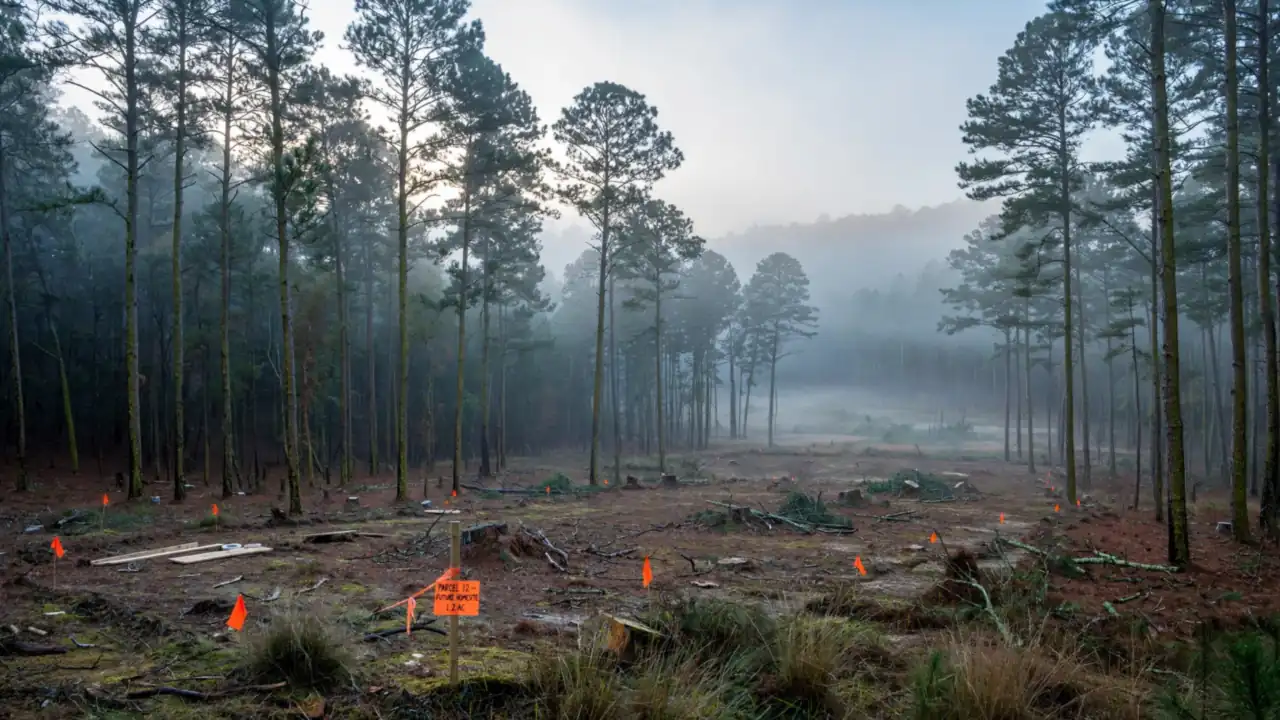
Types of Georgia Land Loans
Georgia offers a wide range of land, and lenders treat each type differently. Where your parcel fits helps you set a realistic budget and choose the right lender.
Pine timberland
Georgia is the leading timber state in the country, and pine plantations in the south are a major land market. Timberland loans are usually written by Farm Credit associations, which understand timber value, harvest cycles, and thinning income. A timber cruise — a professional inventory of the standing timber — is often part of the valuation, and income from a future harvest is rarely counted the same way as farm income. If timber is a major part of the price, talk to a Farm Credit lender experienced with timberland before you offer.
Farmland and poultry land
Central and south Georgia farmland — row crops, peanuts, cotton, and poultry operations — is among the easiest land to finance in the state. Lenders value soil quality, irrigation, drainage, and recent comparable sales, and farm lenders are comfortable underwriting this land when the buyer has farming experience or a tenant farmer in place. Poultry land with houses in place is underwritten on the operation, including integrator contracts, so bring the contract paperwork to the lender.
North Georgia mountain land
Mountain land in the north — Blue Ridge, Dahlonega, Blairsville, Clayton — is popular for cabins, retirement homes, and recreational tracts. These parcels are often steep, wooded, or farther from utilities, so lenders may require a larger down payment and a shorter term. A clear road, a surveyed boundary, and a realistic plan for water and septic make mountain land much easier to approve. Septic can be a particular challenge on steep or rocky ground, so order a perc evaluation early.
Coastal land
Coastal parcels near Savannah, Brunswick, and the Golden Isles command premium prices and bring extra checks: flood zones, marsh buffers, and coastal permitting. Flood insurance and wind coverage can be expensive, and a lender will want to see that the parcel is insurable before it commits. Confirm flood zone status and insurance availability before you make an offer.
Recreational and hunting land
Georgia is a top hunting state, and recreational tracts — deer and turkey hunting, fishing, camping — are a large share of the rural land market. These parcels are often wooded, remote, or lacking utilities, so lenders may require a larger down payment and a shorter term. For the national picture on financing this kind of property, see our guide to recreational land loans.
Construction-to-permanent and owner financing
If you plan to build within a year or two, a construction-to-permanent loan can be the cheapest overall route: one loan covers the land purchase and the build, then converts to a standard mortgage when the home is finished. The lender underwrites the finished home’s value, which is why the down payment (typically 15–30%) is lower than a standalone raw land loan. Seller financing is also common for rural Georgia land, especially in the mountains and for parcels banks find unusual. The seller acts as the lender, terms are negotiable, and the deal is judged mostly on the down payment and the land — but get the contract reviewed, confirm the seller owns the land free and clear, and record the contract. Our land contract calculator can model the payments before you agree to terms. Note that in Georgia, an owner-financed deal secured by a long-term note also triggers the intangible recording tax — see the Georgia-specific section below.
Georgia Land Loan Rates
Land loan rates in Georgia are higher than rates for a primary-home mortgage, and the gap widens as the land gets less developed. That is because vacant land has no structure to insure, no rental income to service the loan, and a thinner resale market if the lender has to foreclose. For current rate ranges by land type, see our regularly updated guide to land loan interest rates — check it before you apply, because rates move and any figure quoted in a guide goes stale fast.
Several factors move your rate. A larger down payment lowers the lender’s risk and can lower the rate. A shorter term, such as 10 or 15 years instead of 20 or 25, often carries a lower rate for a higher monthly payment. Fixed rates give payment certainty, while adjustable rates may start lower but can rise later. Farm Credit associations and community banks that know local land values sometimes offer more competitive terms for agricultural and timber land than a national lender that rarely finances vacant land. Do not compare rates alone. Ask about the term, whether the loan has a balloon payment, prepayment penalties, origination fees, and appraisal and survey costs — a loan that looks cheap on rate but balloons in five years can be riskier than a slightly higher fixed rate with longer amortization.
To see how the rate changes the payment, here are two illustrations. The rates below are assumed figures used only to show the math — they are not quotes and not current market rates. Use the land loan calculator with today’s rates to run your own numbers.
| Scenario | Loan amount | Assumed rate (illustration only) | Term | Monthly payment |
|---|---|---|---|---|
| $300,000 farm/timber purchase, 20% down | $240,000 | 8.00% fixed | 20 years | ≈ $2,007 |
| $100,000 north Georgia mountain parcel, 30% down | $70,000 | 8.50% fixed | 15 years | ≈ $689 |
Two things stand out. First, the down payment is doing a lot of work: the farm buyer borrows $240,000 on a $300,000 purchase and pays about $2,007 a month, while the mountain buyer borrows less than a third as much. Second, the term matters as much as the rate: the 20-year loan’s payment looks manageable, but the total interest paid over 20 years is far higher than over 15. Shorter terms cost more per month and less overall. Choose the term by what your cash flow can carry, not by what makes the monthly payment look smallest — and ask every lender, in writing, whether the loan amortizes fully or has a balloon payment at the end.
Georgia-Specific Things to Check Before You Borrow
These are the Georgia details that catch out-of-state buyers and first-time land buyers. Check each one before you commit to a parcel — they affect the price, the loan, and the cost of holding the land.
Real estate transfer tax
Georgia charges a real estate transfer tax of $1.00 for the first $1,000 of consideration plus $0.10 for each additional $100, when the consideration exceeds $100, under Official Code of Georgia Annotated §48-6-1. The tax is collected by the Clerk of Superior Court as a prerequisite to filing the deed. On a $200,000 land purchase that is $200; on a $500,000 purchase it is $500. Who pays the tax is negotiable in the purchase contract; confirm it in writing so it does not appear as a surprise at the closing table.
Conservation Use Value Assessment (CUVA)
Georgia taxes agricultural, timber, and environmentally sensitive land on its current use value under the Conservation Use Value Assessment program, O.C.G.A. §48-5-7.4. Qualifying land is assessed at 40% of its current use value instead of 40% of its fair market value — a difference that can cut the tax bill sharply on farmland and timberland. The program carries a 10-year covenant, a maximum of 2,000 acres per owner, and a penalty for breaching the covenant: the owner must repay twice the tax savings received. Applications are due to the county board of tax assessors by April 1. Before you buy, confirm whether the parcel is under a CUVA covenant, when the covenant ends, and what happens if your intended use — a house, a subdivision, a commercial use — breaches it. For a farm or timber loan, a CUVA covenant is a plus; for a residential build, it can be a problem.
Intangible recording tax on notes
Georgia also levies an intangible recording tax on notes: $1.50 per $500 of the face amount of a long-term note secured by real estate, under O.C.G.A. §48-6-60 et seq. On a $200,000 note that is $600. This matters most in owner-financed land deals, where the note is a long-term note secured by the land — budget the tax into the closing costs of a seller-financed purchase.
Timber and mineral rights
In Georgia, timber rights and mineral rights are often severed from surface ownership. Confirm in the deed and title search exactly what conveys with the land — a surface purchase that excludes timber or minerals is worth less than one that includes them, and a lender will price it that way. If timber is included, get a timber cruise so the lender can value it; if timber was recently harvested, ask when and whether replanting is required.
Flood zones and septic
Coastal and river-bottom parcels can sit in flood zones, which raises insurance costs and can complicate lending. Much rural Georgia land is not served by public sewer, so a septic system is the norm; soil type, slope, and water table determine whether a standard system will work. A failed perc test can change the buildable area, the cost, or whether the parcel is financeable, so test early when the seller and contract allow it. The Georgia Department of Revenue publishes the state’s tax rules, including transfer tax and CUVA guidance.
Where You Buy in Georgia Changes the Loan
Georgia is not one land market. The lender that is best for south Georgia timberland may not lend at all on a steep mountain parcel, and the terms that work for a lot near Atlanta will not work for coastal land. Local knowledge is the whole game in Georgia land lending.
South Georgia: The southern tier — Valdosta, Albany, Thomasville, Waycross — is pine timber and row-crop country. Farm Credit associations are thick on the ground, comparable sales for farmland and timberland are plentiful, and a timber cruise or a farm plan is part of everyday underwriting. Farm and timber loans here are the most competitive in the state. If you are buying farmland or timberland anywhere in Georgia, start with the Farm Credit association that serves the county.

North Georgia mountains: The Blue Ridge mountains — Dahlonega, Blairsville, Clayton, Ellijay — are the state’s cabin and recreational land heartland. Parcels here are often steep, wooded, or farther from utilities, so lenders may require a larger down payment and a shorter term. A clear road, a surveyed boundary, and a realistic plan for water and septic make a mountain parcel much easier to approve. Septic on steep or rocky ground is the most common surprise — order a perc evaluation during your contingency period.
Coastal Georgia: Savannah, Brunswick, and the Golden Isles have the state’s most expensive land and its strictest extra checks: flood zones, marsh buffers, and coastal permitting. Flood insurance and wind coverage can be expensive, and a lender will want to see that the parcel is insurable before it commits. Confirm flood zone status and insurance availability before you make an offer.
Central Georgia: Macon, Warner Robins, Columbus, and the surrounding counties mix farmland, poultry operations, and growing suburbs. Poultry land with houses in place is underwritten on the operation, including integrator contracts, so bring the contract paperwork to the lender. Lots near growing towns finance on better terms than remote acreage.
Metro Atlanta and the growth corridor: Land near Atlanta, Athens, Gainesville, and the I-85 and I-75 corridors commands premium prices and fierce competition. Zoning and future land use plans matter more here, because a parcel that looks like farmland today may be in the path of development. A pre-approval is essential to be taken seriously, and lot loans from credit unions and community banks are common.
Best Georgia Land Loan Lenders
The best Georgia land loan lender is the one that actually lends on your type of land, in your county, on terms you can live with. That is almost never the biggest bank. These are the lenders Georgia land buyers should quote first.
| Lender | Best for | Key details |
|---|---|---|
| AgSouth Farm Credit | Large acreage, timberland, hunting and recreational tracts, farmland | Statesboro HQ, 100+ years; up to 85% financing, terms up to 20 years |
| AgGeorgia Farm Credit | Land loans in north Georgia | 79-county area; fixed or variable rates, fixed terms up to 20 years, up to 80% financing |
| Southwest Georgia Farm Credit | Farm and rural land in southwest Georgia | Fixed rates up to 30 years, up to 85% financing, no maximum acreage |
| Georgia United Credit Union | Land and lot loans | 170,000+ members; up to 80% financing, flexible terms |
| USDA Farm Service Agency | Farm ownership loans, beginning farmers | Available through local USDA Service Centers statewide |
AgSouth Farm Credit
AgSouth Farm Credit is headquartered in Statesboro and has served the region for more than 100 years. It finances large acreage tracts, timberland, hunting and recreational tracts, farmland, land improvements, construction, small acreage, and residential lots — with up to 85% financing, terms of up to 20 years, and 15 years for lot loans. For farm, timber, and large rural parcels in its territory, AgSouth is usually the first call.
AgGeorgia Farm Credit
AgGeorgia Farm Credit serves a 79-county area in north Georgia. It offers land loans with fixed or variable rates, fixed terms of up to 20 years, and up to 80% financing. If your parcel is in north Georgia — mountain land, farmland, or a lot near a growing town — AgGeorgia is a strong first quote.
Southwest Georgia Farm Credit
Southwest Georgia Farm Credit offers fixed rates for up to 30 years, up to 85% financing, no maximum acreage, no prepayment penalties, and patronage distributions to borrowers. The 30-year fixed term is unusual for land loans and makes it a useful option for buyers who want the lowest possible monthly payment on farm or rural land.
Georgia United Credit Union
Georgia United Credit Union has more than 170,000 members and offers land and lot loans with up to 80% financing and flexible terms. Credit unions often price improved lots and smaller acreage near towns competitively, so confirm acreage limits and maximum terms before you pay for an appraisal.
USDA Farm Service Agency (FSA)
USDA FSA farm ownership loans are available through local USDA Service Centers statewide and are designed for family farmers, including beginning farmers who cannot obtain commercial credit on reasonable terms. FSA loans can carry lower down payments than conventional farm loans, and they are the safety net for buyers the commercial market turns away. The trade-off is paperwork and time: FSA applications take longer than a bank loan, so start early.
Community banks and credit unions
Do not overlook local institutions. Small and regional community banks in rural Georgia often know local land values better than anyone, and they may be more flexible on unusual parcels, local appraisals, and terms that vary widely. If you are buying in a specific county, ask local agents and farmers which banks regularly close land deals there; their answers are worth more than any national ranking.
How to Apply for a Land Loan in Georgia
Land loans take longer than home mortgages. Expect 30–60 days from application to closing for a bank or Farm Credit loan, and longer for an FSA loan. Build that timeline into your purchase contract, and do not waive your financing contingency until the lender has committed.
Step 1: Get pre-approved. Start with a land loan pre-approval so you know what down payment you will need and what payment fits your budget. Pre-approval also signals to sellers that you are a serious buyer.
Step 2: Find the land and verify the basics. Confirm acreage, boundaries, legal access, zoning, flood zone status, CUVA status, and utility options before you offer. Ask for a survey, soil and perc information if septic is planned, and any easements or restrictions.
Step 3: Make an offer with financing contingencies. Include time for appraisal, survey, and loan approval, and be clear about what happens if the appraisal comes in low. A land-savvy agent can help you set realistic timelines.
Step 4: Submit your full application. Expect to provide identification, tax returns, pay stubs or farm income records, bank statements, a purchase agreement, and property details. The lender will order an appraisal and may require a survey, title search, and flood certification.
Step 5: Underwriting and conditions. The underwriter reviews your credit, income, debts, and the appraisal. You may be asked for more documents, a larger down payment if the value is lower than expected, or proof of access and utilities. Respond quickly to keep the timeline on track.
Step 6: Closing. At closing you will sign the note and deed to secure debt, pay closing costs and the down payment — including the transfer tax — and record the transaction. Read our guide to the land loan closing process so you know what to bring and what to check before you sign.
Estimate Your Georgia Land Loan Payment
Before you fall in love with a parcel, run the numbers. A larger down payment, a shorter term, or a lower rate can change your monthly payment by hundreds of dollars, and land loans often have shorter terms than home mortgages, which pushes payments higher.
1. Find the loan amount. Subtract the down payment from the purchase price. On a $200,000 parcel with a 25% down payment, the loan amount is $150,000.
2. Enter the loan amount, rate, and term in the calculator. Use our free land loan calculator to test different purchase prices, down payments, rates, and terms for Georgia land. For a quick monthly estimate, the land payment calculator will show principal and interest on any loan amount. As an illustration only — using an assumed 8.00% fixed rate over 15 years — that $150,000 loan would cost about $1,434 per month in principal and interest.
3. Add the holding costs. The loan payment is not the whole monthly cost. Include property taxes, insurance, and any road maintenance, plus fencing, road maintenance, and utilities for farm and recreational land. A parcel that costs $1,434 a month in loan payments can easily cost $1,750 a month all-in.
4. Stress-test it. Run the payment at a higher rate and a shorter term, and ask whether you could still carry the land if your income dipped or the build took a year longer than planned. Land does not generate income while you hold it, so the payment has to fit your existing cash flow — not a future rent check or a future sale.
Run the numbers before you fall in love with the parcel. The payment tells you whether the land is affordable; the appraisal tells you whether the price is fair. Neither should come as a surprise after you have signed.
Costs Beyond the Purchase Price
The down payment is only the start. Budget for these Georgia land purchase costs before you make an offer — several are due whether or not the loan closes, and the transfer tax and intangible recording tax are ones buyers often forget.
| Cost | Typical range |
|---|---|
| Appraisal | $500–$2,000+ |
| Land survey | $500–$2,500+ |
| Perc test / soil evaluation | $500–$2,000+ |
| Real estate transfer tax | $1.00 per first $1,000 + $0.10 per additional $100 |
| Intangible recording tax on notes | $1.50 per $500 of a long-term note (owner-financed deals) |
| Recording fees | Usually under $200 |
| Title search and insurance | $1,000–$3,000 |
| Escrow and closing fees | $500–$2,000 |
| Loan origination and lender fees | 0.5–2% of the loan |
| Insurance (first year; coastal higher) | $1,000–$4,000+ |
Keep a contingency of at least 5–10% of the purchase price for surprises — a low appraisal, a failed perc test, a boundary dispute, or a well that needs work. Our guide to land survey cost explains what a survey costs and why lenders require one.
Mistakes to Avoid
- Skipping the parcel checks. Buying land before confirming zoning, legal access, flood zone status, CUVA status, and perc suitability is how buyers end up with an unfinanceable parcel.
- Assuming a big bank will lend. National banks rarely finance vacant land — ask AgSouth, AgGeorgia, Southwest Georgia Farm Credit, Georgia United, and community banks first.
- Ignoring CUVA. A Conservation Use Value Assessment covenant restricts the land’s use for 10 years and penalizes breach with twice the tax savings. Check the covenant before you offer.
- Forgetting the transfer tax and intangible recording tax. Budget the transfer tax on the deed and the intangible recording tax on the note in owner-financed deals.
- Accepting a balloon payment without a plan. Know when the balloon hits and how you will pay it — sell, build, or refinance — before you sign.
- Not getting three quotes. Land loan pricing varies widely. One quote is a guess; three quotes are a market.
Frequently Asked Questions
How much is a down payment on land in Georgia?
Expect 15 to 25 percent for a residential lot, 20 to 30 percent for improved land, and 30 to 50 percent for raw land or recreational land. Farm, agricultural, and timber land through Farm Credit or USDA Farm Service Agency can be 15 to 20 percent, and construction-to-permanent loans are typically 15 to 30 percent. Budget reserves on top of the down payment.
What credit score do you need for a land loan in Georgia?
Most Georgia land loans require a credit score of 680 or higher, with the best rates and terms going to borrowers at 720 or above. Farm Credit associations and USDA Farm Service Agency loans can be more flexible on credit, and seller financing may not check your credit at all.
What is the real estate transfer tax in Georgia?
Georgia charges a real estate transfer tax of 1.00 dollar for the first 1,000 dollars of consideration plus 10 cents for each additional 100 dollars, when the consideration exceeds 100 dollars, under Official Code of Georgia Annotated section 48-6-1. The tax is collected by the Clerk of Superior Court as a prerequisite to filing the deed. On a 200,000 dollar purchase that is 200 dollars.
What is CUVA and how does it affect Georgia land taxes?
Conservation Use Value Assessment, under Official Code of Georgia Annotated section 48-5-7.4, lets agricultural, timber, and environmentally sensitive land be assessed at 40 percent of its current use value instead of 40 percent of its fair market value. The program carries a 10-year covenant and a maximum of 2,000 acres per owner, and breaching the covenant means repaying twice the tax savings received. Applications are due to the county board of tax assessors by April 1.
What are current Georgia land loan rates?
Land loan rates change often and vary by credit score, down payment, land type, and term, so check our land loan interest rates page for the current ranges before you apply. In general, land loans price above home mortgage rates, and improved lots price lower than raw land. Get at least three quotes and compare the APR and total cost.
Can you get a land loan in Georgia with bad credit?
It is difficult through a conventional lender, but not always impossible. Options include a larger down payment, seller financing, a USDA Farm Service Agency loan if you farm, or improving your credit score before you apply. No lender will stretch on credit for a parcel it cannot value or resell.
Does Georgia have USDA land loans?
Yes. USDA Farm Service Agency farm ownership loans are available through local USDA Service Centers statewide, including for beginning farmers who cannot get commercial credit on reasonable terms. USDA Rural Development programs can also help eligible rural buyers finance a home with land. Find your local office through the USDA Farm Service Agency.
Do Georgia land loans have balloon payments?
Many do, especially shorter-term land loans and seller-financed deals. With a balloon loan, the remaining balance comes due in full at the end of the term. Ask every lender in writing whether the loan fully amortizes or has a balloon, and have a plan to sell, build, or refinance before it comes due.
Georgia Land Loan Checklist
- Credit score checked; 680 minimum, 720+ for the best terms
- Down payment saved, plus closing costs and three to six months of reserves
- Parcel verified: zoning, legal access, flood zone status, water, septic, perc test
- CUVA covenant status confirmed with the county board of tax assessors
- Transfer tax and intangible recording tax budgeted
- Timber and mineral rights confirmed in the deed and title search
- At least three quotes: AgSouth, AgGeorgia, or Southwest Georgia Farm Credit, plus Georgia United or a community bank
- Pre-approval in hand before making an offer
- Appraisal, survey, and perc test ordered during the contingency period
- Balloon terms, if any, understood in writing
- Payment run through the land loan calculator, including taxes and insurance
By Jameel Noori, Founder & Developer, Land Loan Calculator
About the author: Jameel Noori is the Founder & Developer of Land Loan Calculator. He writes practical, U.S.-focused guides to land financing.
Reviewed by: Jameel Noori, Founder & Lead Developer of Land Loan Calculator, reviewed this article for accuracy.
Disclaimer: This article is for informational purposes only and is not financial advice. Land loan rates and terms change frequently — confirm current rates and requirements with the lender before you apply.
