
VA Land Loans: Financing Options for Veterans

VA land loans are a special corner of the VA home loan program: you cannot use a VA loan to buy land by itself, but you can use VA benefits to finance land plus the construction of your primary residence in one package. In 2026, eligible veterans, active-duty service members, and qualifying surviving spouses have three proven paths to land ownership with VA benefits: a VA construction-to-permanent loan, buying the land with other financing and building with a VA construction loan on land you own, or building with non-VA financing and refinancing into a VA loan after completion. All three come with the VA’s signature benefits — typically $0 down and no private mortgage insurance — but the rules are strict: the finished home must meet VA property standards and you must occupy it as your primary residence.
Table of Contents
- Can You Buy Land With a VA Loan?
- Why VA Loans Can’t Finance Land Alone
- VA Loan Eligibility: Do You Qualify?
- Path 1: VA Construction-to-Permanent Loan
- Path 2: Buy the Land Now, Build With a VA Construction Loan Later
- Path 3: Build With Other Financing, Then Refinance Into a VA Loan
- One-Time Close vs. Two-Time Close
- What the VA Requires: Land & Property Rules
- Builder Requirements
- VA Construction Loan Costs: Funding Fee & Closing Costs
- Credit, Income & Residual Income Requirements
- State Veteran Land Programs Worth Knowing
- When VA Financing Doesn’t Fit: Alternatives for Veterans
- Step by Step: How to Get Started
- Frequently Asked Questions
Can You Buy Land With a VA Loan?
Short answer: not by itself. The Department of Veterans Affairs does not guarantee loans for the purchase of raw land on its own — not for future investment, farming, recreation, or even future home construction. Under federal law, a VA loan can only finance land when the purchase is tied directly to building a dwelling you will own and occupy as your primary residence.
That distinction trips up many veterans. Buying a 10-acre parcel today “because I’ll build in a few years” is a land-only purchase, and it does not qualify — even if you have full VA entitlement available. But buying the land and funding construction as part of the same financing plan is allowed, and that’s where the three paths below come in.
If your timeline has you buying land now and building later, skip to the alternatives section below — a conventional loan for land purchase may be the practical bridge.
Why VA Loans Can’t Finance Land Alone
The VA home loan program exists to help eligible borrowers secure a primary residence, not to fund land speculation or investment acreage. The statute authorizes VA-guaranteed loans “to purchase or construct a dwelling to be owned and occupied by the veteran as a home” (38 U.S.C. §3710), and VA regulations define “residential property” to include land only when it is bought out of the proceeds of a loan for constructing a dwelling on that same parcel, on which the dwelling is to be erected (38 CFR 36.4301).
Two practical consequences follow:
- Land and construction must be one package. You cannot close on an empty lot today and start building next year. The land purchase and the construction contract are part of a single financing, with building scheduled to begin promptly after closing.
- You must move in. The VA expects you to occupy the finished home as your primary residence, generally within 60 days of completion. Military orders or unusual circumstances can justify a delay, but anything much beyond 12 months is considered unreasonable. Buying land to hold, subdivide, flip, or rent out is entirely outside the program.
VA Loan Eligibility: Do You Qualify?
Before chasing a VA construction loan, confirm your eligibility with a Certificate of Eligibility (COE) — requested through VA Form 26-1880 or online at VA.gov. Most lenders can pull your COE in minutes once you apply. Broadly, you qualify if you meet one of these service profiles and have a discharge that is not dishonorable:
| Service profile | Typical service requirement |
|---|---|
| Active-duty service members | 90 continuous days |
| Veterans (wartime service) | 90 days of active service |
| Veterans (peacetime service) | 181 days of active service |
| National Guard / Reserves | 6 years of service, or 90 days under federal orders |
| Surviving spouses | Of a service member who died in service, or a veteran whose death was service-connected |
Using your VA benefit on a land-and-construction deal uses your entitlement just like any VA home purchase. If you still have a VA loan on an existing home, you may need remaining or bonus entitlement to proceed — ask your lender to check this before you commit to a lot. For an unbiased walkthrough of VA loan basics, the Consumer Financial Protection Bureau maintains plain-language borrower guides.
Path 1: VA Construction-to-Permanent Loan
This is the most direct route: one loan covers the land purchase and the construction of your home, then converts to a standard permanent VA mortgage when the build is done. You keep the VA’s core benefits — usually $0 down, no private mortgage insurance, and competitive fixed rates — across both phases.
During construction, you typically pay interest only on the amounts drawn, and full principal-and-interest payments begin once the home is complete and you’ve moved in. The catch: few VA lenders actually offer this product. Construction lending is riskier and more complex than purchase lending, so most VA-approved lenders stick to existing homes. Finding one experienced in VA construction is the single biggest practical hurdle on this path — start with lenders who advertise VA construction products specifically, not just VA loans generally.
When it fits: you have a lot (or a target lot), a builder, and approved plans, and you’re ready to build within weeks or months of closing.
Path 2: Buy the Land Now, Build With a VA Construction Loan Later
If you already own the lot — bought with cash, savings, or a conventional land loan — you can take out a VA construction loan to build on land you own. The land’s value (or the equity you hold in it) can count toward your investment in the project, and the finished home still gets VA financing with the same $0-down and no-PMI benefits.
This path solves the timing problem: you secure the parcel when the right one appears, then arrange construction financing when plans and builder are ready. One wrinkle — the land purchase and the construction loan are separate transactions, so you may temporarily carry two obligations. If you financed the land with a conventional loan, some VA construction lenders will roll the land balance into the construction loan so everything consolidates at completion.
When it fits: you already own land, or found the perfect parcel but aren’t ready to break ground yet.
Path 3: Build With Other Financing, Then Refinance Into a VA Loan
Buy the land and build the home with whatever financing you can get — cash, a conventional land loan, a standard construction loan, or seller financing — and once the home is complete and occupied, refinance into a VA loan with a VA cash-out or Interest Rate Reduction loan. This rolls your land cost and construction cost into one permanent VA mortgage.
Because the VA loan enters only after a finished, occupied home exists, this path sidesteps the complexity of VA construction lending entirely — any VA lender can handle the refinance. The trade-off: you pay twice on closing costs (the construction financing plus the VA refinance), and you carry non-VA financing during construction. Run the combined cost before assuming it’s cheaper.
When it fits: you can’t find a VA construction lender, or your builder/lender can’t meet VA requirements.
One-Time Close vs. Two-Time Close
| Feature | One-time close (construction-to-permanent) | Two-time close |
|---|---|---|
| Closings | One — land + construction + permanent mortgage together | Two — a short-term construction loan, then a separate permanent VA loan |
| Rate lock | Locked at the start for the whole project | Rate set at the second closing (conversion) |
| Closing costs | Paid once | Paid twice |
| Lender availability | Rarest; few VA lenders offer it | More lenders can do this |
| Risk | You lock a rate months before completion | Rate may move before conversion |
Ask lenders upfront which structure they offer and how they handle cost overruns, builder delays, and appraisal shortfalls mid-construction — these are where VA construction deals most often stall.
What the VA Requires: Land & Property Rules
The VA underwrites the project, not just the borrower. Expect every one of these to be checked:
- VA appraisal with a Notice of Value (NOV). A VA-approved appraiser values the completed home and the land together. The VA issues a Notice of Value — if it comes in below your total project cost, you must cover the gap in cash or renegotiate; the VA won’t guarantee more than the reasonable value.
- Minimum Property Requirements (MPRs). The finished home must be safe, sound, and sanitary: adequate roofing, functioning mechanical systems, safe water and sewage, no lead-based paint hazards, and no serious structural or moisture issues. The appraiser inspects for these, and failing items must be corrected before the loan can proceed.
- Reasonable acreage. The VA doesn’t set a hard acreage limit, but the lot should be a typical size for the area and use. A 40-acre hobby farm under the house’s value may be fine; a 500-acre tract where the land dwarfs the home’s value can draw questions, because the program finances residences, not land banks.
- Zoning and legal access. Your intended home must be allowed under current zoning, and the parcel needs legal, permanent access — landlocked parcels are close to unfinanceable under any program.
- Flood zones and wetlands. Check FEMA maps before you commit. Building in a Special Flood Hazard Area triggers mandatory flood insurance and can complicate or kill the deal.
- Utilities and septic. City utilities or approved well/septic — a failed perc test can make a parcel unbuildable.
Builder Requirements
VA construction loans require a builder the VA (or lender) accepts. At minimum, your builder needs to be a licensed, insured contractor with a track record of completed homes — some lenders require builders to be specifically registered with the VA. Your builder must work from VA-acceptable plans and specifications, build to local codes plus VA standards, and provide builder warranties. If your chosen builder can’t or won’t meet these requirements, the loan can’t proceed — which is why Path 3 exists.

VA Construction Loan Costs: Funding Fee & Closing Costs
The VA charges a funding fee on most VA loans — it keeps the program self-funded — and construction loans are no exception. The fee is a percentage of the loan amount and can usually be rolled into the loan balance:
| Usage | Down payment | Funding fee |
|---|---|---|
| First use | $0 | 2.15% |
| First use | 5% | 1.50% |
| First use | 10%+ | 1.25% |
| Subsequent use | $0 | 3.30% |
| Subsequent use | 5% | 1.75% |
| Subsequent use | 10%+ | 1.50% |
Exemptions: veterans receiving VA compensation for a service-connected disability — and some surviving spouses — pay no funding fee at all. If you’re mid-claim for disability compensation, ask your lender about a funding-fee refund, which the VA issues if your claim is approved with a retroactive effective date.
Beyond the funding fee, budget for standard closing costs: the VA appraisal, title search and insurance, recording fees, and construction-specific items like inspections at each draw and a survey. The VA caps certain fees lenders can charge veterans, which keeps costs predictable — get a full Loan Estimate and compare at least three lenders, since construction overlays vary widely. Our land closing costs guide covers the land-side fees in detail.
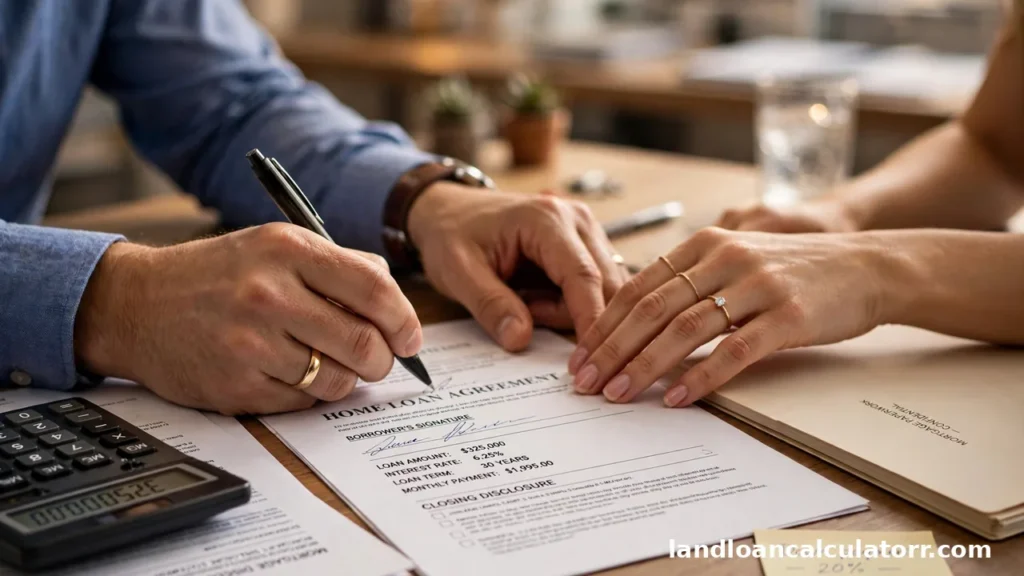
Worked example: $360,000 project
A veteran with first-time entitlement buys a lot for $80,000 and contracts a build for $280,000 — total project $360,000, $0 down, 30-year fixed at 6.5%. The funding fee at 2.15% is $7,740, typically rolled into the loan for a balance of about $367,740 and a principal-and-interest payment of roughly $2,275–$2,325 per month. (Taxes, insurance, and any HOA dues are on top.) Model your own numbers with our land loan calculator before committing.
Credit, Income & Residual Income Requirements
The VA sets no minimum credit score — lenders do. Most VA construction lenders want to see 620–660+, and the scarce lenders offering one-time-close construction products often want 680+ with strong reserves. Two requirements are uniquely VA:
- Residual income. The VA requires enough leftover income each month — after all debts, taxes, and living expenses — to support your family size and region. These are hard guidelines, not suggestions, and they’re the most common reason otherwise-qualified borrowers are declined.
- Occupancy certification. You’ll certify at application and again at closing that you intend to occupy the home as your primary residence.
Debt-to-income ratios are evaluated more flexibly than with conventional loans, but construction lenders still apply their own overlays. For how lenders judge the rest of your file, see our land loan requirements guide.
State Veteran Land Programs Worth Knowing
Some states run their own veteran land programs that can work alongside or instead of federal VA benefits:
- Texas Veterans Land Board (VLB). The only program of its kind in the nation: eligible Texas veterans and military members can borrow up to $150,000 to buy land — tracts of one acre or more — with a minimum 5% down payment, a fixed 30-year rate, and no prepayment penalty. (Dual-spouse veteran couples can borrow up to $225,000.) The land must be in Texas and not for commercial use. Many Texas veterans use a VLB land loan to secure the parcel, then a VA construction loan to build. Details: glo.texas.gov/land-loans. Also see our Texas land loan guide.
- Oregon (ODVA). The Oregon Department of Veterans’ Affairs runs a state home loan program with below-market fixed rates for Oregon veterans, which can finance land-and-construction purchases for eligible borrowers.
- Other states. Several states offer veteran down-payment assistance, property-tax exemptions, or bond-funded loan programs that pair with VA financing. Check your state veterans affairs office — these programs change often and are easy to miss.
When VA Financing Doesn’t Fit: Alternatives for Veterans
Sometimes the honest answer is that VA financing isn’t the right tool — you want land without building, you can’t find a VA construction lender, or your builder won’t meet VA requirements. Veterans have the same backup options as everyone else:
- Conventional land loan. The standard route for buying land with no immediate construction plans: 20–50% down depending on land type, 10- to 20-year terms. See our loan for land purchase guide for how these compare.
- USDA and FSA loans. If the land will be farmland, USDA Farm Service Agency farm ownership loans offer up to 100% financing for eligible farmers — compare the trade-offs in our USDA vs land loan guide.
- Seller financing / land contract. Flexible qualification and negotiable terms, with no bank involved — have an attorney review the contract and model the payments with our land contract calculator.
- State veteran programs (above), which in Texas specifically finance land-only purchases for veterans.
- Cash, then refinance. Buy the land outright, then use Path 3 above to roll everything into a VA loan after the build.
Whichever bridge you choose, affordability comes first — run your numbers with our how much land can I afford guide before you shop.
Step by Step: How to Get Started
- Confirm eligibility. Get your Certificate of Eligibility (COE) via VA Form 26-1880 or VA.gov — most lenders can pull it in minutes.
- Decide your path. Building now (Path 1 or 2) or buying land first (Path 2 or 3, or a conventional bridge loan)?
- Find a VA construction lender. Ask specifically about VA construction products — one-time vs two-time close, builder requirements, credit overlays. Get at least three quotes.
- Lock in a VA-acceptable builder. Licensed, insured, experienced — and willing to meet VA plan and warranty requirements.
- Vet the land. Survey, zoning, legal access, flood maps, utilities, perc test — before you’re committed, not after. Typical approval timelines run 30–60 days once a complete file is in (see our land loan approval timeline).
- Order the VA appraisal. The Notice of Value sets the ceiling — have a plan for an appraisal gap.
- Close, build, move in. Interest-only during construction, then full payments — and occupancy as your primary residence.
Frequently Asked Questions
Can a VA loan be used to buy land only?
No. VA loans cannot finance land by itself — not for investment, farming, recreation, or future construction. The land purchase must be tied to the immediate construction of a primary residence as part of the same financing.
Can you buy land and build a house with a VA loan?
Yes — through a VA construction loan that bundles the land cost and construction cost into one package. Options include a construction-to-permanent loan, a VA construction loan on land you already own, or building with other financing and refinancing into a VA loan afterward.
What is the VA funding fee on a construction loan?
For first-time use with $0 down it’s 2.15% of the loan amount; with subsequent use it’s 3.30%. Putting 5% down drops it to 1.50% (first use). Veterans with a service-connected disability rating are exempt from the fee entirely.
Do VA construction loans require a down payment?
Usually not — $0 down is the norm, the same as a standard VA purchase loan. Some lenders add their own down-payment overlays on construction products, so compare quotes.
What credit score do you need for a VA construction loan?
The VA sets no minimum, but lenders typically require 620–660+, with one-time-close construction products often requiring 680+ plus reserves. The VA’s residual income guideline is evaluated separately and is a common decline reason.
Can a surviving spouse use a VA loan for land?
Eligible surviving spouses of service members who died in service, or of veterans whose deaths were service-connected, generally have the same VA loan eligibility — including for land-plus-construction financing.
How long does a VA construction loan take to close?
Expect 45–90 days from complete application to closing — longer than a standard VA purchase because of plan review, the VA appraisal and Notice of Value, and builder approval. Delays usually come from incomplete plans or appraisal issues.
Can I use a VA loan to buy farmland or investment land?
No. VA loans finance primary residences only. Farmland without an immediate home build doesn’t qualify — look at USDA FSA farm ownership loans or conventional land loans instead.
By Jameel Noori, Founder & Developer, Land Loan Calculator
About the author: Jameel Noori is the Founder & Developer of Land Loan Calculator. He writes practical, U.S.-focused guides on land financing, loan math, and buyer strategy.
Reviewed by: Jameel Noori, Founder & Lead Developer of Land Loan Calculator, reviewed this article for accuracy.
Disclaimer: This article is for informational purposes only and is not financial adv
