
North Dakota Land Loans: Requirements, Rates & Lenders

Yes — you can get a North Dakota land loan for Red River Valley cropland, central small-grain and sunflower ground, pastureland, and western badlands ranch land, but expect a larger down payment and a closer look at the land itself than a regular home mortgage gets. Most North Dakota land lenders want a credit score around 680 or higher and 20% to 35% down, and the parcel must have documented legal access, a workable water plan, and an appraisal that supports the price you are paying. This guide explains North Dakota land loan requirements, typical rates, the kinds of land you will find, the lenders most likely to finance them, and the North Dakota-specific checks — the ban on transfer taxes, productivity-based farm taxation, and severed mineral rights — that catch buyers off guard.
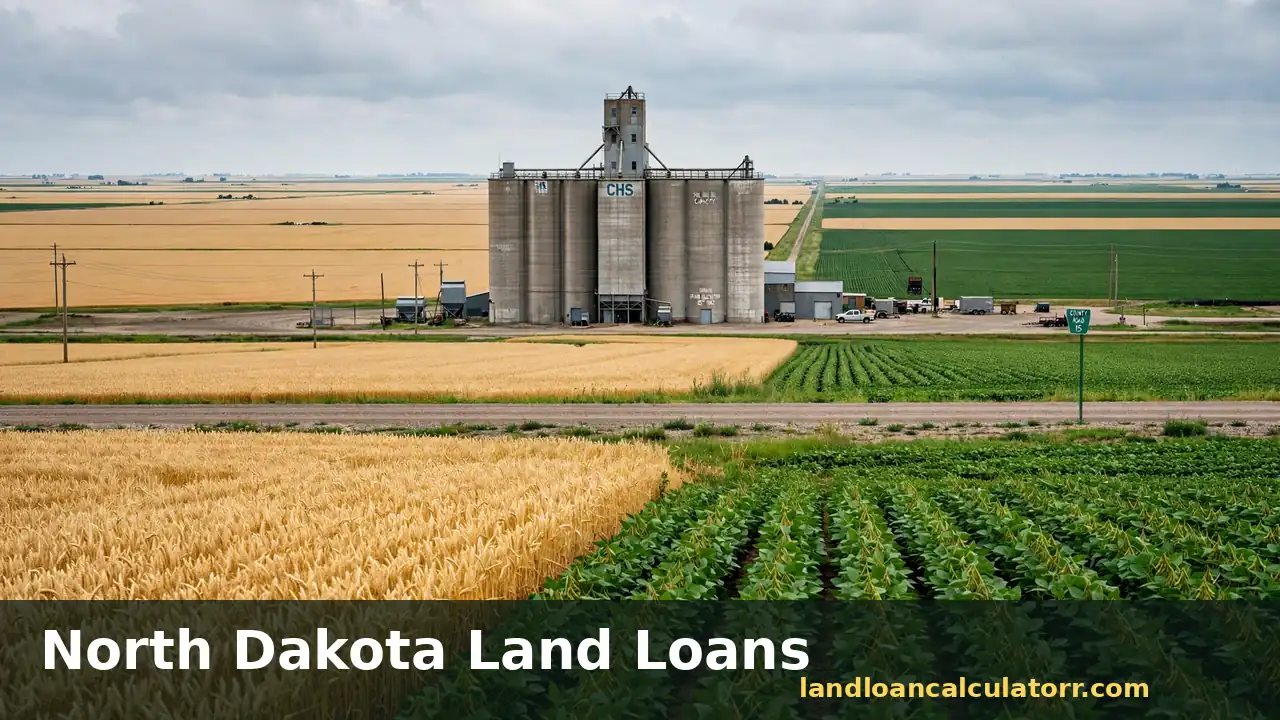
North Dakota is one of the most agricultural states in the U.S. Red River Valley cropland in the east is among the most productive on earth, the center is prairie pothole small-grain country, and the west is badlands ranch country touched by the Bakken oil patch. That variety is exactly why North Dakota land loans are not one-size-fits-all: a lender underwrites a Fargo-area sugarbeet quarter very differently from a remote grazing parcel near Medora. The good news is that North Dakota has deep agricultural lending expertise, a state-owned bank with farm programs, and Farm Credit associations that know local soils, yields, and water issues firsthand.
North Dakota Land Loan Requirements
Most North Dakota land lenders start with the same five questions: Can you repay the loan? How much cash are you putting in? Is the land legally accessible? Can it be used as you plan? And what is it really worth? Your answers shape the rate, term, and down payment you are offered.
Credit score
Credit is the first filter. Many land lenders look for a credit score around 680 or higher, although strong farm lenders may work with slightly lower scores when the borrower has solid cash flow, a large down payment, or a long farming history. A score below that range does not automatically disqualify you, but it often means a higher rate, a larger down payment, or a shorter term. Before you apply, pull your credit reports, fix any errors, and avoid opening new credit accounts or making large purchases on credit while your application is in progress. A score in the 700s will usually open up more lenders and better pricing, and a score below 660 will narrow your options to agricultural lenders and seller financing in most cases.
Down payment
Down payment is where land loans differ most from home mortgages. Expect 20 to 35 percent down, depending on land type. Productive, income-producing cropland with a proven yield history is usually at the lower end of that range. Raw, unimproved, recreational, or remote ranch land often requires 30 to 35 percent or more, because it is harder to resell if the loan defaults. AgCountry Farm Credit Services notes a typical down payment of 35% on new land purchases, which is a useful benchmark for farmland. The table below shows the typical range by parcel type.
| Parcel type | Typical down payment | What lenders weigh most |
|---|---|---|
| Red River Valley cropland | 20% to 35% | Soil, yields, drainage, comparable sales |
| Central small-grain and pastureland | 25% to 35% | Yields, rainfall, carrying capacity |
| Western badlands ranch land | 30% to 35% | Carrying capacity, water, mineral rights |
| Raw or unimproved land | 30% to 35% | Legal access, survey, utilities plan |
| Recreational and hunting land | 30% to 35% | Access, wildlife habitat, comparable sales |
Debt-to-income ratio and income documentation
Lenders also measure your debt-to-income ratio, or DTI. They add up your housing, loan, and other recurring debts and compare that total with your gross income. Farm income is reviewed over several years, not just one good season, because commodity prices and weather swing widely in North Dakota. Keep tax returns, profit-and-loss statements, and bank statements ready. A DTI below 43% is a common target, and several months of cash reserves can help, especially if you plan to carry the land while you develop it or while a crop cycle plays out. Self-employed buyers and farmers should expect to document two years of income, and a lender may average farm income across good and bad years rather than taking your best year at face value.
Legal access, utilities, and appraisal
Documented legal access is non-negotiable. A parcel that looks perfect on a map can be unfinanceable if you must cross a neighbor’s land without a recorded easement. Lenders want to see a clear legal description, a survey or plat where required, road access, and a utilities plan — including water, power, septic, and, for a building site, a realistic path to a well or rural water connection. Finally, expect an appraisal. The appraiser will compare your parcel with recent sales of similar land, consider soil quality, drainage, tillable acres, and improvements, and flag issues such as flood risk, easements, or severed mineral rights. If the appraisal comes in below the purchase price, you will usually need more cash, a lower price, or a different structure.
Documents to gather before you apply
- Government-issued ID and your Social Security number for the credit check
- Two years of federal tax returns and recent pay stubs, or farm profit-and-loss statements if you are self-employed
- Two to three months of bank statements showing your down payment and reserves
- Purchase agreement or the parcel’s legal description, parcel number, and county
- Survey, title commitment, and zoning confirmation from the county planning office
- Well and septic records, or soil and percolation test results for unimproved land
- Mineral-rights and easement documents, and any crop-share or grazing leases on the land
North Dakota Land Loan Rates
Land loan rates in North Dakota are usually higher than home mortgage rates. Lenders price the extra risk of vacant or agricultural land, the longer time it can take to sell, and the volatility of farm income. That said, productive North Dakota cropland often earns better pricing than raw recreational land, because it produces income and has a deep resale market.
As a general pattern, expect the lowest land rates on strong, income-producing cropland with a large down payment and excellent credit. Expect higher rates on unimproved land, land without utilities, and parcels with limited access or unusual title issues. Fixed-rate terms are often shorter than a 30-year mortgage, while adjustable or intermediate terms — commonly 15 to 25 years with a balloon or reset — are also common.
Rates also move with national patterns: when benchmark interest rates rise, land loan rates rise with them, and when they fall, land pricing usually follows. Your credit score, down payment, loan-to-value ratio, and the property itself can matter as much as the national rate environment. For the latest national context, compare current land loan rates and then ask North Dakota lenders for a quote on your specific parcel. A quote tied to a real property, price, and down payment is far more useful than a general rate range, so also ask about fees, prepayment penalties, and whether the rate resets.
| What changes your rate | Lower rate | Higher rate |
|---|---|---|
| Land type | Productive Red River Valley cropland | Raw, recreational, or remote ranch land |
| Down payment | 35% down or more | Minimum 20% down |
| Credit score | 740 or higher | Below 680 |
| Loan term | 10- or 15-year term | 30-year term with balloon |
| Income from the land | Strong crop or cash-rent history | No income, no utilities, severed minerals |
Rates change with the wider market, so treat any range you see online as a starting point, not a quote. Ask each lender whether the rate is fixed or adjustable, whether there is a prepayment penalty, whether the loan can roll into a construction loan later, and what fees are charged on top of the rate. Two offers with the same rate can still differ by thousands of dollars once origination fees, appraisal costs, and survey charges are added.
Types of Land in North Dakota
North Dakota falls into three broad regions, and each one attracts different buyers and lenders. Understanding which region your parcel sits in helps you judge its value, its income potential, and the questions a lender will ask.
Red River Valley Cropland
The Red River Valley, along the state’s eastern edge, holds deep, fertile soils and a long growing tradition of wheat, soybeans, corn, sugarbeets, and potatoes. Land here is often the most expensive per acre in the state, because yields are high, drainage and irrigation infrastructure is well developed, and buyers compete for a limited supply of prime acres.
Central Small-Grain, Sunflower, Prairie Pothole Country

Central North Dakota is small-grain and sunflower country, dotted with prairie potholes — shallow wetlands that are vital for waterfowl and water storage. Farms here are often larger and more diversified, combining wheat, barley, canola, sunflowers, and cattle. Prices per acre are generally lower than in the Red River Valley, which can make central North Dakota attractive to beginning farmers, although rainfall is less certain and some pothole acres cannot be drained or cropped.
Western Badlands Ranch Land

Western North Dakota is badlands ranch country: rugged buttes, coulees, native grass, and wide-open grazing land, much of it near Theodore Roosevelt National Park and the Little Missouri River. Ranch land here is valued less by crop yield and more by carrying capacity — how many animal units it can support — plus water, fencing, and proximity to winter shelter. The Bakken oil patch also raises questions about mineral ownership and surface use agreements on some parcels.
Pastureland and recreational land
Pastureland and recreational ground round out the market. Pasture parcels often sit alongside cropland and are valued for grazing and hay, while recreational and hunting parcels — river bottoms, pothole country, and badlands edges — are valued for wildlife, water, and access. These parcels are the hardest to finance through a standard lender: no farm income, seasonal use, and few comparable sales. Expect a larger down payment, and look first at local banks and Farm Credit associations that know the area.
Best Lenders for North Dakota Land Loans
There is no single best lender for every North Dakota land buyer. The right choice depends on whether you are farming the land, buying a ranch, building later, or investing. Start with lenders that already understand North Dakota agriculture, then compare at least two or three offers. The three lenders below all have confirmed, live land-loan pages and North Dakota-specific programs. Get a written quote from at least two of them before you commit.
| Lender | Best for | Key terms |
|---|---|---|
| Bank of North Dakota — Beginning Farmer Real Estate Loan | First-time farmers with net worth under $1,500,000 | $1,200,000 lifetime cap per borrower; up to 75% of appraised value; max 30 years; rate 1.00% below BND base rate for 10 years |
| Bank of North Dakota — Established Farmer Real Estate Loan | Experienced farmers expanding | Up to $6,000,000 per borrower; up to 65% of appraised value; max 25 years; market rate, fixed or variable |
| AgCountry Farm Credit Services | Farmland, pastureland, and other ag ground | Long-term fixed, interim-fixed, and variable options; payments matched to income flow; typical down payment 35% on new purchases; HQ Fargo |
| Town & Country Credit Union | Long-term ag real estate financing | 3–25 year terms; fixed and variable rates; offices in Minot, Fargo, Stanley, Kenmare |
Bank of North Dakota (BND). The Bank of North Dakota is the nation’s only state-owned bank, and it supports agriculture through lending programs delivered in partnership with local financial institutions. Its Beginning Farmer Real Estate Loan is for buyers with a net worth under $1,500,000: a $1,200,000 lifetime cap per borrower, up to 75% of appraised value, a maximum term of 30 years, and a rate 1.00% below the BND base rate for 10 years. Its Established Farmer Real Estate Loan offers up to $6,000,000 per borrower, up to 65% of appraised value, a maximum term of 25 years, at a market rate, fixed or variable. Ask a participating local lender how a Bank of North Dakota program might apply to your purchase, rather than assuming it replaces a primary land loan. BND’s role is to support agricultural lending in the state, and its real-estate programs are delivered through participating local banks.
AgCountry Farm Credit Services. AgCountry Farm Credit Services offers Land Loans for farmland, pastureland, and other agricultural ground in North Dakota, Minnesota, and Wisconsin, with long-term fixed, interim-fixed, and variable options, payments matched to income flow, and a typical down payment of 35% on new purchases. AgCountry is headquartered in Fargo, North Dakota. Farm Credit lenders are cooperatives owned by their borrowers, and they combine local knowledge with competitive farm loan terms and patronage benefits for eligible members. Note: Farm Credit Services of America serves Iowa, Nebraska, South Dakota, and Wyoming — North Dakota is served by AgCountry Farm Credit Services, not by Farm Credit Services of America.
Town & Country Credit Union. Town & Country Credit Union’s Agriculture Loans offer long-term agricultural real estate financing with 3–25 year terms and fixed and variable rates, with offices in Minot, Fargo, Stanley, and Kenmare. That local footprint matters: the lender knows the land in its own service area and can underwrite a parcel that a distant lender’s automated system would reject.
Beyond these three, community banks in Fargo, Bismarck, Grand Forks, Minot, Dickinson, and smaller farm towns often know the local land market section by section. A community bank may be more flexible on a mixed-use parcel, a building site, or a purchase that combines cropland and pasture, and local decision-makers often answer faster on unusual properties. Credit unions can offer competitive rates and a personal approach, particularly for members buying a homesite or recreational property, though they may be less suited to large farm loans where specialized farm underwriting matters. National land lenders specialize in vacant and recreational land across many states. They can be useful when local lenders are cautious about a remote or unusual parcel, or when you want a longer term or a streamlined online process. Compare their fees and prepayment terms carefully, because specialization does not always mean the lowest total cost. Seller financing, also called a contract for deed, is common in North Dakota farm sales, especially when the seller is retiring and the buyer is a neighbor or family member. The seller acts as the lender, and the buyer makes payments over an agreed term. This can help when a traditional lender is cautious about a parcel’s value or title, but get the terms — rate, balloon payment, and what happens on default — reviewed carefully by an attorney before signing.
How to Apply for a North Dakota Land Loan
Applying for a North Dakota land loan is straightforward if you work in order, but it takes longer than a home purchase loan, mostly because the land itself needs more checking. Plan on 30 to 60 days from application to closing, and longer if the appraisal, mineral-rights review, or title work runs into problems.
- Define your budget and land type. Decide whether you want cropland, pasture, ranch land, or a future building site, and set a maximum price and price per acre based on income, not just asking price.
- Check your credit and gather documents. Review your credit report, collect tax returns, bank statements, and income records, and estimate your down payment and closing costs.
- Get pre-qualified with two or three lenders. Compare AgCountry, community banks, and other ag lenders on rate, term, fees, and how they treat your specific land type.
- Make an offer with financing contingencies. Include time for appraisal, title review, and checks on access, minerals, and wetlands.
- Complete appraisal, survey, and title work. Respond quickly to lender requests, and be ready to renegotiate or add cash if the appraisal comes in low.
- Check mineral rights and easements. Confirm who owns the mineral estate, whether any surface use agreements exist, and whether wetlands or conservation easements affect the parcel.
- Confirm the auditor’s certificate and recording steps. The county recorder generally may not record a deed unless it bears the county auditor’s certificate of transfer — see the state-specific section below.
- Close and record the loan. Review the closing disclosure, confirm the rate, term, record the deed and mortgage, and keep copies of every easement and mineral document.
Two mistakes slow down more North Dakota land loans than anything else: applying before the parcel’s mineral rights and legal access are understood, and choosing a lender that does not finance the type of land you are buying. A call to the county recorder’s office and the lender’s ag-loan department before you write an offer can save weeks later.
Estimate Your North Dakota Land Payment
Before you commit to a price, run the numbers. Use a land loan calculator to test different prices, down payments, rates, and terms, and see how each change affects your monthly payment. Then refine the estimate with a lender quote for your specific parcel. The worked examples below use an illustrative rate of 7.5% only to show the math — it is not a current rate quote. Always check today’s rates with your lender before you budget.
| Example | Loan amount | Term | Monthly principal & interest* |
|---|---|---|---|
| $400,000 parcel, 25% down | $300,000 | 20 years | About $2,417 |
| $600,000 Red River Valley farm, 35% down | $390,000 | 30 years | About $2,727 |
| $150,000 pasture, 35% down | $97,500 | 15 years | About $904 |
| $400,000 parcel, 35% down | $260,000 | 20 years | About $2,095 |
*Principal and interest only, at an illustrative 7.5% fixed rate used for the example. Your actual payment will differ with the real rate, term, taxes, and insurance.
Try a realistic example: a $400,000 parcel with 25 percent down leaves a $300,000 loan. At a fixed rate over 20 years, the monthly payment will be higher than the same loan stretched over 25 years, but the total interest paid will be far lower. Testing both options shows whether a shorter term fits your cash flow and how much interest you save by paying faster. On the same $400,000 parcel, raising the down payment from 25% to 35% cuts the 20-year payment by about $322 a month. That is why a larger down payment is worth considering even when a lender would accept 20% or 25%: it lowers the payment, the total cost, and often the rate itself. Remember that the loan payment is only part of the cost. Add property taxes, insurance, fence and road maintenance, and weed control to the monthly budget. On cropland, also budget for drainage and tile work; on ranch ground, for fence and stock-water maintenance. Build those numbers into your monthly budget before you sign, not after.
North Dakota-Specific Things to Check
No transfer tax — it is constitutionally banned. North Dakota has no transfer tax on real-property transfers. The ban is constitutional: N.D. Const. art. X, § 27 bars the state, counties, townships, and cities from imposing any sales or transfer tax on real-property transfers. A deed is recorded for a recording fee only. That makes North Dakota one of the cheapest states in which to close a land purchase, at least on transfer costs.
Auditor’s certificate before recording. The county recorder generally may not record a deed unless it bears the county auditor’s certificate of transfer, under N.D.C.C. § 11-18-02. A statement of full consideration travels with most deeds (§ 11-18-02.2) for assessment disclosure, not as a tax. Your title company or attorney will prepare both as part of closing, but confirm they are in order before your closing date so recording is not delayed.
Agricultural land is taxed on productivity, not market value. Agricultural land is taxed on productivity, not market value — assessed on productivity (capitalized value from cash rents and crop-share returns) under N.D.C.C. § 57-02-27.2. Non-agricultural vacant land is assessed at market value. That distinction matters: a productive farm parcel and a non-farm vacant parcel of the same size can carry very different tax bills, and a change in use can change the assessment. Ask the county assessor how the parcel is currently classified and what would change if your use changes.
Property tax timing. Property taxes are due January 1, with installments due by March 1 and October 15, under N.D.C.C. § 57-20-01. Ask the seller for recent tax bills, confirm whether any installments are outstanding, and make sure the closing statement prorates taxes correctly for the year.
Mineral rights are commonly severed. Mineral rights are commonly severed in North Dakota: surface and mineral estates are often owned separately. Under the Dormant Mineral Act, unused mineral interests may revert to the surface owner after 20 years of non-use, but only through legal action — title search must check minerals. Before you buy, confirm who owns the minerals, whether any leases or surface use agreements exist, and whether the Bakken oil patch affects the parcel. A lender will ask the same questions, and a severed mineral estate can affect both value and insurability.
Prairie potholes and wetlands. Central North Dakota’s prairie potholes are shallow wetlands that are vital for waterfowl and water storage. Some pothole acres cannot be drained or cropped, and wetland easements can restrict how land is used. Check the title commitment for easements, and ask the county and the Farm Service Agency whether any conservation or wetland restrictions apply before you close.
Corporate and family-corporation farm ownership. North Dakota restricts some forms of farm ownership, including certain corporate and family-corporation structures. If you plan to buy through a corporation, LLC, or trust, or if the seller is a corporate entity, confirm the structure is permitted and get the details checked by a North Dakota attorney before you sign. Getting this wrong can delay or block a closing.
Beginning-farmer and finance programs. The North Dakota Department of Commerce publishes a list of finance programs that can help buyers and businesses, including agricultural borrowers. Program availability and eligibility change, so confirm current programs directly. The Bank of North Dakota’s Beginning Farmer and Established Farmer real estate loans, described above, are the most directly relevant programs for most land buyers.
North Dakota Land Loans FAQs
How much down payment do I need for a North Dakota land loan?
Most buyers need 20% to 35% down. Productive, income-producing cropland with a proven yield history is usually at the lower end of that range, around 20% to 25%. Raw, unimproved, recreational, or remote ranch land often requires 30% to 35% or more. AgCountry Farm Credit Services notes a typical down payment of 35% on new land purchases, which is a useful benchmark for farmland.
What credit score do I need for a North Dakota land loan?
Around 680 or higher is typical for land financing, though strong farm lenders may work with slightly lower scores when the borrower has solid cash flow, a large down payment, or a long farming history. A score in the 700s opens up more lenders and better pricing, while a score below 660 usually leaves agricultural lenders and seller financing as the main options.
Who are the best lenders for North Dakota land loans?
The Bank of North Dakota is a strong option for farmers: its Beginning Farmer Real Estate Loan offers a $1,200,000 lifetime cap, up to 75% of appraised value, up to 30 years, and a rate 1.00% below the BND base rate for 10 years, while its Established Farmer Real Estate Loan offers up to $6,000,000 per borrower and up to 65% of appraised value. AgCountry Farm Credit Services is a natural first call for farmland, pastureland, and other agricultural ground, with long-term fixed, interim-fixed, and variable options. Town & Country Credit Union offers long-term agricultural real estate financing with 3–25 year terms. Note that North Dakota is served by AgCountry Farm Credit Services, not by Farm Credit Services of America.
Does North Dakota have a real estate transfer tax?
No. North Dakota has no transfer tax on real-property transfers, and the ban is constitutional: N.D. Const. art. X, § 27 bars the state, counties, townships, and cities from imposing any sales or transfer tax on real-property transfers. A deed is recorded for a recording fee only. The county recorder generally may not record a deed unless it bears the county auditor’s certificate of transfer (N.D.C.C. § 11-18-02).
Can a beginning farmer get a land loan in North Dakota?
Yes. The Bank of North Dakota’s Beginning Farmer Real Estate Loan is designed for buyers with a net worth under $1,500,000, with a $1,200,000 lifetime cap per borrower, up to 75% of appraised value, a maximum term of 30 years, and a rate 1.00% below the BND base rate for 10 years. AgCountry Farm Credit Services and FSA programs are also standard routes for beginning and smaller-scale farm buyers in North Dakota.
Do mineral rights come with North Dakota farmland?
Not necessarily. Mineral rights are commonly severed in North Dakota: surface and mineral estates are often owned separately. Under the Dormant Mineral Act, unused mineral interests may revert to the surface owner after 20 years of non-use, but only through legal action. Before you buy, confirm who owns the minerals, whether any leases or surface use agreements exist, and whether the Bakken oil patch affects the parcel. A title search must check minerals.
How is North Dakota farmland taxed?
Agricultural land is taxed on productivity, not market value — assessed on productivity (capitalized value from cash rents and crop-share returns) under N.D.C.C. § 57-02-27.2. Non-agricultural vacant land is assessed at market value. Property taxes are due January 1, with installments due by March 1 and October 15, under N.D.C.C. § 57-20-01. Ask the county assessor how the parcel is currently classified and what would change if your use changes.
How long does it take to close on a North Dakota land loan?
Plan on 30 to 60 days from application to closing, and longer if the appraisal, mineral-rights review, or title work runs into problems. Complex titles, mineral questions, or wetland easements can extend that timeline, so build extra time into your purchase agreement if any of those issues appear. Getting pre-qualified and gathering documents before you make an offer is the best way to keep the timeline short.
Sources
- Bank of North Dakota — Beginning Farmer Real Estate Loan: bnd.nd.gov/loans/ag/beginning-farmer-real-estate-loan
- Bank of North Dakota — Established Farmer Real Estate Loan: bnd.nd.gov/loans/ag/established-farmer-real-estate-loan
- AgCountry Farm Credit Services — Land Loans: agcountry.com/financing/land-loans
- Town & Country Credit Union — Agriculture Loans: townandcountry.org/business-agriculture/agriculture/ag-loans
- North Dakota Department of Commerce — Finance Programs: commerce.nd.gov/economic-development-finance/finance-and-incentives/finance-programs
- N.D. Const. art. X, § 27 (transfer-tax ban); N.D.C.C. § 11-18-02 and § 11-18-02.2 (auditor’s certificate, statement of full consideration); § 57-02-27.2 (productivity assessment); § 57-20-01 (tax due dates)
By Jameel Noori, Founder & Developer, Land Loan Calculator
About the author: Jameel Noori is the founder and developer of Land Loan Calculator, where he writes practical guides to land loans, rates, and requirements across the United States.
