
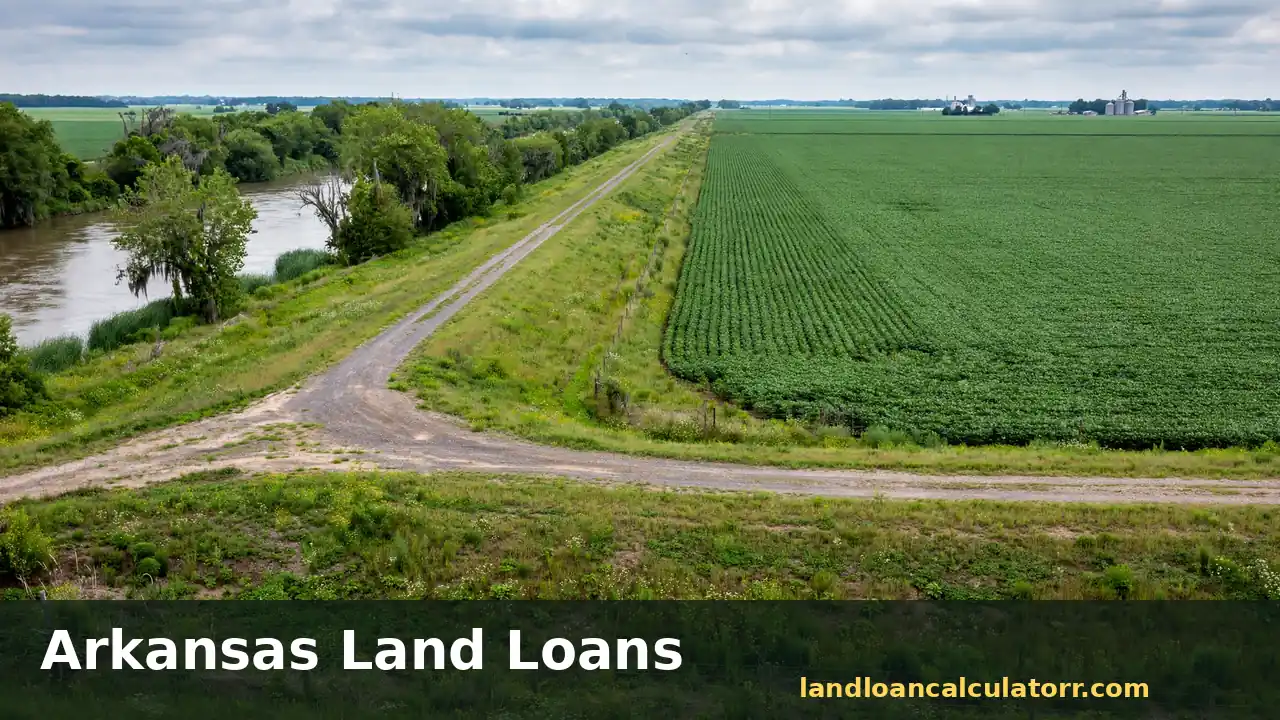
Arkansas Land Loans: Requirements, Rates & Lenders

Short answer: Yes — you can get a land loan in Arkansas, and Arkansas is one of the more affordable states in which to buy land. Most Arkansas land lenders require a credit score of 680 or higher, a down payment of 20–50% depending on the land type, and a debt-to-income ratio under 43–45%. Arkansas charges a real property transfer tax of $3.30 per $1,000 of consideration, and farmland is taxed on its productive value rather than its market price. Farm Credit associations, credit unions, and USDA Farm Service Agency loans cover most Arkansas buyers — the right one depends on whether the land is Delta row-crop ground, Ozark recreational land, or pine timberland.
Table of Contents
- Why Arkansas Land Loans Are Different
- Arkansas Land Loan Requirements
- Types of Arkansas Land Loans
- Arkansas Land Loan Rates
- Arkansas-Specific Things to Check Before You Borrow
- Where You Buy in Arkansas Changes the Loan
- Best Arkansas Land Loan Lenders
- How to Apply for a Land Loan in Arkansas
- Estimate Your Arkansas Land Loan Payment
- Costs Beyond the Purchase Price
- Mistakes to Avoid
- Frequently Asked Questions
- Arkansas Land Loan Checklist
Why Arkansas Land Loans Are Different
If you are shopping for Arkansas land loans, Arkansas is a state where the land itself shapes the loan. The state stretches from Delta row-crop farms in the east to Ozark and Ouachita mountain land in the north and west, with southern pine timberland in between. Prices are often more affordable than in many coastal or fast-growing markets, but approval still turns on practical checks: irrigation, floodplain status, legal access, and whether the land can support the use you plan for it.
Several Arkansas-specific factors make land financing here distinct. First, Arkansas has a real property transfer tax that applies to most deeds — $3.30 per $1,000 of actual consideration — paid through documentary stamps bought from the Department of Finance and Administration before recording. Second, Arkansas taxes agricultural land on its productive value under Amendment 59, not on its market price, which keeps holding costs manageable for farm buyers. Third, water is a central question: Delta farmland depends on irrigation and groundwater, while Ozark and Ouachita parcels depend on wells, springs, and septic systems. A lender will ask about water on almost every Arkansas parcel. And fourth, Arkansas’s lender landscape is dominated by Farm Credit associations and local banks — the Farm Credit system has deep roots in the Delta and the Ozarks, and it underwrites farm and rural land in ways national banks do not.
The other side of that picture is that no single loan fits every Arkansas parcel. A lender will look closely at the land itself, your cash reserves, and your plan for the property before it quotes terms. Productive Delta farmland with irrigation in place is a very different loan from a steep, wooded 40 acres in the Ozarks with no road frontage. Understand the parcel first, and the financing follows.
Arkansas Land Loan Requirements
Arkansas land loan requirements are similar to those in other states, but lenders weigh the property just as heavily as the borrower. A strong credit profile helps, yet a parcel with unclear access, flood risk, or an uncertain appraisal can still slow approval. Lenders want to know that the land is marketable, reachable, and usable for its stated purpose. For the full national picture on credit, income, and down payment standards, see our guide to land loan requirements.
Credit score
For most borrowers, a credit score around 680 or higher puts you in a stronger position for Arkansas land loans, and scores above 720 often open up better rates and longer terms. Borrowers with lower scores can still be approved in some cases — especially through Farm Credit or USDA programs — but they should expect a larger down payment or a shorter term. Farm Credit associations weigh farm income, production history, and the land’s productive value alongside the credit score, which helps a strong farm operation with a thin credit file. A recent bankruptcy, foreclosure, or pattern of late payments will still stop most applications, whatever the land is worth.
Down payment
Down payment usually depends on land type, and it is the biggest difference from a home mortgage:
| Land type | Typical down payment |
|---|---|
| Improved land (road access, utilities, well or septic, buildable site) | 20–30% |
| Raw land (may lack utilities, driveway, or perc-approved septic site) | 30–50% |
| Recreational / Ozark hunting land (often treated as raw land) | 30–50% |
| Residential lot in or near town | 15–25% |
| Farm / agricultural land (Farm Credit, FSA) | 15–20% |
| Construction-to-permanent (land + build) | 15–30% |
The down payment is not the whole cash requirement. Most Arkansas land lenders also want to see reserves — money left over after closing — typically enough to cover several months of payments. A borrower who puts every dollar into the down payment and has nothing left for the appraisal, survey, perc test, and first tax bill looks risky even with a strong credit score.
Debt-to-income ratio (DTI)
Expect lenders to review your income, debts, employment history, and reserves. Your debt-to-income ratio matters because land loans often carry shorter terms and higher payments than a standard home mortgage. Most lenders want total monthly debts — including the new land payment, taxes, and insurance — to stay within a comfortable share of gross income, commonly around 40–45%, although farm lenders may weigh farm income differently. If your DTI is above 45%, the realistic fixes are paying down revolving debt, documenting additional income, increasing the down payment to shrink the loan, or buying a less expensive parcel.
Income, reserves, and documentation
Expect to provide tax returns, pay stubs, and bank statements. Self-employed buyers and farmers should expect a deeper request: two years of tax returns, profit-and-loss statements, and, for farm loans, a farm business plan or production history. Farm buyers may also be asked about farming experience. Many Arkansas land lenders also require reserves of three to six months of payments.
The property itself must qualify
Finally, the property itself must pass muster. Lenders want legal road access — not just a driveway across a neighbor’s land — and they want to know how water, sewer or septic, and electricity will be provided. An appraisal is required in many cases to confirm value, boundaries, and acreage. Before a lender orders an appraisal, confirm the zoning, legal access, floodplain and levee district status, irrigation and water rights, and perc/soil suitability with the county. Any one of these can change the loan, and ordering the appraisal first wastes money if the parcel fails a basic check.

Types of Arkansas Land Loans
Arkansas offers a wide range of land, and lenders treat each type differently. Where your parcel fits helps you set a realistic budget and choose the right lender.
Delta row-crop farmland
The flat, fertile ground of the Mississippi Alluvial Plain in eastern Arkansas is known for rice, soybeans, cotton, and corn. Productive, irrigated acres are among the easiest types of land to finance: lenders value soil quality, irrigation infrastructure, drainage, and recent comparable sales, and farm lenders are comfortable underwriting this land when the buyer has farming experience or a tenant farmer in place. If the farm has a cash-rent tenant, that income strengthens the application.
Ozark mountain and recreational land
Ozark land in northern Arkansas is a mix of timber, pasture, and recreational tracts. These parcels are often hilly, wooded, or farther from utilities, so lenders may require a larger down payment and a shorter term. A clear road, a surveyed boundary, and a realistic plan for water and septic make Ozark land much easier to approve. For the national picture on financing this kind of property, see our guide to recreational land loans.
Ouachita timberland
Timber parcels in the Ouachita Mountains of west-central Arkansas can be financed, but lenders will want to talk about timber value, harvest history, access, and any conservation easements. A timber valuation may be needed, and income from a future harvest is rarely counted the same way as farm income. If timber is a major part of the price, talk to a lender experienced with timberland before you offer.
Land near Little Rock and Northwest Arkansas
Parcels near growing cities — Little Rock, Fayetteville, Bentonville, Rogers, Springdale — can be more expensive and competitive. Zoning, future land use plans, and utility access are especially important, because a parcel that looks like farmland today may be in the path of development. The flip side is that improved lots near towns finance on better terms than remote acreage, with lower down payments and longer terms.
Construction-to-permanent and owner financing
If you plan to build within a year or two, a construction-to-permanent loan can be the cheapest overall route: one loan covers the land purchase and the build, then converts to a standard mortgage when the home is finished. The lender underwrites the finished home’s value, which is why the down payment (typically 15–30%) is lower than a standalone raw land loan. Seller financing is also common for rural Arkansas land, especially in the Ozarks and for parcels banks find unusual. The seller acts as the lender, terms are negotiable, and the deal is judged mostly on the down payment and the land — but get the contract reviewed, confirm the seller owns the land free and clear, and record the contract. Our land contract calculator can model the payments before you agree to terms.
Arkansas Land Loan Rates
Land loan rates in Arkansas are higher than rates for a primary-home mortgage, and the gap widens as the land gets less developed. That is because vacant land has no structure to insure, no rental income to service the loan, and a thinner resale market if the lender has to foreclose. For current rate ranges by land type, see our regularly updated guide to land loan interest rates — check it before you apply, because rates move and any figure quoted in a guide goes stale fast.
Several factors move your rate. A larger down payment lowers the lender’s risk and can lower the rate. A shorter term, such as 10 or 15 years instead of 20 or 25, often carries a lower rate for a higher monthly payment. Fixed rates give payment certainty, while adjustable rates may start lower but can rise later. Farm Credit associations and community banks that know local land values sometimes offer more competitive terms for agricultural land than a national lender that rarely finances vacant land. Do not compare rates alone. Ask about the term, whether the loan has a balloon payment, prepayment penalties, origination fees, and appraisal and survey costs — a loan that looks cheap on rate but balloons in five years can be riskier than a slightly higher fixed rate with longer amortization.
To see how the rate changes the payment, here are two illustrations. The rates below are assumed figures used only to show the math — they are not quotes and not current market rates. Use the land loan calculator with today’s rates to run your own numbers.
| Scenario | Loan amount | Assumed rate (illustration only) | Term | Monthly payment |
|---|---|---|---|---|
| $200,000 Delta farm purchase, 20% down | $160,000 | 8.00% fixed | 20 years | ≈ $1,338 |
| $90,000 Ozarks recreational parcel, 30% down | $63,000 | 8.50% fixed | 15 years | ≈ $620 |
Two things stand out. First, the down payment is doing a lot of work: the farm buyer borrows $160,000 on a $200,000 purchase and pays about $1,338 a month, while the recreational buyer borrows less than half as much. Second, the term matters as much as the rate: the 20-year loan’s payment looks manageable, but the total interest paid over 20 years is far higher than over 15. Shorter terms cost more per month and less overall. Choose the term by what your cash flow can carry, not by what makes the monthly payment look smallest — and ask every lender, in writing, whether the loan amortizes fully or has a balloon payment at the end.
Arkansas-Specific Things to Check Before You Borrow
These are the Arkansas details that catch out-of-state buyers and first-time land buyers. Check each one before you commit to a parcel — they affect the price, the loan, and the cost of holding the land.
Real property transfer tax
Arkansas charges a real property transfer tax of $3.30 per $1,000 of actual consideration on transactions over $100, under Arkansas Code Annotated §26-60-101 et seq. The tax is paid through documentary stamps bought from the Department of Finance and Administration (DFA) before the deed is recorded. On a $200,000 land purchase that is $660; on a $500,000 purchase it is $1,650. The tax also applies to transfers of mineral-rights ownership — so a deal that separates surface and mineral rights can trigger the tax on the mineral transfer as well. Who pays the tax is negotiable in the purchase contract; confirm it in writing so it does not appear as a surprise at the closing table. The official rules are published on the Arkansas DFA real property transfer tax page.
Amendment 59: agricultural use valuation
Arkansas taxes agricultural land on what it can produce, not on its market price. Amendment 59, adopted in 1980, provides for agricultural use valuation: cropland, pastureland, and timberland are valued for tax on productivity and use, not market value, under Arkansas Code Annotated §26-26-407. The DFA Assessment Coordination Division publishes updated valuation tables every year, so the assessed value of a farm parcel tracks its productive capacity rather than the price a developer would pay for it. That matters twice: it keeps the annual tax bill on working farmland manageable, and it means a farm’s assessed value will not jump to match a high purchase price the way a residential lot’s would. Confirm the parcel’s current classification with the county assessor before you buy.
Irrigation and groundwater
Delta farmland depends on irrigation, and irrigation depends on groundwater from the Mississippi River Valley alluvial aquifer. Before you buy Delta ground, confirm the well, the pump, the irrigation infrastructure, and the water situation — and ask the local conservation district and the Arkansas Natural Resources Commission about groundwater conditions in the area. A farm without reliable water is a farm without reliable income, and lenders know it.
Floodplain and levee districts
Large parts of eastern Arkansas lie in the Mississippi River floodplain, behind levees and within drainage districts. A floodplain designation can affect insurance costs, building requirements, and lender approval — and levee and drainage district assessments are an ongoing cost of holding the land. Order a flood certification, review FEMA maps, and ask your insurer for a quote before you close.
Mineral rights, timber rights, and septic
In Arkansas, mineral rights are often severed from surface ownership, and timber rights can be sold separately as well. Confirm in the deed and title search exactly what conveys with the land — a surface purchase that excludes minerals or timber is worth less than one that includes them, and a lender will price it that way. Much rural Arkansas land is not served by public sewer, so a septic system is the norm; soil type, slope, and water table determine whether a standard system will work. A failed perc test can change the buildable area, the cost, or whether the parcel is financeable, so test early when the seller and contract allow it.
Where You Buy in Arkansas Changes the Loan
Arkansas is not one land market. The lender that is best for Delta farmland may not lend at all on a steep Ozark parcel, and the terms that work for a lot near Fayetteville will not work for south Arkansas timberland. Local knowledge is the whole game in Arkansas land lending.
The Delta: Eastern Arkansas — the Mississippi Alluvial Plain — is row-crop country: rice, soybeans, cotton, and corn on flat, fertile ground. Farm Credit associations and FSA offices are thick on the ground, comparable sales for farmland are plentiful, and irrigation, drainage districts, and levee assessments are part of everyday underwriting. Farm loans here are the most competitive in the state. If you are buying farmland anywhere in Arkansas, start with the Farm Credit association that serves the county.

The Ozarks: Northern Arkansas’s Ozarks are the state’s recreational land heartland — hunting, fishing, camping, and weekend cabins. Parcels here are often wooded, steep, or farther from utilities, so lenders may require a larger down payment and a shorter term. A clear road, a surveyed boundary, and a realistic plan for water and septic make an Ozarks parcel much easier to approve. Seller financing is common here precisely because bank financing is thinner.
The Ouachitas: West-central Arkansas’s Ouachita Mountains are pine timber country. Timber value, harvest history, access, and conservation easements are part of underwriting here, and a timber valuation may be needed. Lenders experienced with timberland are the right first call — a lender that only finances subdivision lots will not know how to value a pine stand.
Central Arkansas: Around Little Rock, North Little Rock, and Conway, land prices are higher and zoning and future land use plans matter more. Improved lots near towns finance on better terms than remote acreage, and a parcel that looks like farmland today may be in the path of development. Confirm zoning and the city’s growth plans before you offer.
Northwest Arkansas: Fayetteville, Bentonville, Rogers, and Springdale are among the fastest-growing areas in the state, and land near them commands premium prices. Competition is fierce, timelines are short, and a pre-approval is essential to be taken seriously. Lot loans from credit unions and community banks are common here, and Arkansas Federal Credit Union — based in Little Rock but lending statewide — is a useful option for lot buyers.
South Arkansas: Southern Arkansas mixes pine timberland, pasture, and farmland, with lower prices and thinner comparable sales than the Delta. Appraisals can be slower, and lenders may be more cautious on remote parcels. Local community banks that know the county are usually the best first call.
Best Arkansas Land Loan Lenders
The best Arkansas land loan lender is the one that actually lends on your type of land, in your county, on terms you can live with. That is almost never the biggest bank. These are the lenders Arkansas land buyers should quote first.
| Lender | Best for | Key details |
|---|---|---|
| Farm Credit Mid-America | Farm real estate in northeast Arkansas | Jonesboro office serves Craighead and Poinsett counties |
| Arkansas Federal Credit Union | Lot loans, including lots not construction-ready | Little Rock-based, founded 1956; lot and renovation loans |
| Rural 1st | Fixed-rate bare-land loans, country homes | Bare-land loans on 10+ acres; Arkansas in its 22-state footprint |
| Farm Credit of Western Arkansas | Farm and rural land in western Arkansas | Named only — no verified official website link |
| USDA Farm Service Agency | Farm ownership loans, beginning farmers | Available through local USDA Service Centers statewide |
Farm Credit Mid-America
Farm Credit Mid-America serves parts of Arkansas, and its Jonesboro office serves Craighead and Poinsett counties in the northeast of the state. It offers farm real estate loans for farmland purchase, expansion, and transitional land, as well as Rural 1st country-home loans for buyers who want a home in the country. For Delta and northeast Arkansas farmland, it is a strong first quote alongside the other Farm Credit associations in the state.
Arkansas Federal Credit Union
Arkansas Federal Credit Union is based in Little Rock and was founded in 1956. It offers lot loans — including lots that are not yet construction-ready — plus renovation loans, making it a good fit for buyers who have found a lot and plan to build or improve it. Credit unions often price improved lots and smaller acreage near towns competitively, so confirm acreage limits and maximum terms before you pay for an appraisal.
Rural 1st
Rural 1st offers fixed-rate bare-land loans on 10 or more acres, with terms designed for buyers who want a predictable payment on country land. Arkansas is in its 22-state footprint. Because it specializes in rural property, Rural 1st is a strong option for recreational and homesite acreage that conventional banks pass on.
Farm Credit of Western Arkansas
Farm Credit of Western Arkansas is the Farm Credit association for western Arkansas, serving farm and rural land buyers in that part of the state. It is named here without a website link because no verified official URL was available. If you are buying in western Arkansas, ask the association directly or through a local Farm Credit office for its current lending programs.
USDA Farm Service Agency (FSA)
USDA FSA farm ownership loans are available through local USDA Service Centers statewide and are designed for family farmers, including beginning farmers who cannot obtain commercial credit on reasonable terms. FSA loans can carry lower down payments than conventional farm loans, and they are the safety net for buyers the commercial market turns away. The trade-off is paperwork and time: FSA applications take longer than a bank loan, so start early.
Community banks and credit unions
Do not overlook local institutions. Small and regional community banks in rural Arkansas often know local land values better than anyone, and they may be more flexible on unusual parcels, local appraisals, and terms that vary widely. If you are buying in a specific county, ask local agents and farmers which banks regularly close land deals there; their answers are worth more than any national ranking.
How to Apply for a Land Loan in Arkansas
Land loans take longer than home mortgages. Expect 30–60 days from application to closing for a bank or Farm Credit loan, and longer for an FSA loan. Build that timeline into your purchase contract, and do not waive your financing contingency until the lender has committed.
Step 1: Get pre-approved. Start with a land loan pre-approval so you know what down payment you will need and what payment fits your budget. Pre-approval also signals to sellers that you are a serious buyer.
Step 2: Find the land and verify the basics. Confirm acreage, boundaries, legal access, zoning, floodplain and levee district status, irrigation and water, and utility options before you offer. Ask for a survey, soil and perc information if septic is planned, and any easements or restrictions.
Step 3: Make an offer with financing contingencies. Include time for appraisal, survey, and loan approval, and be clear about what happens if the appraisal comes in low. A land-savvy agent can help you set realistic timelines.
Step 4: Submit your full application. Expect to provide identification, tax returns, pay stubs or farm income records, bank statements, a purchase agreement, and property details. The lender will order an appraisal and may require a survey, title search, and flood certification.
Step 5: Underwriting and conditions. The underwriter reviews your credit, income, debts, and the appraisal. You may be asked for more documents, a larger down payment if the value is lower than expected, or proof of access and utilities. Respond quickly to keep the timeline on track.
Step 6: Closing. At closing you will sign the note and deed of trust, pay closing costs and the down payment — including the transfer tax documentary stamps — and record the transaction. Read our guide to the land loan closing process so you know what to bring and what to check before you sign.
Estimate Your Arkansas Land Loan Payment
Before you fall in love with a parcel, run the numbers. A larger down payment, a shorter term, or a lower rate can change your monthly payment by hundreds of dollars, and land loans often have shorter terms than home mortgages, which pushes payments higher.
1. Find the loan amount. Subtract the down payment from the purchase price. On a $150,000 parcel with a 25% down payment, the loan amount is $112,500.
2. Enter the loan amount, rate, and term in the calculator. Use our free land loan calculator to test different purchase prices, down payments, rates, and terms for Arkansas land. For a quick monthly estimate, the land payment calculator will show principal and interest on any loan amount. As an illustration only — using an assumed 8.00% fixed rate over 15 years — that $112,500 loan would cost about $1,075 per month in principal and interest.
3. Add the holding costs. The loan payment is not the whole monthly cost. Include property taxes, insurance, and any road maintenance, plus fencing, road maintenance, and utilities for farm and recreational land. A parcel that costs $1,075 a month in loan payments can easily cost $1,400 a month all-in.
4. Stress-test it. Run the payment at a higher rate and a shorter term, and ask whether you could still carry the land if your income dipped or the build took a year longer than planned. Land does not generate income while you hold it, so the payment has to fit your existing cash flow — not a future rent check or a future sale.
Run the numbers before you fall in love with the parcel. The payment tells you whether the land is affordable; the appraisal tells you whether the price is fair. Neither should come as a surprise after you have signed.
Costs Beyond the Purchase Price
The down payment is only the start. Budget for these Arkansas land purchase costs before you make an offer — several are due whether or not the loan closes, and the transfer tax is one buyers often forget.
| Cost | Typical range |
|---|---|
| Appraisal | $500–$2,000+ |
| Land survey | $500–$2,500+ |
| Perc test / soil evaluation | $500–$2,000+ |
| Real property transfer tax | $3.30 per $1,000 of consideration |
| Recording fees | Usually under $200 |
| Title search and insurance | $1,000–$3,000 |
| Escrow and closing fees | $500–$2,000 |
| Loan origination and lender fees | 0.5–2% of the loan |
| Insurance (first year) | $1,000–$3,000+ |
Keep a contingency of at least 5–10% of the purchase price for surprises — a low appraisal, a failed perc test, a boundary dispute, or a well that needs work. Our guide to land survey cost explains what a survey costs and why lenders require one.
Mistakes to Avoid
- Skipping the parcel checks. Buying land before confirming zoning, legal access, floodplain and levee status, irrigation, and perc suitability is how buyers end up with an unfinanceable parcel.
- Assuming a big bank will lend. National banks rarely finance vacant land — ask Farm Credit associations, Arkansas Federal Credit Union, community banks, and credit unions first.
- Ignoring the transfer tax. Arkansas charges $3.30 per $1,000 of consideration, paid through documentary stamps before recording. Budget it — $660 on a $200,000 purchase.
- Forgetting mineral and timber rights. In Arkansas, minerals and timber are often severed. Confirm in the deed exactly what conveys with the land.
- Accepting a balloon payment without a plan. Know when the balloon hits and how you will pay it — sell, build, or refinance — before you sign.
- Not getting three quotes. Land loan pricing varies widely. One quote is a guess; three quotes are a market.
Frequently Asked Questions
How much is a down payment on land in Arkansas?
Expect 15 to 25 percent for a residential lot, 20 to 30 percent for improved land, and 30 to 50 percent for raw land or recreational land in the Ozarks. Farm and agricultural land through Farm Credit or USDA Farm Service Agency can be 15 to 20 percent, and construction-to-permanent loans are typically 15 to 30 percent. Budget reserves on top of the down payment.
What credit score do you need for a land loan in Arkansas?
Most Arkansas land loans require a credit score of 680 or higher, with the best rates and terms going to borrowers at 720 or above. Farm Credit associations and USDA Farm Service Agency loans can be more flexible on credit, and seller financing may not check your credit at all.
What is the real property transfer tax in Arkansas?
Arkansas charges a real property transfer tax of 3.30 dollars per 1,000 dollars of actual consideration on transactions over 100 dollars, under Arkansas Code Annotated section 26-60-101. The tax is paid through documentary stamps bought from the Department of Finance and Administration before the deed is recorded. On a 200,000 dollar purchase that is 660 dollars. The tax also applies to transfers of mineral-rights ownership.
What are current Arkansas land loan rates?
Land loan rates change often and vary by credit score, down payment, land type, and term, so check our land loan interest rates page for the current ranges before you apply. In general, land loans price above home mortgage rates, and improved lots price lower than raw land. Get at least three quotes and compare the APR and total cost.
Can you get a land loan in Arkansas with bad credit?
It is difficult through a conventional lender, but not always impossible. Options include a larger down payment, seller financing, a USDA Farm Service Agency loan if you farm, or improving your credit score before you apply. No lender will stretch on credit for a parcel it cannot value or resell.
What is Amendment 59 and how does it affect Arkansas land taxes?
Amendment 59, adopted in 1980, provides for agricultural use valuation in Arkansas. Cropland, pastureland, and timberland are valued for tax on productivity and use rather than market value, under Arkansas Code Annotated section 26-26-407. The Department of Finance and Administration Assessment Coordination Division publishes updated valuation tables every year.
Does Arkansas have USDA land loans?
Yes. USDA Farm Service Agency farm ownership loans are available through local USDA Service Centers statewide, including for beginning farmers who cannot get commercial credit on reasonable terms. USDA Rural Development programs can also help eligible rural buyers finance a home with land. Find your local office through the USDA Farm Service Agency.
Do Arkansas land loans have balloon payments?
Many do, especially shorter-term land loans and seller-financed deals. With a balloon loan, the remaining balance comes due in full at the end of the term. Ask every lender in writing whether the loan fully amortizes or has a balloon, and have a plan to sell, build, or refinance before it comes due.
Arkansas Land Loan Checklist
- Credit score checked; 680 minimum, 720+ for the best terms
- Down payment saved, plus closing costs and three to six months of reserves
- Parcel verified: zoning, legal access, floodplain and levee district status, irrigation, water, septic, perc test
- Transfer tax budgeted: $3.30 per $1,000 of consideration, paid by documentary stamps before recording
- Agricultural use valuation confirmed with the county assessor
- Mineral and timber rights confirmed in the deed and title search
- At least three quotes: Farm Credit Mid-America, Arkansas Federal Credit Union or Rural 1st, and a community bank or credit union
- Pre-approval in hand before making an offer
- Appraisal, survey, and perc test ordered during the contingency period
- Balloon terms, if any, understood in writing
- Payment run through the land loan calculator, including taxes and insurance
By Jameel Noori, Founder & Developer, Land Loan Calculator
About the author: Jameel Noori is the Founder & Developer of Land Loan Calculator. He writes practical, U.S.-focused guides to land financing.
Reviewed by: Jameel Noori, Founder & Lead Developer of Land Loan Calculator, reviewed this article for accuracy.
Disclaimer: This article is for informational purposes only and is not financial advice. Land loan rates and terms change frequently — confirm current rates and requirements with the lender before you apply.
