
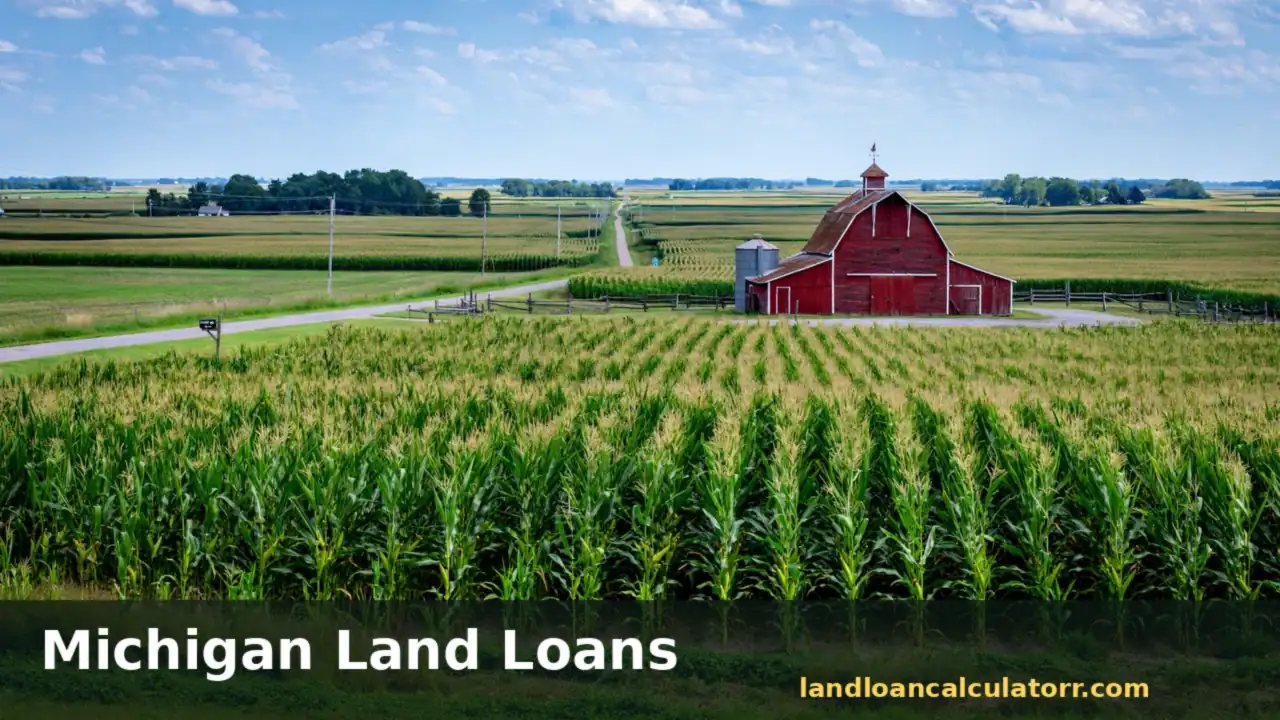
Michigan Land Loans: Requirements, Rates & Lenders

Yes, you can get a land loan in Michigan, and Michigan land loans open the door to farmland in the Thumb, cherry orchards near Traverse City, lakefront parcels on inland lakes, and hunting land in the Upper Peninsula. Expect a different process from a standard home purchase: down payments for Michigan land loans are typically 20% to 30% or more for improved land, and often higher for raw or waterfront land, with rates usually above mortgage rates because vacant land carries more risk for lenders and is harder to resell quickly. Farm Credit associations such as GreenStone Farm Credit Services, community banks such as Mercantile Bank and Honor Bank, and credit unions all play different roles in Michigan, and USDA programs can help some buyers.
Whether you want a few acres for a future home, a working farm, or a quiet parcel for recreation, the key is matching the land type to the right lender. A cherry orchard with road frontage is a different risk from a remote Upper Peninsula hunting parcel, and lenders price that difference into the down payment, the rate, and the term. Start with a clear budget, a realistic down payment, and a plan for road access, utilities, and septic approval.
This guide explains Michigan land loans in plain terms: who qualifies, how much you will usually need to put down, what rates tend to look like, which lenders work most often in Michigan, and the Michigan-specific checks to make before you close. Where a fact comes from a statute or a state program, this guide names the source so you can check it yourself.
Michigan Land Loan Requirements
Lenders treat vacant land as riskier than a finished home, because there is no house to live in or rent out if the loan goes bad. That is why Michigan land loans carry larger down payments and more property checks than a standard mortgage. The exact bar moves with the lender and the land, but the pattern below is what most Michigan buyers run into. For a fuller checklist, see our guide to land loan requirements.
Credit score
Most Michigan land lenders look for a credit score of around 680 or higher, although some lenders will consider lower scores with a larger down payment or additional collateral. A higher score usually means a lower rate and a wider choice of lenders. Check your credit early, correct any errors, and avoid new large debts while you apply.
Down payment
Down payment requirements vary sharply by land type. Improved land with road access, utilities, and a septic approval may qualify for 20% down or less, while raw land and waterfront parcels often need 25% to 35% or more. GreenStone Farm Credit Services, for example, finances recreational and vacant land with typically 20% down, and 15% is possible for qualifying borrowers. Mercantile Bank’s lot loan offers up to 90% loan-to-value, meaning 10% down, for a lot in a platted subdivision or vacant land with documented utility access or a passing perc test. Compare the down payment against the land type, not against a single number.
Income and debt-to-income ratio
Lenders also review your debt-to-income ratio, or DTI. This compares your monthly debt payments with your gross monthly income, and many land lenders want total DTI at or below the mid-40s in percentage terms. Agricultural lenders weigh farm income, off-farm income, and cash flow differently. Self-employed buyers and farmers should expect to show two years of tax returns, profit-and-loss statements, and, for a working farm, production and lease history. If the land will produce income, such as cherries, corn, or a hunting lease, bring the records that prove it.
Property checks
Beyond your finances, the property itself must pass muster. Expect a lender to ask about documented legal access, a survey or boundary confirmation, a perc test or septic approval for a building site, a well or water source, and a clean title. A lender will also want to know what you plan to do with the land: build now, build later, farm it, hold it, or use it recreationally. Each plan carries a different risk, and some lenders only finance certain plans. In Michigan, also ask whether the parcel is in a floodplain or a mapped wetland, because both can limit building and affect the appraisal.
Appraisal
An appraisal is required in most cases, and land appraisals can be slower than home appraisals because there are fewer comparable sales, especially for large or remote parcels. The appraiser looks at recent sales of similar land, access, utilities, zoning, and income potential. If the appraisal comes in below the purchase price, the lender will lend against the appraised value, and you will need to cover the gap in cash or renegotiate the price. Parcels of 30 or more acres may be valued on State Equalized Value instead of a full appraisal by some Farm Credit lenders, so ask your lender which valuation method it will use.
Michigan Land Loan Rates
Land loan rates in Michigan generally follow national patterns: they are usually higher than rates for a primary-home mortgage, because vacant land is harder for a lender to resell if the loan defaults. The size of the gap depends on the land type, your credit, your down payment, and the lender. For current rate ranges and the factors that move them, see our guide to land loan rates.
Rates also vary by land type. A serviced, buildable lot in or near a growing town will usually price closer to mortgage rates than a remote recreational parcel or a large farm. Agricultural land with a proven income history can price better than raw land with no income, because the lender can underwrite the farm’s cash flow as well as the borrower.
Your credit score, down payment, loan term, and whether the rate is fixed or adjustable all move the rate. A larger down payment and a shorter term usually mean a lower rate. Fixed rates cost more at the start but never change; adjustable rates can start lower and then move with the market. Some land loans also carry a balloon payment, where a large sum is due at the end of the term, so ask your lender to spell out exactly when and how much is due.
Because rates change with the market and with each lender’s appetite for land, treat any rate you see online as a starting point, not a quote. Get written quotes from at least three lenders, compare the same loan amount, term, and down payment, and ask each lender to itemize fees and any prepayment penalty. A lower rate with high fees can cost more than a slightly higher rate with low fees.
Types of Land in Michigan
Michigan’s land market breaks down into a few broad types, and lenders price each one differently. Knowing which type you are buying helps you pick the right lender and the right loan.
Cherry orchards and farmland
The Grand Traverse Bay region around Traverse City is Michigan’s cherry country, with orchards on rolling hills above the bay. The Thumb and the Saginaw Valley hold much of the state’s row-crop ground, while southern Michigan has a mix of grain, vegetable, and livestock farms. Farm lenders underwrite these purchases on soil quality, tillable acreage, water, and the farm’s income history. For an orchard, a lender may want to understand tree age and condition, irrigation, and the buyer or packer behind the crop. Bring yield records, lease agreements, and any crop insurance history, because a lender will want to see that the farm can service the debt from its own income.

Lakefront land
Michigan has more than 11,000 inland lakes plus Great Lakes shoreline, so lakefront land is a large part of the state’s market. Lakefront parcels command a premium, but they also bring checks that other land does not: shoreline and setback rules, erosion and bluff risk on the Great Lakes, floodplain maps, and septic suitability near the water. A lender will want to know whether the lot has a buildable site, legal access, and a septic approval. Lakefront lots also appraise differently from inland land, because comparable sales are fewer and the premium for frontage varies by lake and by season.
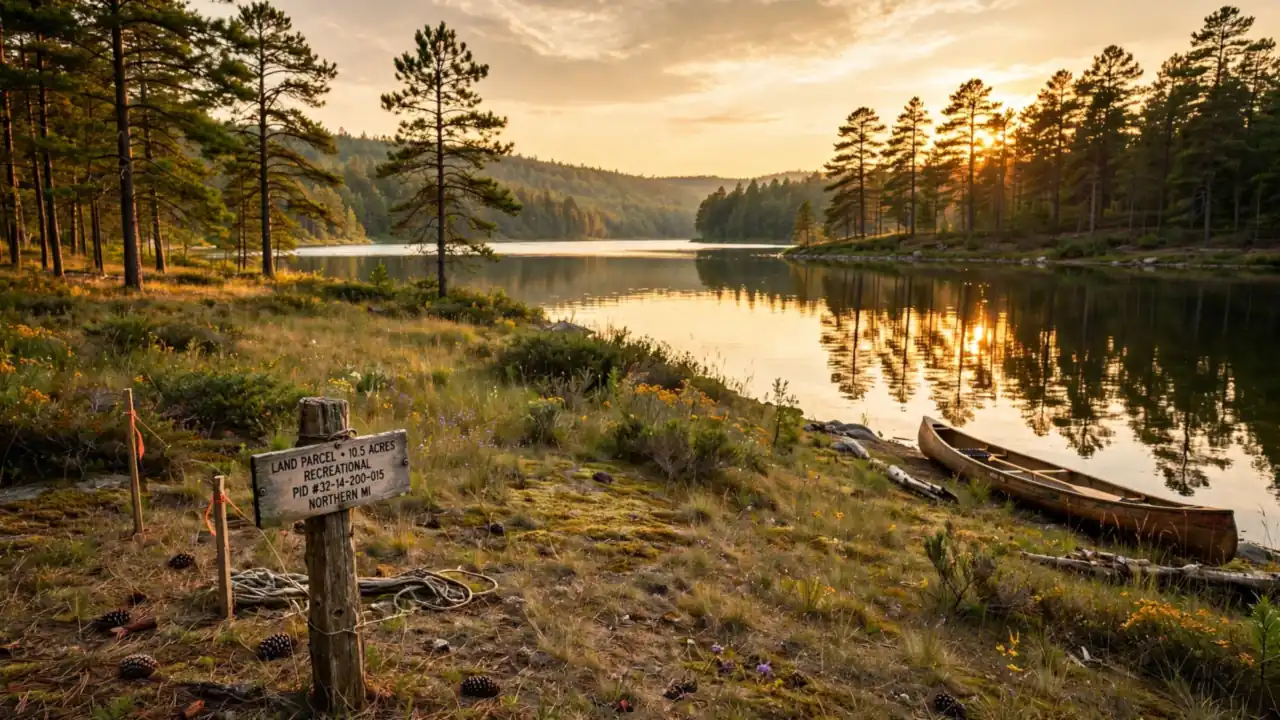
Upper Peninsula hunting and recreational land
The Upper Peninsula offers large, affordable tracts of forest and hunting land, often with few neighbors and long drives to town. These parcels can be beautiful and cheap per acre, but they are the hardest to finance: limited road access, few comparable sales, and often no utilities. Expect a larger down payment and a shorter term, and expect the lender to ask hard questions about access in winter, septic and water, and whether mineral or timber rights are included. A recreational lot with recorded access, a perc approval, and power nearby will finance far more easily than one without them.
Northern Michigan forest and timberland
Northern lower Michigan holds large areas of forest and former timberland. Its value may depend on timber species, age, and harvest history as much as on the land itself. A lender may ask for a timber cruise or a forester’s report before it will lend, and it will want to know whether the timber is being sold with the land or reserved by the seller. If you plan to build on timberland, check township zoning dwelling rules early, along with wildfire risk and insurance costs.
Buildable lots
Buildable lots, meaning platted lots in or near a town, with road access and utilities at or near the boundary, are the easiest land to finance in Michigan. Many banks offer lot loans for these parcels, and some pair the lot loan with a one-time-close construction loan so you can buy the lot and build the home under a single closing. Ask a lot lender how long you have to start building, what happens if you wait, and whether the lot loan converts to a construction loan or must be refinanced.
Best Lenders for Michigan Land Loans
No single lender is best for every Michigan buyer. The right lender depends on the land type, the county, your down payment, and whether the land will produce income. Start with the lenders below, then compare at least three written offers.
GreenStone Farm Credit Services
For farmland, recreational land, and vacant land, GreenStone Farm Credit Services is the lender most Michigan buyers start with. GreenStone serves Michigan and northeast Wisconsin through 35 branches, and it finances home sites, vacant land, and recreational land with no acreage limit. Recreational and vacant land loans typically need 20% down, with 15% possible for qualifying borrowers, and come with 30-year amortization and no requirement to build by a deadline. Parcels of 30 or more acres may be valued on State Equalized Value instead of an appraisal. See GreenStone’s recreational and vacant land financing page for details.
Mercantile Bank
Mercantile Bank, Michigan’s largest Michigan-headquartered bank, offers a Let’s Build lot loan with up to 90% loan-to-value and no mortgage insurance, for a lot in a platted subdivision or vacant land with documented utility access or a passing perc test. You must build within five years, and the lot loan transitions to a construction loan when you do. That structure suits buyers who have found a buildable lot and plan to build within a few years.
Honor Bank
Honor Bank serves northern Michigan from the Traverse City area, with eight locations, and offers lot and land loans for buyers in its footprint. As a local bank, it is worth a call for northern Michigan land, alongside a Farm Credit lender, so you can compare a local bank’s terms with an agricultural lender’s. Ask about its lot and land loan options and its no-hassle construction loans.
Old National Bank
Old National Bank has a footprint that includes Michigan and publishes lot lending for buyers in its markets. As a large regional bank, it is worth a call for lots and smaller parcels, alongside a Farm Credit lender, so you can compare a bank’s terms with an agricultural lender’s. Ask about its lot and land loan options for the county where you are buying.
Community banks and credit unions
Community banks in the county where you are buying often know the local market, the township zoning, and the appraisers. They can be flexible on unusual parcels, and they keep the decision local. Michigan credit unions sometimes offer competitive land and lot loans to members, particularly for residential lots and smaller parcels. If you already bank with a credit union, ask what it offers before you shop elsewhere.
Seller financing and USDA programs
Seller financing, where the seller carries a note instead of a bank loan, is common for rural Michigan land. It can close faster and with fewer property conditions than a bank loan, but it still needs a written agreement, a title search, and a plan for the balloon payment if there is one. For working farms, also ask a lender about USDA Farm Service Agency farm ownership loans, which are designed for farmers and ranchers buying land. FSA loan terms change regularly, so confirm current terms with your local FSA office rather than relying on a general guide.
How to Apply for a Michigan Land Loan
Applying for Michigan land loans is smoother when you do the property checks before you fall in love with the parcel. Work through the steps below in order.
- Check access, zoning, and buildability first. Confirm the recorded access, get a survey, and ask the township or county whether a dwelling is allowed on the parcel.
- Strengthen your credit and down payment position. Aim for a credit score around 680 or higher, gather proof of income and assets, and set aside 20% to 35% for a down payment plus closing costs.
- Compare at least three lenders. Talk to a Farm Credit lender, a community bank or credit union, and a lot lender if you plan to build, and get each offer in writing.
- Get pre-qualified and make a careful offer. Use your pre-qualification to set a realistic budget, then make an offer with contingencies for financing, appraisal, and perc approval. See our guide to land loan pre-approval for what to bring.
- Complete the appraisal, survey, and title work. Order the appraisal early, confirm legal access and boundaries, and clear any title or easement issues, including severed mineral rights.
- Close and plan your site work. Review the loan terms, closing costs, and any balloon or adjustable-rate features before signing. Our guide to the land loan closing process walks through the final steps. After closing, start the well, septic, and access work your building plan needs.
Estimate Your Michigan Land Payment
Before you make an offer, run the numbers for a few different prices, down payments, and terms. A larger down payment lowers your loan amount and your monthly payment, and a shorter term raises the monthly payment but cuts the total interest you pay.
Try the site’s land loan calculator to test monthly payments, and use the land affordability calculator to see how much land your income can support. Enter the loan amount after your down payment, not the full purchase price, and add property taxes and insurance to get the full monthly cost. For example, on a $300,000 purchase with 25% down, your loan amount is $225,000, and the calculator shows the monthly payment for that loan at the rate and term your lender quotes.
Run the same numbers at a higher rate and a longer term so you know your payment in the worst case, not just the best case. If the payment only works at the lowest rate you have seen, the land is too expensive for your budget.
Michigan-Specific Things to Check
Michigan land comes with a few checks that surprise buyers from other states. Work through them before you close, not after.
Real estate transfer tax
Michigan charges two real estate transfer taxes, both on the seller: a state tax of $3.75 per $500 under MCL 207.525, and a county tax of $0.55 per $500 under MCL 207.504 for counties under 2,000,000 people. Together that is $4.30 per $500, or $8.60 per $1,000, so the tax on a $300,000 sale is $2,580. Your closing statement will show it, but it is a seller cost, not a buyer cost, so do not budget for it as part of your down payment.
Qualified Agricultural Property Exemption
The Qualified Agricultural Property Exemption under MCL 211.7dd can lower the property tax bill on qualifying farmland by exempting it from local school operating taxes, typically up to 18 mills. A parcel qualifies if it is classified agricultural, or if more than 50% of its acreage is devoted to agricultural use. Vacant land classified agricultural is automatically exempt; otherwise the owner files Form 2599 with the assessor by May 1. A transfer of qualified agricultural property is not treated as a transfer of ownership, meaning no uncapping of the taxable value, if the property stays qualified and the new owner files Form 3676. Confirm the parcel’s classification and exemption status with the local assessor before you buy, and see the Michigan State Tax Commission’s Qualified Agricultural Property Exemption guidelines.
Township zoning and wetlands
Michigan townships control much of the zoning for rural land, so the township office, not the county, is often the first call. Ask the township whether a dwelling is allowed, what the minimum lot size and setbacks are, and whether the parcel is in a mapped wetland or floodplain. Wetlands and floodplains can limit where you can build and affect the appraisal, and a lender will want to know about them before it commits.
Mineral rights
Mineral rights are a Michigan issue that catches buyers off guard, especially in areas with oil, gas, and gravel history. In Michigan, mineral rights can be severed from surface rights, so the deed may not include them. Ask the title company to confirm whether the mineral rights transfer with the land, and read the deed carefully. A lender will also want to know whether mineral rights are included, because severed minerals can affect the value and the appraisal. For a deeper look at this topic, see our guide to mineral rights and land loans.
Perc tests and septic
Most rural Michigan parcels are not on a city sewer system, so a septic system will usually be required. A perc test or site evaluation shows whether the soil can support one, and a failed perc test can make a lot unbuildable, so get it done before closing, not after. Some lot lenders, including Mercantile Bank, require documented utility access or a passing perc test for vacant land. For a deeper look at this topic, see our guide to perc tests for land loans.
Michigan Land Loans FAQs
How much down payment do I need for Michigan land?
Down payments for Michigan land typically run from 20% to 35%, depending on the land type. GreenStone Farm Credit Services finances recreational and vacant land with typically 20% down, and 15% is possible for qualifying borrowers. Mercantile Bank’s lot loan offers up to 90% loan-to-value, meaning 10% down, for a qualifying lot or vacant land with utility access or a passing perc test.
Who are the best lenders for land loans in Michigan?
GreenStone Farm Credit Services is strong for farmland, recreational land, and vacant land statewide, while Mercantile Bank is a good fit for buildable lots that will be paired with a construction loan. Honor Bank serves northern Michigan buyers, and community banks and credit unions are worth checking for local knowledge.
Can I finance lakefront land in Michigan?
Yes. Lakefront land in Michigan finances well when the lot has a buildable site, legal access, and a septic approval. Check shoreline and setback rules, erosion and bluff risk on the Great Lakes, and floodplain maps before you buy, because all of them affect the appraisal and the loan.
What is Michigan’s real estate transfer tax?
Michigan charges two transfer taxes, both on the seller: a state tax of $3.75 per $500 and a county tax of $0.55 per $500, for a total of $4.30 per $500, or $8.60 per $1,000. On a $300,000 sale that is $2,580, paid by the seller.
Does Michigan exempt farmland from school taxes?
Yes, through the Qualified Agricultural Property Exemption under MCL 211.7dd. Qualifying farmland is exempt from local school operating taxes, typically up to 18 mills. A parcel qualifies if it is classified agricultural or if more than 50% of its acreage is devoted to agricultural use, and the owner files Form 2599 with the assessor by May 1 when the exemption is not automatic.
Can I build on Michigan farmland?
Sometimes, but check township zoning first. A dwelling on farmland must be allowed by the township’s zoning, and the parcel must have a perc approval for septic and legal access. Confirm the rules with the township office in writing before you make an offer, because a lender will not finance a building plan the township will not allow.
What credit score do I need for a Michigan land loan?
Many lenders look for around 680 or higher. A stronger score, a larger down payment, and a straightforward property can mean better pricing, while a lower score usually means a higher rate or a bigger down payment.
Do I need a perc test in Michigan?
Yes, for most rural parcels. A perc test or site evaluation shows whether the soil can support a septic system, and a failed perc test can make a lot unbuildable. Some lot lenders require documented utility access or a passing perc test for vacant land, so get the test done before closing, not after.
Sources
- Michigan Real Estate Transfer Tax Chart, Crawford County
- Michigan State Tax Commission, Qualified Agricultural Property Exemption Guidelines
- GreenStone Farm Credit Services, recreational and vacant land financing
- Mercantile Bank, construction and lot loans
By Jameel Noori, Founder & Developer, Land Loan Calculator
About the author: Jameel Noori is the Founder & Developer of Land Loan Calculator. He writes practical, U.S.-focused guides on land financing, loan math, and buyer strategy.
Reviewed by: Jameel Noori, Founder & Lead Developer of Land Loan Calculator, reviewed this article for accuracy.
Disclaimer: This article is for informational purposes only and is not financial advice. Land loan rates and terms vary by lender, property, and market conditions. Consult a licensed loan professional before making financing decisions.
