
Florida Land Loans: Requirements, Rates & Buying Guide

Short answer: Yes — you can get a land loan in Florida, and Florida has more specialized land lenders than most states. Most Florida land lenders require a credit score of 680 or higher, a down payment of 20–50% depending on the land type, and a debt-to-income ratio under 43–45%. Florida charges a documentary stamp tax on deeds of $0.70 per $100 of consideration — $700 on a $100,000 land sale — with a higher rate in Miami-Dade County, and farmland can qualify for Green Belt agricultural classification, which taxes the land on its agricultural value. Farm Credit associations, community banks, and credit unions finance most Florida land; the right one depends on whether the land is a subdivision lot, Central Florida ranchland, or a coastal parcel.
Table of Contents
- Why Florida Land Loans Are Different
- Florida Land Loan Requirements
- Types of Florida Land Loans
- Florida Land Loan Rates
- Florida-Specific Things to Check Before You Borrow
- Where You Buy in Florida Changes the Loan
- Best Florida Land Loan Lenders
- How to Apply for a Land Loan in Florida
- Estimate Your Florida Land Loan Payment
- Costs Beyond the Purchase Price
- Mistakes to Avoid
- Frequently Asked Questions
- Florida Land Loan Checklist
Why Florida Land Loans Are Different
Florida land loans help buyers purchase undeveloped land and residential lots across the Sunshine State. Buying land in Florida is different from buying a house: a house gives a lender collateral that is easy to value, insure, and resell, while bare land offers none of that certainty — so lenders ask for more down payment, charge higher rates, and look much more closely at the land itself.
Several Florida-specific factors make land financing here distinct. First, Florida is a peninsula of water: flood zones, wetlands, and coastal rules affect a large share of parcels, and flood insurance can decide whether a loan closes. Second, Florida charges a documentary stamp tax on every deed and on the mortgage note, plus a nonrecurring intangible tax on the amount financed — costs that belong in your closing budget. Third, Florida’s Green Belt agricultural classification taxes farmland on its agricultural value, which keeps holding costs manageable for farm buyers but requires an annual return by March 1. And fourth, Florida’s lender landscape is dominated by Farm Credit associations and local banks — Farm Credit of Central Florida and Farm Credit of Florida finance farm, ranch, and rural land in ways national banks do not, and credit unions like MIDFLORIDA compete hard for lot loans.
The other side of that picture is that no single loan fits every Florida parcel. A lender will look closely at the land itself, your cash reserves, and your plan for the property before it quotes terms. A buildable lot in a Central Florida subdivision is a very different loan from a 40-acre ranch parcel in the interior or a waterfront lot on the Gulf Coast. Understand the parcel first, and the financing follows.
Florida Land Loan Requirements
Florida land loan requirements vary by lender and land type, but the core checklist is consistent. Lenders judge two things at once: you, and the land. Strong credit cannot rescue a parcel with no legal access or a high-risk flood zone, and a perfect parcel cannot rescue a borrower with no reserves. For the full national picture on credit, income, and down payment standards, see our guide to land loan requirements.
Credit score
Most Florida lenders prefer a credit score of 680 or higher for lot loans, and 700 or higher for raw land and the best rates. Farm Credit associations and USDA programs can be more flexible on credit than a conventional bank, because they underwrite the farm operation and the land’s productive value alongside the borrower’s score — but they are not no-credit lenders, and a recent bankruptcy, foreclosure, or string of late payments will still stop most applications. If your score is below 680, do not assume a Florida land loan is impossible: owner financing (seller financing) is common in rural Florida counties and is judged mostly on the down payment and the deal, and a larger down payment can compensate for a weaker score with some community banks.
Down payment
Down payments are the biggest difference from a home mortgage — and the first place Florida buyers are surprised. Typical Florida ranges:
| Land type | Typical down payment |
|---|---|
| Improved lot (road access, water, sewer, power) | 20–30% |
| Raw acreage (no utilities or improvements) | 30–50% |
| Recreational / hunting land (often treated as raw land) | 30–50% |
| Residential lot in a subdivision | 15–25% |
| Farm / agricultural land (Farm Credit, FSA) | 15–20% |
| Construction-to-permanent (land + build) | 15–30% |
The down payment is not the whole cash requirement. Most Florida land lenders also want to see reserves — money left over after closing — typically enough to cover several months of payments. A borrower who puts every dollar into the down payment and has nothing left for the appraisal, survey, perc test, and first tax and insurance bills looks risky even with a strong credit score.
Debt-to-income ratio and income
Lenders generally want a debt-to-income ratio below 43–45%, plus proof of stable, consistent income. Land loans often carry shorter terms and higher payments than a standard home mortgage, which pushes the ratio higher for the same loan amount. Farm lenders may weigh farm income differently from a conventional bank. If your DTI is above 45%, the realistic fixes are paying down revolving debt, documenting additional income, increasing the down payment to shrink the loan, or buying a less expensive parcel. Expect to provide tax returns, pay stubs, and bank statements; self-employed buyers and farmers should have two years of returns and, for farm loans, a farm business plan or production history ready.
Appraisal, survey, and land-use plan
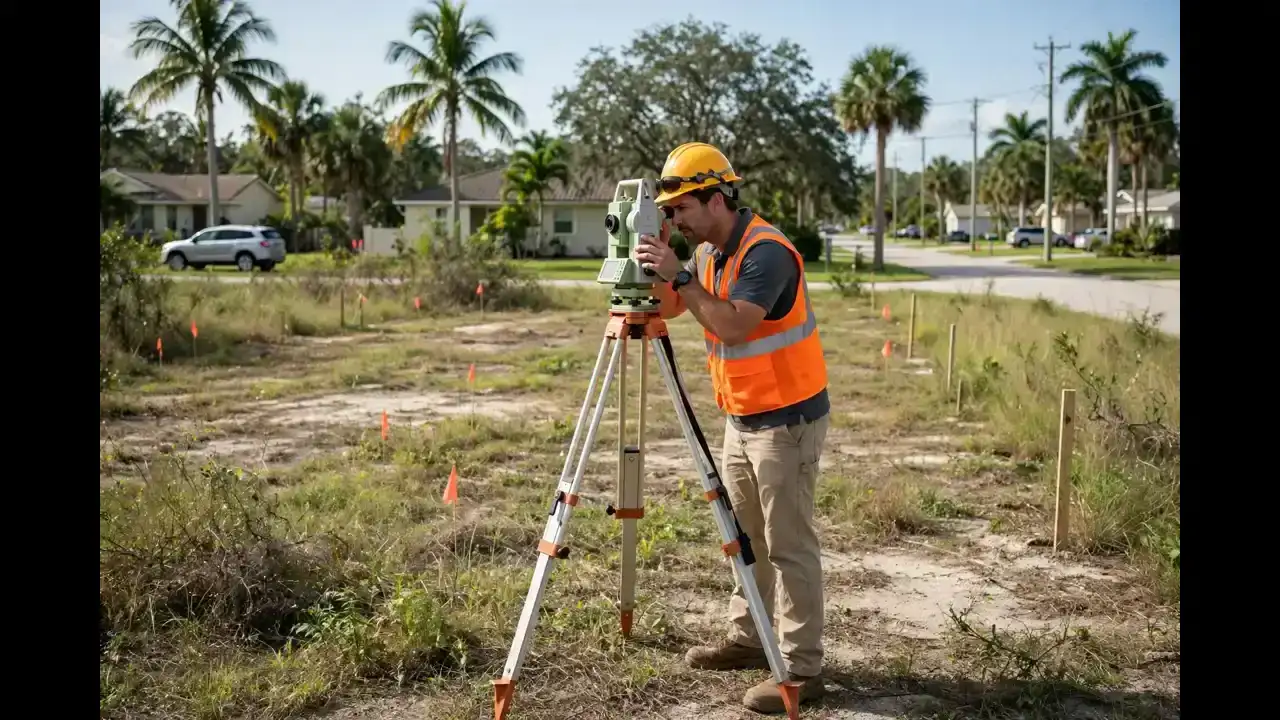
Lenders order an appraisal to confirm the land’s market value, and appraisals on vacant land are often more conservative than for a house because there are fewer comparable sales. A survey confirms boundaries and buildable area, and a perc test or soil evaluation confirms septic feasibility where public sewer is not available. Before a lender orders an appraisal, confirm the zoning, legal access, flood zone, and wetland status with the county. Any one of these can change the loan, and ordering the appraisal first wastes money if the parcel fails a basic check.
Types of Florida Land Loans
Florida offers a wide range of land, and lenders treat each type differently. Where your parcel fits helps you set a realistic budget and choose the right lender.
Improved lot loans
An improved lot has road access, water, sewer, and power, and is ready to build on. These are the easiest land loans in Florida: down payments of 20–30% are typical, terms of 10–20 years are available, and credit unions and community banks compete for them. Seacoast Bank, for example, offers lot loans for residential lots up to 5 acres, and MIDFLORIDA Credit Union offers lot loans up to 80% of market value.
Raw acreage loans
Raw land is unimproved acreage: no utilities, no driveway, no septic, sometimes no surveyed boundary. It is the hardest land to finance in Florida, with the largest down payments (often 30–50%), the shortest terms, and the fewest lenders. Farm Credit associations and local community banks are the realistic sources; most conventional banks will not lend on raw land at all. Buyers of raw land should also budget for a survey, access improvements, and utility extension — costs that can rival the down payment on remote parcels.
Recreational and hunting land
Florida has extensive hunting and recreational land — deer, turkey, and hog hunting, fishing, and camping tracts in the interior. These parcels are often wooded, remote, or lacking utilities, so lenders may require a larger down payment and a shorter term. For the national picture on financing this kind of property, see our guide to recreational land loans.
Farm and ranch land
Central Florida ranchland and farmland — cattle, citrus, sod, and row crops — is where Florida’s Farm Credit associations do their best work. Farm Credit of Central Florida offers land-only loans with no minimum acreage, and agricultural real estate typically requires 20% down. Farm loans are underwritten on the land’s productive value and the farm operation’s income, not just the borrower’s salary — which is why a working farm can qualify on terms a recreational parcel cannot. USDA Farm Service Agency (FSA) farm ownership loans are another route, available through local USDA Service Centers statewide.
Coastal and waterfront lots
Coastal and waterfront lots on the Gulf Coast, the Atlantic Coast, and the Keys command premium prices and bring extra checks: flood zones, the coastal construction control line, wetlands, and insurance. Flood and wind insurance can be expensive, and a lender will want to see that the parcel is insurable before it commits. Confirm flood zone status and insurance availability before you make an offer.
Construction-to-permanent and owner financing
If you plan to build within a year or two, a construction-to-permanent loan can be the cheapest overall route: one loan covers the land purchase and the build, then converts to a standard mortgage when the home is finished. The lender underwrites the finished home’s value, which is why the down payment (typically 15–30%) is lower than a standalone raw land loan. Seller financing is also common for rural Florida land, especially in the interior and for parcels banks find unusual. The seller acts as the lender, terms are negotiable, and the deal is judged mostly on the down payment and the land — but get the contract reviewed, confirm the seller owns the land free and clear, and record the contract. Our land contract calculator can model the payments before you agree to terms.
Land equity loans and HELOCs
If you already own land in Florida free and clear, or with substantial equity, a land equity loan or a home equity line of credit (HELOC) secured by that land can be another way to borrow — for example, to fund a build or a second purchase. These are not purchase loans, and they still require an appraisal and a lien on the property. Compare their terms with a purchase loan before you choose, because the rate, the term, and the tax treatment can differ.
Florida Land Loan Rates
Land loan rates in Florida are higher than rates for a primary-home mortgage, and the gap widens as the land gets less developed. That is because vacant land has no structure to insure, no rental income to service the loan, and a thinner resale market if the lender has to foreclose. For current rate ranges by land type, see our regularly updated guide to land loan interest rates — check it before you apply, because rates move and any figure quoted in a guide goes stale fast.
Several factors move your rate. A larger down payment lowers the lender’s risk and can lower the rate. A shorter term, such as 10 or 15 years instead of 20 or 25, often carries a lower rate for a higher monthly payment. Fixed rates give payment certainty, while adjustable rates may start lower but can rise later. Farm Credit associations and community banks that know local land values sometimes offer more competitive terms for agricultural land than a national lender that rarely finances vacant land. Do not compare rates alone. Ask about the term, whether the loan has a balloon payment, prepayment penalties, origination fees, and appraisal and survey costs — a loan that looks cheap on rate but balloons in five years can be riskier than a slightly higher fixed rate with longer amortization.
To see how the rate changes the payment, here are two illustrations. The rates below are assumed figures used only to show the math — they are not quotes and not current market rates. Use the land loan calculator with today’s rates to run your own numbers.
| Scenario | Loan amount | Assumed rate (illustration only) | Term | Monthly payment |
|---|---|---|---|---|
| $400,000 Central Florida farm/ranch purchase, 20% down | $320,000 | 8.00% fixed | 20 years | ≈ $2,677 |
| $150,000 improved lot, 25% down | $112,500 | 8.00% fixed | 15 years | ≈ $1,075 |
Two things stand out. First, the down payment is doing a lot of work: the farm buyer borrows $320,000 on a $400,000 purchase and pays about $2,677 a month, while the lot buyer borrows about a third as much. Second, the term matters as much as the rate: the 20-year loan’s payment looks manageable, but the total interest paid over 20 years is far higher than over 15. Shorter terms cost more per month and less overall. Choose the term by what your cash flow can carry, not by what makes the monthly payment look smallest — and ask every lender, in writing, whether the loan amortizes fully or has a balloon payment at the end.
Florida-Specific Things to Check Before You Borrow
These are the Florida details that catch out-of-state buyers and first-time land buyers. Check each one before you commit to a parcel — they affect the price, the loan, and the cost of holding the land.
Documentary stamp tax on deeds
Florida charges a documentary stamp tax on deeds of $0.70 per $100 of consideration in every county except Miami-Dade, under Florida Statutes §201.02. That is $700 on a $100,000 land sale and $2,100 on a $300,000 sale. Miami-Dade County is different: the rate there is $0.60 per $100 plus a $0.45 per $100 surtax on vacant land — $1,050 on a $100,000 vacant-land sale and $3,150 on a $300,000 vacant-land sale. All parties to the document are liable for the tax. Who pays is negotiable in the purchase contract, but confirm it in writing so it does not appear as a surprise at the closing table. The Florida Department of Revenue publishes the current documentary stamp tax rules.
Green Belt agricultural classification
Florida’s Green Belt agricultural classification, under Florida Statutes §193.461, lets land in bona fide agricultural use be assessed on its agricultural value rather than its market value — a difference that can cut the tax bill sharply on farmland and ranchland. To keep the classification, the owner must file a return with the county property appraiser by March 1 each year. And merely listing the land for sale does not by itself end the classification while the agricultural use continues: the statute provides that offering property for sale does not constitute a primary use of land and may not be the basis for denying an agricultural classification if the land continues to be used primarily for bona fide agricultural purposes while it is being offered for sale. Before you buy, confirm whether the parcel has a Green Belt classification, when the return is due, and what happens if your intended use — a house, a subdivision, a commercial use — ends the agricultural use. For a farm loan, a Green Belt classification is a plus; for a residential build, losing it changes the holding cost.
Flood zones, wetlands, and the coast
A large share of Florida land sits in or near a flood zone. A flood zone designation can affect insurance costs, building requirements, and lender approval — and flood insurance is often required by the lender. Wetlands are another common surprise: a parcel that looks dry can contain jurisdictional wetlands that cannot be filled or built on without permits. Coastal parcels face the coastal construction control line, which restricts building near the beach. Order a flood certification, check the wetlands delineation, and ask your insurer for a quote before you close.
Utilities, access, and septic
Much rural Florida land is not on municipal water or sewer. A lender will want to know how the land gets water and handles wastewater before it lends — usually a well and a septic system — and a perc test or soil evaluation confirms septic feasibility. Confirm legal access (a recorded easement counts; a dirt track across a neighbor’s field does not), water, and septic suitability with the county before you pay for an appraisal.
Zoning, HOA, and deed restrictions
Florida subdivisions and planned communities often carry HOA rules and deed restrictions that limit what you can build, how much land you must clear, and whether you can keep livestock or run a business. Check the HOA documents, the deed restrictions, and the county zoning before you offer — a restriction that bans the home you plan to build makes the lot worth far less to you, and a lender will notice.
Where You Buy in Florida Changes the Loan
Florida is not one land market. The lender that is best for Central Florida ranchland may not lend at all on a Keys lot, and the terms that work for a subdivision lot near Orlando will not work for Panhandle timberland. Local knowledge is the whole game in Florida land lending.
Central Florida: The interior — Orlando, Lakeland, Ocala, Sebring, and the ranch country around them — is Florida’s farm and ranch heartland: cattle, citrus, sod, and row crops. Farm Credit of Central Florida serves 13 central Florida counties, comparable sales for farmland are plentiful, and a farm plan or a ranch operation is part of everyday underwriting. Farm loans here are the most competitive in the state. If you are buying farmland or ranchland anywhere in Florida, start with the Farm Credit association that serves the county.
North Florida: Jacksonville, Tallahassee, Gainesville, and the surrounding counties mix farmland, timber, and growing suburbs. Land prices are lower than in the south, flood zones along the St. Johns River and the Suwannee matter, and local community banks know these parcels well. Lot loans from credit unions are common near the cities.
South Florida and Miami-Dade: South Florida has the state’s highest land prices and its highest transfer tax on vacant land — Miami-Dade charges $0.60 per $100 plus a $0.45 per $100 surtax on vacant land. Parcels here are usually improved lots or small acreage, and lenders are strict about flood zones, insurance, and zoning. Budget the Miami-Dade surtax and a flood insurance quote into every offer.
Gulf Coast: The Gulf Coast — Tampa Bay, Sarasota, Fort Myers, Naples — has expensive coastal and waterfront lots, with flood insurance, wind coverage, and the coastal construction control line shaping every loan. A lender will want to see that the parcel is insurable before it commits. Confirm flood zone status and insurance availability before you make an offer.
The Panhandle: The Panhandle — Pensacola, Panama City, Tallahassee’s west — has lower prices, timber and farmland, and hurricane exposure. Appraisals can be slower on remote parcels, and lenders may be more cautious on land far from services. Local community banks that know the county are usually the best first call.
The Keys: The Florida Keys are a special case: scarce land, strict building limits, hurricane exposure, and very high prices. Lot loans here are rare and expensive, and many purchases are cash. If you are buying in the Keys, talk to a local lender that has actually closed land loans there before you offer.
Best Florida Land Loan Lenders
The best Florida land loan lender is the one that actually lends on your type of land, in your county, on terms you can live with. That is almost never the biggest bank. These are the lenders Florida land buyers should quote first.
| Lender | Best for | Key details |
|---|---|---|
| Farm Credit of Central Florida | Land-only loans, farm real estate, lot loans | No minimum acreage; ag real estate typically 20% down; serves 13 central Florida counties |
| Farm Credit of Florida | Farm, ranch, and rural land statewide | Farm Credit association serving Florida farm, ranch, and rural land buyers |
| Seacoast Bank | Residential lot loans | Lots up to 5 acres, up to $650,000, max 75% LTV |
| MIDFLORIDA Credit Union | Lot loans | Lot loans up to 80% of market value |
| USDA Farm Service Agency | Farm ownership loans, beginning farmers | Available through local USDA Service Centers statewide |
Farm Credit of Central Florida
Farm Credit of Central Florida offers land-only loans with no minimum acreage, which is unusual — most land lenders want at least 5 or 10 acres. Agricultural real estate typically requires 20% down, and lot loans go up to 75% of the purchase price or appraised value, meaning 25% down. It serves 13 central Florida counties. For farm, ranch, and rural land in Central Florida, it is usually the first call.
Farm Credit of Florida
Farm Credit of Florida is the Farm Credit association serving Florida farm, ranch, and rural land buyers. It finances farm real estate, rural homesites, and agricultural operations, and its underwriting is built around agricultural value and farm income rather than a borrower’s salary alone. If your county is outside Central Florida’s territory, Farm Credit of Florida is the association to quote.
Seacoast Bank
Seacoast Bank offers lot loans for residential lots up to 5 acres, up to $650,000, with a maximum 75% loan-to-value and a 15-year term on a 5/6 adjustable-rate mortgage. It requires a vacant-land appraisal, a boundary survey, residential zoning, and recorded ingress and egress — so have those ready before you apply. It is a good fit for buyers who have found a buildable lot and plan to build.
MIDFLORIDA Credit Union
MIDFLORIDA Credit Union offers lot loans up to 80% of market value, which is a lower down payment than most Florida lot lenders require. Credit unions often price improved lots and smaller acreage near towns competitively, so confirm acreage limits and maximum terms before you pay for an appraisal.
USDA Farm Service Agency (FSA)
USDA FSA farm ownership loans are available through local USDA Service Centers statewide and are designed for family farmers, including beginning farmers who cannot obtain commercial credit on reasonable terms. FSA loans can carry lower down payments than conventional farm loans, and they are the safety net for buyers the commercial market turns away. The trade-off is paperwork and time: FSA applications take longer than a bank loan, so start early.
Community banks and credit unions
Do not overlook local institutions. Small and regional community banks in rural Florida often know local land values better than anyone, and they may be more flexible on unusual parcels, local appraisals, and terms that vary widely. If you are buying in a specific county, ask local agents and farmers which banks regularly close land deals there; their answers are worth more than any national ranking.
How to Apply for a Land Loan in Florida
Land loans take longer than home mortgages. Expect 30–60 days from application to closing for a bank or Farm Credit loan, and longer for an FSA loan. Build that timeline into your purchase contract, and do not waive your financing contingency until the lender has committed.
Step 1: Check your credit and your cash. Know your score, know the down payment you can afford, and add up the closing costs. If your credit is below 680, you will likely need a bigger down payment or an alternative lender.
Step 2: Research and inspect land. Confirm zoning, flood zone, wetlands, and access before you spend money on an appraisal. Look for legal access, floodplain risk, and any county or HOA restrictions.
Step 3: Get pre-approved. A land loan pre-approval gives you a realistic budget and makes you a credible buyer.
Step 4: Compare at least three lenders. Quote a Farm Credit association, a community bank or credit union, and — if the land qualifies — USDA FSA. Compare the APR, the down payment, the term, any balloon provision, and the total cost, not just the monthly payment.
Step 5: Submit your application. Provide tax returns, pay stubs, bank statements, and, for farm loans, farm financials and a business plan. The lender will order an appraisal and may require a survey, a perc test, and a flood certification.
Step 6: Underwriting and conditions. The underwriter reviews your credit, income, debts, and the appraisal. You may be asked for more documents, a larger down payment if the value is lower than expected, or proof of access, utilities, and insurance. Respond quickly to keep the timeline on track.
Step 7: Close. At closing you will sign the note and mortgage, pay the down payment and closing costs — including the documentary stamp tax and intangible tax — and record the deed. For a full rundown of what closing involves and what it costs, see our guide to land closing costs.
Estimate Your Florida Land Loan Payment
Before you fall in love with a parcel, run the numbers. A larger down payment, a shorter term, or a lower rate can change your monthly payment by hundreds of dollars, and land loans often have shorter terms than home mortgages, which pushes payments higher.
1. Find the loan amount. Subtract the down payment from the purchase price. On a $250,000 parcel with a 25% down payment, the loan amount is $187,500.
2. Enter the loan amount, rate, and term in the calculator. Use our free land loan calculator to test different purchase prices, down payments, rates, and terms for Florida land. For a quick monthly estimate, the land payment calculator will show principal and interest on any loan amount. As an illustration only — using an assumed 8.00% fixed rate over 15 years — that $187,500 loan would cost about $1,792 per month in principal and interest.
3. Add the holding costs. The loan payment is not the whole monthly cost. Include property taxes, hazard and flood insurance, and any HOA fees or road maintenance. A parcel that costs $1,792 a month in loan payments can easily cost $2,300 a month all-in in Florida, where insurance is a major cost.
4. Stress-test it. Run the payment at a higher rate and a shorter term, and ask whether you could still carry the land if your income dipped or the build took a year longer than planned. Land does not generate income while you hold it, so the payment has to fit your existing cash flow — not a future rent check or a future sale.
Run the numbers before you fall in love with the parcel. The payment tells you whether the land is affordable; the appraisal tells you whether the price is fair. Neither should come as a surprise after you have signed.
Costs Beyond the Purchase Price
The down payment is only the start. Budget for these Florida land purchase costs before you make an offer — several are due whether or not the loan closes, and Florida’s documentary stamp and intangible taxes are ones buyers often forget.
| Cost | Typical range |
|---|---|
| Appraisal | $500–$2,000+ |
| Land survey | $500–$2,500+ |
| Perc test / soil evaluation | $500–$2,000+ |
| Documentary stamp tax on the deed | $0.70 per $100 of consideration (Miami-Dade vacant land $1.05 per $100) |
| Documentary stamps on the note | $0.35 per $100 of the mortgage amount |
| Nonrecurring intangible tax | $2.00 per $1,000 financed |
| Recording fees | Usually under $200 |
| Title search and insurance | $1,000–$3,000 |
| Escrow and closing fees | $500–$2,000 |
| Loan origination and lender fees | 0.5–2% of the loan |
| Insurance (first year; flood extra) | $1,500–$5,000+ |
Keep a contingency of at least 5–10% of the purchase price for surprises — a low appraisal, a failed perc test, a boundary dispute, a wetlands finding, or a well that needs work. Our guide to land survey cost explains what a survey costs and why lenders require one. The Consumer Financial Protection Bureau publishes plain-language guidance on mortgage closing costs that applies to land loans as well.
Mistakes to Avoid
- Skipping the parcel checks. Buying land before confirming zoning, legal access, flood zone, wetlands, and perc suitability is how buyers end up with an unfinanceable parcel.
- Assuming a big bank will lend. National banks rarely finance vacant land — ask Farm Credit of Central Florida, Farm Credit of Florida, Seacoast Bank, MIDFLORIDA, and community banks first.
- Ignoring flood zones and wetlands. A flood zone designation changes insurance costs and can block a loan; wetlands can make part of the parcel unbuildable.
- Forgetting the documentary stamp and intangible taxes. Budget the deed stamps, the note stamps, and the nonrecurring intangible tax — they add up on a large loan.
- Accepting a balloon payment without a plan. Know when the balloon hits and how you will pay it — sell, build, or refinance — before you sign.
- Not getting three quotes. Land loan pricing varies widely. One quote is a guess; three quotes are a market.
Frequently Asked Questions
How much is a down payment on land in Florida?
Expect 15 to 25 percent for a residential lot, 20 to 30 percent for improved land, and 30 to 50 percent for raw land or recreational land. Farm and agricultural land through Farm Credit or USDA Farm Service Agency can be 15 to 20 percent, and construction-to-permanent loans are typically 15 to 30 percent. Budget reserves on top of the down payment.
What credit score do you need for a land loan in Florida?
Most Florida lenders prefer a credit score of 680 or higher for lot loans, and 700 or higher for raw land and the best rates. Farm Credit associations and USDA Farm Service Agency loans can be more flexible on credit, and seller financing may not check your credit at all.
What is the documentary stamp tax on a Florida land purchase?
Florida charges a documentary stamp tax on deeds of 70 cents per 100 dollars of consideration, under Florida Statutes section 201.02. That is 700 dollars on a 100,000 dollar land sale. Miami-Dade County charges 60 cents per 100 dollars plus a 45 cent per 100 dollar surtax on vacant land, which is 1,050 dollars on a 100,000 dollar vacant-land sale. All parties to the document are liable for the tax.
What is Green Belt agricultural classification in Florida?
Green Belt agricultural classification, under Florida Statutes section 193.461, lets land in bona fide agricultural use be assessed on its agricultural value rather than its market value. To keep the classification, the owner must file a return with the county property appraiser by March 1 each year. Offering the land for sale does not by itself end the classification while the agricultural use continues, but land diverted from agricultural use is reclassified.
What are current Florida land loan rates?
Land loan rates change often and vary by credit score, down payment, land type, and term, so check our land loan interest rates page for the current ranges before you apply. In general, land loans price above home mortgage rates, and improved lots price lower than raw land. Get at least three quotes and compare the APR and total cost.
Can you get a land loan in Florida with bad credit?
It is difficult through a conventional lender, but not always impossible. Options include a larger down payment, seller financing, a USDA Farm Service Agency loan if you farm, or improving your credit score before you apply. No lender will stretch on credit for a parcel it cannot value or resell.
Does Florida have USDA land loans?
Yes. USDA Farm Service Agency farm ownership loans are available through local USDA Service Centers statewide, including for beginning farmers who cannot get commercial credit on reasonable terms. USDA Rural Development programs can also help eligible rural buyers finance a home with land. Find your local office through the USDA Farm Service Agency.
Do Florida land loans have balloon payments?
Many do, especially shorter-term land loans and seller-financed deals. With a balloon loan, the remaining balance comes due in full at the end of the term. Ask every lender in writing whether the loan fully amortizes or has a balloon, and have a plan to sell, build, or refinance before it comes due.
Florida Land Loan Checklist
- Credit score checked; 680 minimum for lot loans, 700+ for raw land and the best terms
- Down payment saved, plus closing costs and three to six months of reserves
- Parcel verified: zoning, legal access, flood zone, wetlands, water, septic, perc test
- Documentary stamp tax and intangible tax budgeted, including the Miami-Dade surtax where it applies
- Green Belt classification confirmed with the county property appraiser
- Flood and hazard insurance quoted before making an offer
- At least three quotes: Farm Credit of Central Florida or Farm Credit of Florida, Seacoast Bank or MIDFLORIDA, and a community bank or credit union
- Pre-approval in hand before making an offer
- Appraisal, survey, and perc test ordered during the contingency period
- Balloon terms, if any, understood in writing
- Payment run through the land loan calculator, including taxes and insurance
By Jameel Noori, Founder & Developer, Land Loan Calculator
About the author: Jameel Noori is the Founder & Developer of Land Loan Calculator. He writes practical, U.S.-focused guides to land financing, loan math, and buyer strategy.
Reviewed by: Jameel Noori, Founder and Lead Developer of Land Loan Calculator, reviewed this article for accuracy.
Disclaimer: This article is for informational purposes only and is not financial advice. Land loan rates and terms vary by lender, property, and market conditions. Consult a licensed loan professional before making financial decisions.
