
Land Financing Calculator

A land financing calculator shows what it really costs to buy land with borrowed money — down payment, monthly payment, closing costs, and lifetime interest in one view. Quick 2026 example: a $120,000 parcel with 25% down ($30,000) at 8% over 15 years means a $90,000 loan with an $860/month principal-and-interest payment, about $3,600 in closing costs, and roughly $64,816 in total interest. Enter your own numbers in the free calculator below and compare the four main ways Americans finance land.
Table of Contents
- How to Use This Land Financing Calculator
- What Is Land Financing?
- The 4 Main Ways to Finance Land in the U.S.
- How Land Financing Payments Are Calculated
- Typical Land Financing Terms in 2026
- The Full Cost: Closing Costs, Taxes & Insurance
- Can You Afford It? The Income Test
- Land Financing vs Home Mortgage Financing
- How to Get Better Financing Terms
- 5 Red Flags in Land Financing Offers
- Worked Example: Financing a $120,000 Parcel
- Frequently Asked Questions
Land Financing Calculator
Compare the real cost of financing land — down payment, monthly payment, closing costs, and total cost — across four common financing options.
| Term | Monthly P&I | Total interest |
|---|
Estimate only. Rates, terms, closing costs and taxes vary by lender, land type and location. This is not financial advice.
How to Use This Land Financing Calculator
- Enter the land price — the full purchase price of the parcel.
- Pick a financing option — conventional bank land loan, Farm Credit association, USDA/FSA program, or seller financing. Each option loads realistic 2026 rate and down payment defaults; adjust them to match your actual quote.
- Set the interest rate and term — most land loans run 5–20 years at 6.5–10%.
- Estimate closing costs — land closings typically run 2–5% of the price; the default 3% is a reasonable starting point.
- Add property tax and insurance — vacant land is usually taxed at 0.5–1.5% of assessed value per year, and bare-land liability insurance runs $300–$800/year.
- Optional: enter your gross monthly income — the calculator checks whether the payment fits comfortably under standard debt-to-income guidelines.
The results show your down payment, loan amount, cash needed at closing, total monthly payment, total interest, and the total cost of financing — plus a 10/15/20-year term comparison so you can see what a shorter term saves. These are planning estimates; your lender's underwriting decides the final terms.
What Is Land Financing?
Land financing is the full funding package used to buy a parcel of land — the down payment, the loan itself, the closing costs, and the ongoing taxes and insurance. A "land loan" usually refers only to the borrowed portion, but financing a land purchase involves a bigger picture:
- Down payment — your cash equity, typically 20–50% on land (much higher than a home purchase).
- The loan — a bank land loan, Farm Credit loan, USDA/FSA loan, or seller-financed note, amortized over 5–20 years.
- Closing costs — title work, survey, recording fees, and lender fees, usually 2–5% of the price.
- Carrying costs — property taxes and insurance you pay every year you own the parcel.
Thinking in terms of financing rather than just the loan prevents the classic land-buyer mistake: qualifying for the monthly payment but getting blindsided by the $30,000+ cash needed at closing. The calculator above models all four layers together. If you only want the loan payment math, our land loan calculator on the homepage covers that; for the mortgage-style view with taxes and insurance, see the land mortgage calculator.
The 4 Main Ways to Finance Land in the U.S.
Most large national banks do little land lending, so buyers usually finance through one of four channels:

1. Conventional bank land loans
Community banks and credit unions that know local land values are the most common source. Expect 20–50% down, 7–10% rates, and 5–15 year terms, with full underwriting (credit, income, appraisal, survey). A local lender two counties from your parcel is often more flexible than a national brand.
2. Farm Credit associations
The Farm Credit System's local associations are the largest land lenders in the country, especially for agricultural and rural parcels. They understand land collateral and often offer the best combinations of rate and term — frequently 25–40% down at 6.5–8.5% over 15–25 years.
3. USDA / FSA programs
Qualifying rural borrowers can access low- or zero-down financing. The USDA's Farm Service Agency makes direct and guaranteed farm ownership loans for buyers who cannot obtain conventional credit, with below-market rates and long terms. Land tied to an eligible rural home may also qualify for USDA rural housing programs with 0% down. Compare the tradeoffs in our USDA loan vs land loan guide, and see the current programs on the USDA Farm Service Agency site.
4. Seller financing
When bank financing is unavailable, some sellers finance the purchase directly — often with 10–20% down at 8–12%, frequently on a short term with a balloon payment. It is the fastest route to a deal but usually the most expensive. Our land contract calculator models seller-financed payments including balloon structures.
How Land Financing Payments Are Calculated
The monthly loan payment uses the standard fixed-rate amortization formula:
M = P × r(1+r)n / ((1+r)n − 1)
Where M is the monthly payment, P is the loan principal, r is the monthly interest rate (annual rate ÷ 12), and n is the number of monthly payments (years × 12).
For the quick-answer example: P = $90,000, r = 0.08 ÷ 12 = 0.00667, n = 180. That gives M = $860.09/month. Total interest is (M × n) − P = $64,815.64.
Your total monthly financing cost adds tax and insurance on top: $860.09 + $100 tax + $41.67 insurance = $1,001.75/month. The full year-by-year breakdown for any loan is covered in our land loan amortization calculator, and the payment formula is explained step by step in how to calculate a land loan.
Typical Land Financing Terms in 2026
Because bare land produces no rent and can be hard to resell quickly, lenders treat it as riskier collateral than a house. Here is what typical 2026 terms look like by financing channel:
| Financing option | Typical down payment | Typical rate (2026) | Typical max term |
|---|---|---|---|
| Conventional bank land loan | 25–50% | 7–10% | 10–15 years |
| Farm Credit association | 25–40% | 6.5–8.5% | 15–25 years |
| USDA / FSA program | 0–10% | Below market | 20–40 years |
| Seller financing | 10–20% | 8–12% | 3–10 years (often balloon) |
These are planning estimates based on 2026 lender guidelines, not quotes — your credit profile, the property's appraisal, and the lender's portfolio appetite all move the final numbers. See our full breakdown of land loan interest rates and model different down payments with our down payment for land loan calculator.
The Full Cost: Closing Costs, Taxes & Insurance
Most online calculators quote principal and interest only — and then your first real bill is hundreds higher. A financed land purchase has three cost layers beyond the loan:
- Closing costs (2–5% of price): title search and title insurance, recording fees, survey, appraisal, and lender origination fees. On a $120,000 parcel, budget $2,400–$6,000. Our land closing costs guide breaks down every line item U.S. buyers actually pay.
- Property taxes: vacant land is taxed, and rates vary wildly by county — roughly 0.5–1.5% of assessed value per year is a common range, but some rural counties are lower and some states much higher. Always check the county assessor's records before you budget.
- Insurance: bare land needs liability coverage ($300–$800/year is typical), not a full homeowner's policy. If the parcel has barns, a cabin, or other structures, insure those separately.
Many land lenders do not escrow taxes and insurance the way home mortgage servicers do — you may pay the county and the insurer directly. Confirm this at closing so a missed tax bill never becomes a lien surprise.
Can You Afford It? The Income Test
Lenders measure affordability with the debt-to-income (DTI) ratio: all your monthly debt payments divided by your gross monthly income. The Consumer Financial Protection Bureau explains the calculation and notes that different loan products have different limits (see the CFPB's DTI explainer).
- Under 28% (payment-to-income): comfortably affordable by the classic housing guideline.
- 28–36%: a stretch, but often still financeable — especially with strong credit and reserves.
- Above 36–43%: most lenders cap total debt payments around 43% of income. A payment that eats this much alone leaves little room for your other debts.
Enter your income in the calculator above and it applies this test automatically. Before you apply anywhere, also work out how much land you can afford so your price range matches your income and down payment capacity, and review the full land loan requirements checklist.
Land Financing vs Home Mortgage Financing
Financing land is a different product from financing a home — here is how the two compare:
| Feature | Land financing | Home mortgage |
|---|---|---|
| Typical down payment | 20–50% | 3–20% |
| Typical rate (2026) | 6.5–10% | ~6–7% |
| Typical max term | 5–20 years | 30 years |
| Government-backed options | USDA/FSA (limited) | FHA, VA, USDA, conventional |
| PMI / mortgage insurance | Generally not applicable | Required below 20% down |
| Tax escrow | Often not escrowed | Usually escrowed |
| Appraisal complexity | Higher — few comparable sales | Standard |
Land lenders protect themselves with the large down payment instead of mortgage insurance, and they price the rate 1–3 points above home mortgage rates to reflect the weaker collateral. That is also why comparing at least three lenders matters more for land than for homes — the spread between quotes is wider.
How to Get Better Financing Terms
- Raise your credit score before you apply. Most land lenders want 670+; the best rates go to 720+. Even a 20-point improvement can move your quote.
- Put more down. Moving from 25% to 40% down lowers the lender's risk and often unlocks a better rate — and it cuts total interest dramatically.
- Get three quotes minimum. Compare a community bank, a Farm Credit association, and one more lender. A single point of rate difference on a 15-year note is worth thousands.
- Buy improved land if you can. A build-ready lot with road access and utilities prices far better than raw acreage.
- Ask about USDA/FSA eligibility. If the parcel qualifies, government programs can beat every conventional quote on down payment and rate.
- Shorten the term if cash flow allows. A 10-year note at 8% on $90,000 costs $1,091.95/month versus $860.09 on 15 years — but saves about $22,400 in interest.
5 Red Flags in Land Financing Offers
- A "low rate" with a hidden balloon. Some seller and private notes quote an attractive rate but demand the full balance in 3–5 years. Know the balloon date before you sign — and have a refinance or payoff plan.
- Prepayment penalties. Most bank land loans do not penalize early payoff, but some seller-financed and private notes do. If you plan to pay extra or refinance, get it in writing that there is no penalty.
- Points and junk fees. Origination fees above 1–2% of the loan, "processing" fees, and mandatory add-on products inflate the true cost. Compare the APR, not just the rate.
- No appraisal or title work. Any legitimate financing requires an independent valuation and clean title. A lender or seller who skips these is a lender to avoid.
- Pressure to close fast without a survey. Land boundaries are where expensive disputes start. Budget for a land survey and never close without one.
Worked Example: Financing a $120,000 Parcel
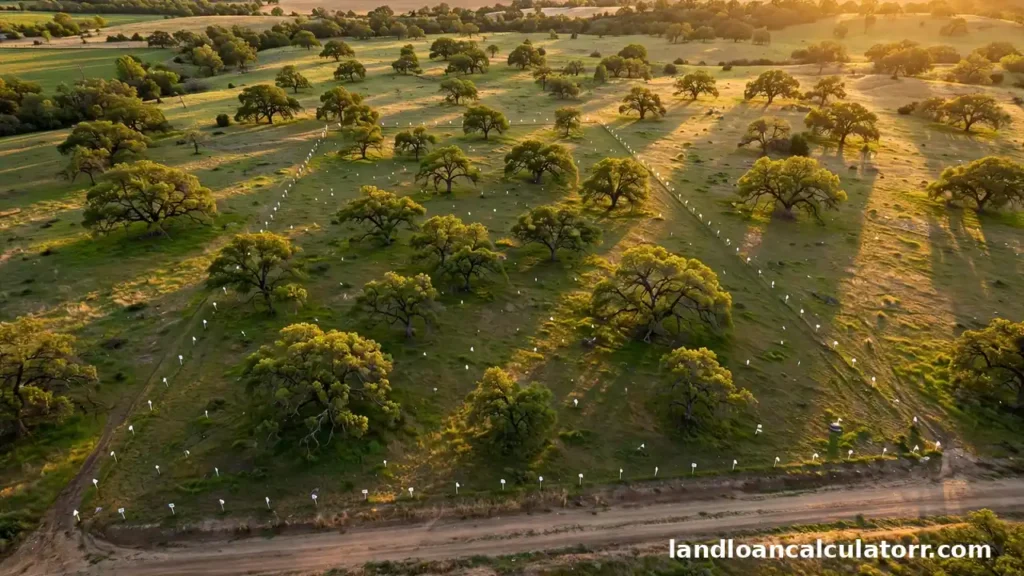
Let us walk through the calculator's default scenario — conventional bank financing in 2026:
Inputs: $120,000 land price · 25% down payment · 8% interest · 15-year term · 3% closing costs · $1,200/year property tax · $500/year insurance · $6,500/month gross income.
Step 1 — Down payment and loan: $120,000 × 25% = $30,000 down; loan amount = $90,000.
Step 2 — Monthly P&I: $90,000 at 8% over 180 months = $860.09/month.
Step 3 — Tax and insurance: $1,200 ÷ 12 = $100/month tax; $500 ÷ 12 = $41.67/month insurance.
Step 4 — Total monthly payment: $860.09 + $100 + $41.67 = $1,001.75/month.
Step 5 — Cash needed at closing: $30,000 down + $3,600 closing costs (3%) = $33,600 — this is the number that surprises first-time land buyers.
Step 6 — Lifetime cost: $860.09 × 180 = $154,815.64 in loan payments, of which $64,815.64 is interest. Add $30,000 down + $3,600 closing + $25,500 in taxes and insurance over 15 years, and the true all-in cost is about $213,900 — nearly 80% above the sticker price.
Step 7 — Affordability: $1,001.75 ÷ $6,500 = 15.4% of gross income — comfortably affordable under the 28% guideline, leaving room for other debts.
Buying to build later? Read our construction loan vs land loan comparison and the loan for land purchase guide to plan the full sequence.
Frequently Asked Questions
What does a land financing calculator do?
A land financing calculator estimates the full cost of buying land with borrowed money: the down payment, monthly principal-and-interest payment, closing costs, property taxes, insurance, total interest, and the all-in cost of the parcel. This calculator also compares financing options (bank, Farm Credit, USDA, seller financing) and checks affordability against your income.
How much down payment do I need to finance land?
Most U.S. lenders require 20–50% down on land. Conventional bank loans typically want 25–50%, Farm Credit associations 25–40%, and seller financing 10–20%. USDA/FSA programs are the main route to low- or zero-down land financing for qualifying rural borrowers.
What is the average interest rate for land financing in 2026?
Typical land financing rates in 2026 run 6.5–10%, roughly 1–3 percentage points above home mortgage rates. Farm Credit and improved-lot loans price at the low end; raw land and seller financing at the high end. Your credit score, down payment, and land type all move the final rate.
Can you finance land with no money down?
Rarely outside government programs. USDA/FSA farm ownership loans and some USDA rural housing programs can finance eligible land with 0% down, but they have income limits, property eligibility rules, and limited funding. Conventional and seller-financed land deals almost always require a down payment.
Is land financing the same as a land loan?
Not exactly. A land loan is the borrowed portion; land financing is the whole funding package — down payment, loan, closing costs, taxes, and insurance. Thinking in financing terms (not just the loan) is what keeps the cash-needed-at-closing from becoming a surprise.
How long can you finance land for?
Most land loans run 5–20 years. Conventional bank loans usually cap at 10–15 years; Farm Credit associations often go to 20–25 years; USDA programs can stretch to 30–40 years. A 30-year land loan from a private lender is rare — check for a balloon clause.
Does financing land include closing costs?
The loan itself does not, but your financing plan must. Land closings typically cost 2–5% of the purchase price (title, survey, appraisal, recording, lender fees). This calculator estimates closing costs separately so your cash-at-closing number is realistic.
What credit score do I need to finance land?
Most land lenders want a credit score of 670 or above, with the best rates going to 720+. Below 660, expect either a denial or a much larger down payment requirement. USDA/FSA programs can be more flexible for borrowers with limited credit history.
By Jameel Noori, Founder & Developer, Land Loan Calculator
About the author: Jameel Noori is the Founder & Developer of Land Loan Calculator. He writes practical, U.S.-focused guides on land financing, loan math, and buyer strategy.
Reviewed by: Jameel Noori, Founder & Lead Developer of Land Loan Calculator, reviewed this article for accuracy.
Disclaimer: This article is for informational purposes only and is not financial advice. Land loan rates and terms vary by lender, property, and market conditions. Consult a licensed loan professional before making financing decisions.