

Land Contract Calculator

A land contract calculator estimates your monthly payment, total interest, and balloon payment when you buy land or property directly from the seller instead of a bank. Enter the purchase price, down payment, interest rate, and term — with an optional balloon date — and it instantly shows what you will owe each month and what balance remains due at the end. Use the free calculator below, then read the complete guide to how land contracts work, their risks, and how they compare to a traditional mortgage.
Land Contract Calculator
Land Contract Payment Calculator
Estimate your monthly payment, total interest, balloon amount, and full amortization schedule.
| # | Payment | Principal | Interest | Balance |
|---|
Estimates only — not a loan offer. Actual land contract terms vary by seller, state law, taxes, insurance, and fees. Consult a licensed loan professional or real estate attorney before signing.
Enter your contract details above — this land contract amortization calculator estimates your monthly payment, total interest, balloon amount, and full payment schedule. All figures are estimates for planning purposes.
What Is a Land Contract?
A land contract — also called a contract for deed, installment land contract, or agreement for deed — is a form of seller financing. Instead of borrowing from a bank, the buyer makes installment payments directly to the seller. The seller keeps legal title to the property until the buyer completes all payments, at which point the deed transfers to the buyer.
During the contract term, the buyer typically takes possession and assumes most ownership duties — property taxes, insurance, maintenance, and repairs — even though the deed is not yet theirs, as the Consumer Financial Protection Bureau (CFPB) explains. They are commonly used for vacant land and rural property when buyers cannot qualify for conventional financing.
How Land Contract Payments Are Calculated
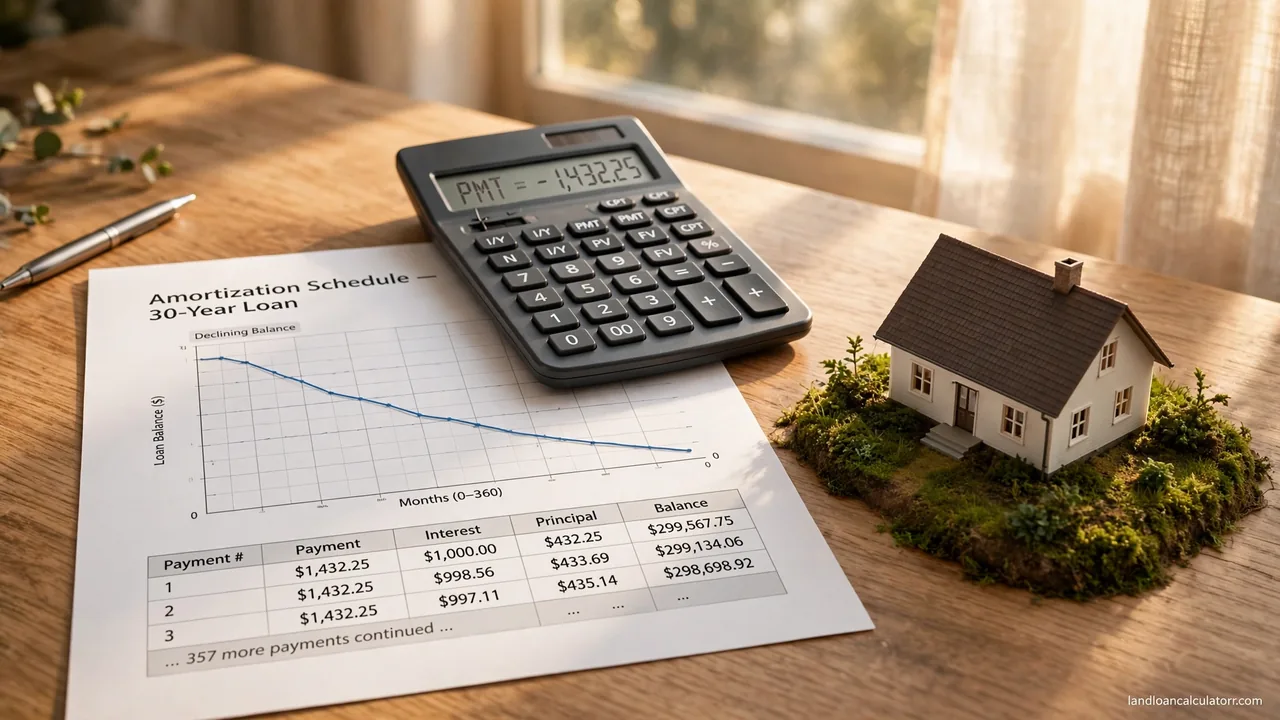
A land contract payment calculator uses the standard loan amortization formula — the same math behind a mortgage payment:
Monthly payment = P × r ÷ (1 − (1 + r)−n)
Where P is the financed amount (price minus down payment), r is the monthly interest rate (annual rate ÷ 12), and n is the total number of payments. Each payment is split into an interest portion (balance × monthly rate) and a principal portion (the rest), so early payments are mostly interest while later payments pay down principal faster.
Two features make land contracts different from standard mortgages and change the math:
- Balloon payments: many contracts amortize over 15–30 years but require the full remaining balance after a much shorter period (often 3–7 years).
- Extra payments: paying more than the scheduled amount each month reduces principal faster, which shrinks total interest and can lower — or even eliminate — the balloon amount.
The calculator above handles both. If you want to see how a standard amortizing loan compares, try our land loan amortization calculator side by side.
Balloon Payments Explained
A balloon payment is a large lump sum due at the end of a short contract term, even though payments were calculated over a much longer amortization. For example, a $162,000 contract at 8% amortized over 30 years costs about $1,189/month — but with full payoff required after 5 years, roughly $154,000 is still due on that date.
Balloon structures are the single biggest risk in land contracts. Before signing, have a realistic plan: refinance into a conventional loan, sell the property, or pay cash. The CFPB warns that buyers who cannot make a required balloon payment can face eviction and lose everything paid in.
How to plan for a balloon date
- Get pre-qualified for refinancing 6–12 months before the balloon date, not after it.
- Make extra principal payments during the contract term to shrink the balloon amount.
- Negotiate the longest balloon period the seller will accept — each extra year meaningfully reduces the lump sum.
- Keep your credit clean during the contract so refinancing remains an option.
What Happens If You Miss Payments?
This is the most misunderstood — and most dangerous — part of land contracts. Many contracts include a forfeiture clause: if the buyer defaults (missed payment, unpaid taxes, lapsed insurance), the seller can cancel the contract, retake the property, and keep everything the buyer has paid — down payment, principal, interest, and even the value of improvements the buyer made.
Unlike a traditional mortgage, where the lender must go through a lengthy foreclosure process, forfeiture under a land contract can be fast. However, protections vary significantly by state: some states require sellers to follow foreclosure-like procedures or give the buyer time to cure the default first.
To protect yourself:
- Read the default and forfeiture clauses before signing — never after.
- Have a real estate attorney in your state review the contract.
- Keep taxes and insurance current; most defaults are triggered by these, not just monthly payments.
- Communicate with the seller early if you expect trouble — a written forbearance beats a forfeiture notice.
Land Contract vs Traditional Mortgage

Both finance a property purchase, but the mechanics, risks, and costs differ sharply:
| Feature | Land Contract | Traditional Mortgage |
|---|---|---|
| Lender | The property seller | Bank or mortgage company |
| Title | Seller keeps deed until paid in full | Buyer holds title; lender holds a lien |
| Qualifying | Negotiated; often no credit check | Credit, income, and appraisal required |
| Interest rate | Negotiated; often higher than market | Market rate based on credit profile |
| Balloon payment | Very common | Rare in residential loans |
| Default remedy | Forfeiture (fast, buyer may lose all) | Foreclosure (slower, regulated process) |
| Closing costs | Lower, but fewer protections | Higher, with regulated disclosures |
Cost comparison: because land contract rates are negotiated and often run above conventional mortgage rates, the same purchase price usually costs more in total interest under a land contract — even before accounting for the refinancing you will likely need at the balloon date. Run both scenarios: use this page’s calculator for the contract terms, then compare with our land loan calculator using a conventional rate and term to see the true cost difference.
Taxes, Insurance & Escrow: Who Pays What?
In a typical land contract, the buyer pays property taxes and insurance, just like a homeowner — even though the seller still holds the deed. This surprises many first-time buyers.
- Property taxes: the contract should state who pays and when. If the buyer fails to pay, most contracts treat it as a default.
- Insurance: the buyer usually carries a policy naming the seller as an additional insured party, since the seller still owns the property on paper.
- Escrow: unlike mortgages, there is rarely a formal escrow account. Some buyers and sellers agree to one voluntarily — or use a third-party servicing company — to make sure taxes and insurance actually get paid.
Confirm in writing how tax and insurance payments are documented each year. The CFPB has found cases where sellers collected tax money from buyers but never paid it, leaving buyers with liens and penalties.
Are Land Contracts Legal? State-by-State Rules
Land contracts are legal in most U.S. states, but the rules, required disclosures, and buyer protections vary widely:
- Some states require contracts for deed to be recorded with the county — recording protects the buyer against later liens or a seller who tries to sell the property twice.
- Some states give buyers foreclosure-like protections, including a right to cure the default and a minimum notice period before the seller can repossess.
- A few states restrict or heavily regulate contracts for deed, particularly for residential properties.
- In 2024, the CFPB issued an advisory opinion stating that contracts for deed fall under federal home lending rules, adding disclosure and consumer-protection requirements for larger sellers.
Because the law is so state-specific, generic online templates are risky. Budget for a local real estate attorney to review your contract — it is the cheapest insurance in the transaction. If you are still learning the basics, start with what a land loan calculator is and how to calculate a land loan first.
Title Insurance & Closing Costs
Skipping title work is one of the most expensive mistakes land contract buyers make. Before signing:
- Get a title search. The seller might not have clear title — existing mortgages, tax liens, or judgments against the seller can all attach to the property.
- Consider title insurance. An owner’s title policy (or at minimum an attorney’s title opinion) protects you if hidden defects surface later.
- Record the contract. Recording puts the public on notice of your interest and prevents the seller from encumbering or reselling the property behind your back. Confirm who is responsible for recording and who pays the fee.
- Budget closing costs. Even without a bank, expect recording fees, title search or insurance premiums, and attorney fees — typically far less than mortgage closing costs, but not zero.
Seller’s Guide: Tax Treatment of Land Contracts
Land contracts are not just a buyer tool — sellers use them strategically, too. Under the IRS installment sale method, a seller who finances the sale may spread capital-gains tax across the years payments are received rather than owing it all in the sale year — one of the main reasons landowners offer contracts.
Key points for sellers:
- Interest income received is generally taxable as ordinary income in the year received.
- The installment method has eligibility rules and exceptions (for example, it generally does not apply to sales at a loss or to certain dealer sales).
- If the buyer defaults and the property is repossessed, the tax accounting gets complicated.
Tax law is complex and fact-specific — consult a qualified tax professional before structuring a sale. This section is educational only and is not tax advice.
Common Mistakes to Avoid
- Signing without a title search — hidden liens become your problem.
- Ignoring the balloon date — no refinancing plan is the #1 reason land contracts fail.
- Not recording the contract — leaves you exposed to the seller’s creditors.
- Verbal side agreements — if it is not in the written contract, it does not exist.
- Skipping the attorney review — state law controls everything here; templates do not know your state.
- Overlooking tax and insurance duties — most defaults start here, not with the monthly payment.
- No prepayment terms — confirm in writing whether extra payments are allowed and whether any prepayment penalty applies.
How to Negotiate Land Contract Terms
Almost everything in a land contract is negotiable. Buyers who negotiate typically get materially better deals:
- Interest rate: anchor to current mortgage rates plus a modest premium — not whatever the seller first proposes.
- Down payment: larger down payments can justify demanding a lower rate or longer balloon period.
- Balloon length: push for the longest term the seller will accept; model the difference with the calculator above.
- Amortization schedule: a 30-year amortization keeps payments low, but confirm the balloon date separately.
- Prepayment: insist on the right to make extra payments with no penalty.
- Taxes and insurance: spell out exactly who pays, how it is documented, and what counts as default.
- Recording and title: require a title search and agree in writing to record the contract promptly.
Worked Example: $180,000 Land Contract
Suppose you agree to buy land for $180,000 with 10% down ($18,000), an 8% interest rate, payments amortized over 30 years, and the full balance due after 5 years (balloon):
- Amount financed: $162,000
- Monthly payment: ≈ $1,189
- Total paid over 5 years: ≈ $71,325 (of which ≈ $63,335 is interest)
- Balloon amount due at year 5: ≈ $154,010
Notice how little principal is repaid in the early years — after 60 payments, the buyer still owes about 95% of the original loan. This is why the balloon plan matters more than the monthly payment. Plug your own numbers into the land contract calculator at the top of this page to see your scenario.
Frequently Asked Questions (FAQs)
What is a land contract calculator?
A land contract calculator estimates the monthly payment, total interest, and balloon amount for seller-financed property purchases. You enter the purchase price, down payment, interest rate, and term, and it computes the amortization schedule — including what you will still owe if the contract has a balloon date.
How is a land contract payment calculated?
Payments use the standard amortization formula: the financed amount multiplied by the monthly interest rate, divided by one minus the discount factor over the total number of payments. The calculator above does this math instantly, including extra payments and balloon scenarios.
What is a balloon payment in a land contract?
A balloon payment is the large remaining balance due at the end of a short contract term, even though monthly payments were calculated over a longer amortization period. For example, payments may be based on a 30-year schedule while the full balance comes due after 5 years.
Are land contracts legal in every state?
Land contracts are legal in most U.S. states, but protections vary widely. Some states require recording and give buyers foreclosure-like rights before repossession; others allow fast forfeiture. Always have a local real estate attorney review your contract.
What happens if I miss a payment on a land contract?
Many contracts allow the seller to cancel the agreement and retake the property through forfeiture — potentially keeping your down payment and all prior payments. Some states require notice and a cure period first. Read the default clause before signing and keep taxes and insurance current.
Is a land contract better than a mortgage?
It depends. Land contracts offer easier qualifying and lower closing costs, but usually carry higher interest rates, balloon risk, and weaker buyer protections than conventional mortgages. Compare total costs with both this calculator and a standard land loan calculator before deciding.
Who pays property taxes on a land contract?
In a typical land contract, the buyer pays property taxes and insurance even though the seller retains the deed. The contract should spell out exactly who pays, how payments are documented, and what happens if they are missed.
Can I refinance a land contract into a regular mortgage?
Yes — refinancing before the balloon date is the most common exit strategy. Lenders will treat it like a purchase refinance, so you will need qualifying credit, income documentation, and usually an appraisal. Start the process 6–12 months before the balloon date.
By Jameel Noori, Founder & Developer, Land Loan Calculator
About the author: Jameel Noori is the Founder & Developer of Land Loan Calculator. He writes practical, U.S.-focused guides on land financing, loan math, and buyer strategy.
Reviewed by: Jameel Noori, Founder & Lead Developer of Land Loan Calculator, reviewed this article for accuracy.
Disclaimer: This article is for informational purposes only and is not financial advice. Land loan rates and terms vary by lender, property, and market conditions. Consult a licensed loan professional before making financing decisions.