Vacant Land Loan Calculator: How U.S. Buyers Estimate Payments on Undeveloped Land

By Sarah Mitchell, Head of Content & Land Finance Research · Reviewed by Zayn Ashford, Founder & Lead Developer
A vacant land loan calculator is a free online tool that estimates what it will cost to finance an empty parcel of land: your monthly payment, total interest, and overall loan cost. Vacant land — property with no buildings on it — is financed on tougher terms than a house, with bigger down payments, higher rates, and shorter terms, so running the numbers before you talk to a lender is essential. This guide shows you how the calculator works, what numbers to enter, and how U.S. buyers use the results to plan.
What Is a Vacant Land Loan Calculator?
A vacant land loan calculator takes four inputs — loan amount, interest rate, down payment, and loan term — and instantly estimates your monthly payment, total interest, and total repayment cost for financing undeveloped land. Unlike a standard mortgage calculator, it is built around the realities of land financing: higher interest rates, down payments that often start at 20% or more, and repayment periods that are far shorter than a 30-year home loan.
The tool cannot approve your loan or lock in a rate — no calculator can. What it does is let you compare scenarios: a 10-year term versus a 15-year term, an extra 10% down, or a one-point rate difference over the life of the loan. New to land financing? Start with our explainer on what a land loan calculator is first.
Why Vacant Land Loans Work Differently Than Home Mortgages
Lenders treat an empty parcel very differently from a house. An empty lot can sit idle for years, produces no income, and can be hard to resell if the borrower defaults. That risk shows up in every term: bigger down payments, higher rates, shorter repayment windows, and stricter qualification. U.S. lenders generally sort vacant property into three categories:
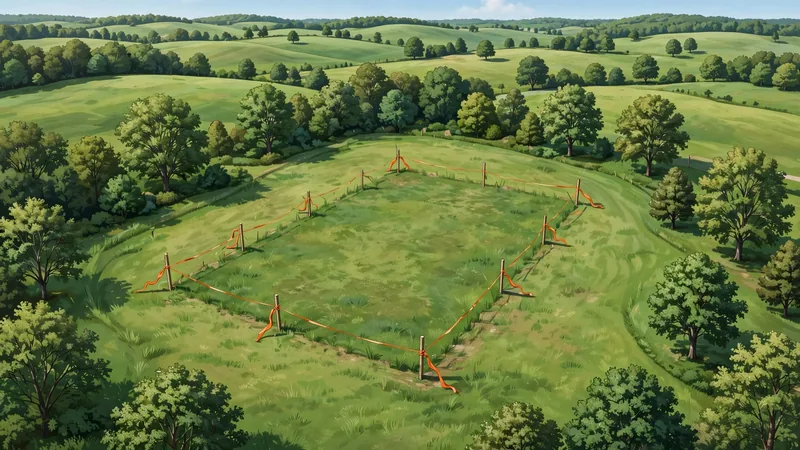
Raw land
Raw land is property in its natural state — no roads, no electricity, no water lines, no sewer. It is the hardest category to finance because the cost and timeline to make it usable are unpredictable. Expect the largest down payments (often 35–50%), the highest rates, and the shortest terms. Some conventional lenders will not touch raw land at all, which is why many buyers turn to Farm Credit institutions, community banks, or seller financing.
Unimproved land
Unimproved land has some basic work done — a cleared building pad, graded road access, or partial utility service — but is not fully ready for construction. The risk is lower than raw land because part of the development cost is already absorbed. Down payments typically run 25–40%, and more mainstream lenders will consider these parcels.
Improved land
Improved land is fully serviced: water, sewer or septic capacity, electrical connections, and road access. A builder could break ground quickly, so lenders view it as the safest vacant-land category. Down payments can be as low as 20%, rates sit at the friendlier end of the land-loan range, and terms may stretch to 15 years or more.
How to Use a Vacant Land Loan Calculator
Running your numbers takes a few minutes. Gather the inputs below, then test a few scenarios before you approach a lender:
- Enter the loan amount — the purchase price minus your down payment. Because vacant-land down payments are large, getting this number right matters more than with a home mortgage.
- Input the interest rate — use a rate a lender actually quoted you, not an advertised teaser. Vacant land rates typically run 1–5 points above conventional mortgage rates.
- Add your down payment — watch how raising it from 20% to 30% changes both the payment and the total interest.
- Select the loan term — land loans usually run 5 to 15 years. Shorter terms mean higher payments but far less total interest.
- Compare scenarios — run different rate, term, and down payment combinations through the vacant land loan calculator and screenshot them for lender discussions.
For a quick headline payment estimate on any land purchase, our free land loan calculator handles the basics in seconds. For the full month-by-month breakdown, run the results through a land loan amortization calculator to see exactly how each payment splits between interest and principal.
Vacant Land Loan Rates and Terms: What U.S. Borrowers Usually See
Rates move with the market, so treat these as typical ranges rather than quotes — always confirm with lenders. The pattern below reflects what U.S. land lenders commonly offer for vacant parcels:
| Land type | Typical down payment | Typical APR range | Common terms |
|---|---|---|---|
| Raw land | 35–50% | 8–12% | 5–10 years |
| Unimproved land | 25–40% | 7–10% | 7–15 years |
| Improved land | 20–35% | 6.5–9% | 10–15+ years |
Two things make a bigger difference than most buyers expect. First, the down payment: putting more down not only shrinks the loan amount but can also unlock a better rate tier, because the lender’s risk drops. Second, the term: the difference between a 10-year and a 15-year land loan can mean tens of thousands of dollars in interest. A vacant land loan calculator turns that abstract trade-off into exact dollar figures before you commit.
Borrowers with strong credit, low debt, and a relationship with a local bank or Farm Credit institution tend to land at the friendlier end of each range. The Consumer Financial Protection Bureau publishes guidance on comparing loan offers that applies just as well to land financing as to home mortgages.
Down Payment Requirements for Vacant Land
The down payment is the single biggest hurdle in vacant land financing. Federal banking guidance caps the maximum loan on raw land at about 65% of appraised value, which means many lenders will not go below a 35% down payment on truly undeveloped parcels. In practice:
- 20–25% down is sometimes possible on improved lots with full utilities, strong credit, and an established lender relationship.
- 25–35% down is the typical range for unimproved land at community banks and credit unions.
- 35–50% down is standard for raw land, and some lenders simply require it regardless of credit score.
A larger down payment does more than satisfy the lender. It reduces your monthly payment, cuts total interest, and gives you equity from day one — which matters if land values in the area dip. If you cannot reach the required down payment yet, USDA rural development programs and Farm Credit lenders are worth exploring, especially if the parcel has agricultural or timber potential. Seller financing is also more common in rural markets than most buyers expect, with terms that are often negotiable.
Worked Example: Financing a $150,000 Vacant Parcel
Here is what a vacant land loan calculator produces for a realistic scenario: a $150,000 unimproved parcel, 30% down ($45,000), leaving a $105,000 loan at 8.5% APR. The table compares a 15-year term with a 10-year term:
| Detail | 15-year term | 10-year term |
|---|---|---|
| Loan amount | $105,000 | $105,000 |
| Down payment (30%) | $45,000 | $45,000 |
| Monthly payment | $1,033.98 | $1,301.85 |
| Total paid over loan life | $186,115.78 | $156,221.97 |
| Total interest | $81,115.78 | $51,221.97 |
The shorter term costs about $268 more per month but saves roughly $29,894 in interest. That trade-off is exactly what the calculator is for: it turns a vague sense that “shorter is cheaper” into concrete numbers you can budget around. Try the same math with your own figures in our land loan calculator, and if you want to check the arithmetic by hand, see our guide on how to calculate a land loan.

How to Improve Your Odds of Approval
Vacant land lenders scrutinize both the borrower and the parcel. Strengthen your application on both fronts:
- Raise your credit score — most conventional land lenders want 680 or higher; the best rates go to borrowers in the mid-700s.
- Lower your debt-to-income ratio — pay down revolving balances before applying so total monthly debts stay well under 43% of gross income.
- Document the land’s potential — a survey, soil report, or timber valuation helps the underwriter justify better terms.
- Bring a larger down payment — every extra 5% down reduces lender risk and can unlock a better rate tier.
- Shop local and specialized lenders — community banks, credit unions, and Farm Credit institutions finance rural land far more often than national banks. Get at least three quotes and compare them with the calculator.
Mistakes to Avoid With Vacant Land Financing
- Budgeting for the payment only — property taxes, insurance, survey costs, and any immediate improvements (a driveway, well, or septic) are not in the calculator’s payment figure. Add them to your budget separately.
- Ignoring zoning and restrictions — confirm what you can legally build before you borrow. A parcel that cannot be permitted is nearly impossible to refinance or sell.
- Skipping the survey — boundary disputes are expensive. Most lenders require a current survey anyway.
- Accepting the first offer — land loan terms vary widely between lenders. Comparing three or more quotes in a vacant land loan calculator routinely saves buyers thousands.
Vacant Land Loan Calculator FAQs
What is a vacant land loan calculator and how does it work?
It is an online tool that estimates monthly payments, total interest, and overall loan cost for financing vacant land. You enter the loan amount, interest rate, down payment, and loan term, and it applies the standard loan payment formula to produce the estimates instantly.
Why are vacant land loans different from traditional home loans?
Vacant land is riskier collateral — it produces no income and can be hard to resell — so lenders require larger down payments (typically 20–50%), charge higher interest rates, and offer shorter repayment terms than home mortgages.
How much down payment do I need for a vacant land loan?
Most U.S. lenders require 20–50% down depending on the land type: around 20–35% for improved lots, 25–40% for unimproved land, and 35–50% for raw land. Stronger credit and a local lender relationship can move you toward the lower end.
What interest rate will I get on a vacant land loan?
Rates are typically 1–5 percentage points above conventional mortgage rates, commonly in the 6.5–12% range depending on land type, credit score, down payment, and lender. Always compare at least three lender quotes.
Are property taxes and insurance included in the calculator estimates?
No. Most vacant land loan calculators estimate principal and interest only. Budget property taxes, insurance, survey costs, and any improvement expenses separately.
Can I use a vacant land loan calculator to compare lender offers?
Yes. Enter each lender’s quoted rate, term, and down payment requirement into the calculator and compare the monthly payment and total interest side by side — the cheapest monthly payment is not always the cheapest loan.
About the author: Sarah Mitchell is the Head of Content & Land Finance Research at Land Loan Calculator. She writes practical, U.S.-focused guides on land financing, loan math, and buyer strategy.
Reviewed by: Zayn Ashford, Founder & Lead Developer of Land Loan Calculator, reviewed this article for accuracy.
Disclaimer: This article is for informational purposes only and is not financial advice. Land loan terms vary by lender, property, and market conditions. Consult a licensed loan professional before making financing decisions.
