
How to Calculate a Land Loan: Step-by-Step Guide for U.S. Buyers

By Sarah Mitchell, Head of Content & Land Finance Research · Reviewed by Zayn Ashford, Founder & Lead Developer
How to calculate a land loan: subtract your down payment from the land price to get the loan amount, then apply the amortization formula M = P × [r(1 + r)n] ÷ [(1 + r)n − 1] using your interest rate and loan term. That gives you the exact monthly payment. Below, we walk through the full method step by step — with a worked example — so you can calculate any land loan with confidence.
Getting the math right matters more than most buyers expect. Land financing means higher rates, bigger down payments, and shorter terms than a home mortgage — so a small error can turn an affordable parcel into a decade of budget strain.
The 4-Step Method in Plain English
Anyone learning how to calculate a land loan should start with the loan amount, not the listing price. Follow these four steps in order:
- Find your real loan amount. Take the agreed land price and subtract your down payment. If the parcel costs $80,000 and you put 30% down ($24,000), your loan amount (P) is $56,000. Never calculate on the full price — lenders only finance what you do not pay up front.
- Get a realistic interest rate. Land loan rates typically run 1 to 3 percentage points above conventional mortgage rates. Call two or three lenders and use the highest quote for your first calculation — it is better to be pleasantly surprised than caught short.
- Pick your loan term. Most land loans run 10 to 20 years, not 30. A shorter term means a higher monthly payment but far less total interest. Decide the term before you calculate, because it changes everything.
- Run the amortization formula. Plug the three numbers into the standard loan payment formula below. That is your monthly payment — before taxes and insurance.
The Land Loan Formula (and What Each Part Means)
Every fixed-rate land loan uses the same amortization formula:
M = P × [r(1 + r)n] ÷ [(1 + r)n − 1]
- M — your monthly payment (what you are solving for).
- P — the loan amount: land price minus down payment.
- r — the monthly interest rate: annual rate ÷ 12 (so 9% becomes 0.0075).
- n — the total number of payments: years × 12 (so 12 years becomes 144).
The formula only does one thing: it spreads your loan plus all its interest evenly across every month of the term. Our free land loan calculator runs this exact math instantly.
Worked Example: How to Calculate a Land Loan on $80,000 of Land
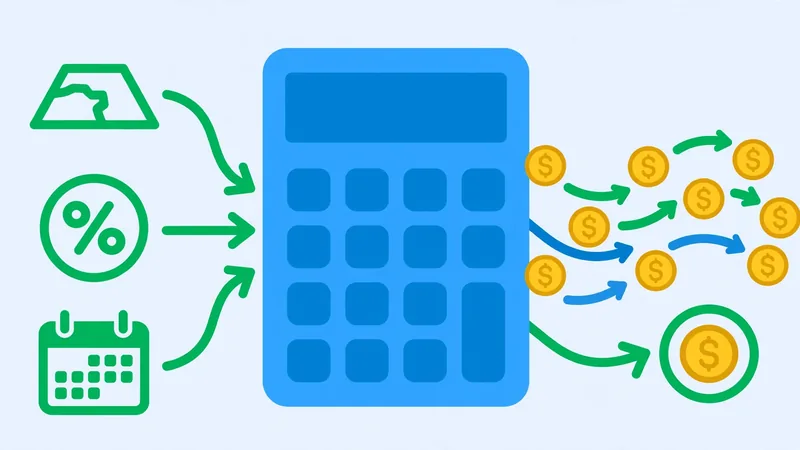
Take a realistic deal: an $80,000 parcel, 30% down, a 9% fixed rate, and a 12-year term.
Step 1 — loan amount: $80,000 − $24,000 down payment = $56,000 (P).
Step 2 — monthly rate: 9% ÷ 12 = 0.0075 (r).
Step 3 — number of payments: 12 × 12 = 144 (n).
Step 4 — plug into the formula:
M = 56,000 × [0.0075 × (1.0075)144] ÷ [(1.0075)144 − 1] ≈ $637.30 per month
Over 144 payments you would pay about $91,771 total — roughly $35,771 in interest on top of the $56,000 borrowed. That interest figure surprises most first-time land buyers, which is why running the numbers before you make an offer matters.
Why Land Type Changes Your Numbers
That is why how to calculate a land loan differs from a standard mortgage calculation: lenders price the loan around the kind of land securing it. The Consumer Financial Protection Bureau notes that loan terms depend heavily on the property itself (CFPB). Three categories matter:
- Raw land — untouched, no utilities or road access. Hardest to finance: expect 35% to 50% down and the highest rates. Your calculated payment will be the steepest here.
- Unimproved land — partially developed (road access, utilities nearby). Moderate terms — easier math than raw land, tougher than improved.
- Improved land — utilities, access, sometimes a structure. Closest to mortgage-style terms; some lenders offer near-conventional rates.
Once you understand how to calculate a land loan for raw land, the easier land types follow the same math — just with friendlier inputs. Buyers of farmland should also check USDA Farm Service Agency loan programs, which can offer better terms for eligible agricultural purchases (USDA FSA). For background on the tool behind these numbers, see what a land loan calculator is.
Amortization: Where Your Money Actually Goes
Your $637.30 payment is not split evenly: in month one, about $420 goes to interest and only $217.30 reduces your loan balance. That is just amortization math — interest is charged on the remaining balance, so early payments are interest-heavy and later ones principal-heavy.
Two things worth knowing: extra principal payments hit hardest early — $100 extra in year one saves more interest than the same $100 in year ten. And if your raw land later gains road access or utilities, it may qualify as improved land — recalculate with better terms before assuming your current loan is still your best option.

5 Mistakes That Make Your Calculation Wrong
- Calculating on the listing price instead of the loan amount. Forgetting to subtract the down payment is the single most common error — and with 30% to 50% down on land, it is a big one.
- Using a mortgage rate instead of a land loan rate. Plugging in a 6.5% home-loan rate when land lenders are quoting 9% understates your payment by hundreds per month.
- Assuming a 30-year term. Most land loans max out at 10 to 20 years. A 30-year assumption makes any parcel look affordable on paper.
- Forgetting taxes, insurance, and closing costs. The formula gives you principal and interest only. Add roughly 2% to 5% of the loan amount in closing costs, plus annual property tax ÷ 12.
- Mixing up number formats. Always use US formatting ($56,000 — never $56.000) and convert the annual rate to a monthly decimal before calculating. One misplaced decimal can throw your payment off by thousands.
Still have questions? Our FAQs page covers the most common land-buying questions in one place.
What is the fastest way to learn how to calculate a land loan?
Start with the four-step method above: loan amount, realistic rate, term, then the formula. Once you have done it by hand a single time, the fastest way to learn how to calculate a land loan for every new parcel is our free calculator — it runs the same math instantly.
What is the formula for calculating a land loan payment?
M = P × [r(1 + r)n] ÷ [(1 + r)n − 1], where M is the monthly payment, P is the loan amount, r is the monthly interest rate, and n is the total number of payments.
How much down payment should I include in the calculation?
Plan on 20% to 50% of the land price, depending on the lender and land type. Raw land usually demands 35% to 50%; improved land or USDA-backed loans can require less. A bigger down payment shrinks both the monthly payment and the total interest.
Can I use a regular mortgage calculator instead?
You can, but it will likely understate your payment. Mortgage calculators assume 30-year terms, low rates, and small down payments — the opposite of typical land loan terms. Always use land-specific numbers, or better, a land loan calculator.
How does the loan term change the calculation?
Shorter terms raise the monthly payment but slash total interest. On our $56,000 example at 9%, a 12-year term costs about $35,771 in interest; stretching the same loan to 20 years would drop the payment but add tens of thousands in interest.
Should property taxes be part of the calculation?
Yes, in your budget — but not in the formula. The amortization formula covers principal and interest only. Add your county’s annual land property tax divided by 12, plus insurance, to the formula’s result for your true monthly cost.
The Bottom Line
Now that you know how to calculate a land loan, it comes down to four honest inputs — loan amount, rate, term, and the formula — plus the discipline to use land-specific numbers instead of mortgage assumptions. Run the math before you fall in love with a parcel, compare at least two lender scenarios, and confirm final figures with a licensed loan professional. Try our free land loan calculator to check your hand calculation in seconds.
About the author: Sarah Mitchell is Head of Content & Land Finance Research at landloancalculatorr.com, covering land loans and rural financing for U.S. buyers.
Reviewed by: Zayn Ashford, Founder & Lead Developer, reviewed this article for accuracy.
Disclaimer: This article is for informational purposes only and is not financial advice. Terms vary by lender, property, and borrower. Consult a licensed loan professional before making financing decisions.
